
In the world of finance, few acronyms carry as much weight as “the S&P.” Whether you are watching a nightly news broadcast, reading a financial newspaper, or discussing retirement plans with an advisor, the S&P 500 is frequently cited as the ultimate pulse check for the American economy. But for many individual investors, the mechanics of this index remain somewhat of a mystery. Is it simply a list of the 500 largest companies? Is it a stock you can buy directly?
Understanding the S&P 500 is essential for anyone looking to navigate the modern financial landscape. It is more than just a number on a screen; it is a sophisticated financial instrument that represents the health, growth, and evolution of the United States corporate sector. This article explores the depths of the S&P 500, from its rigorous selection criteria to its role as a cornerstone of passive investing strategies.

Understanding the Fundamentals of the S&P 500
The S&P 500, or the Standard & Poor’s 500 Index, is a stock market index that tracks the performance of 500 of the largest companies listed on stock exchanges in the United States. Created in its modern form in 1957, it has grown to become the most widely followed equity index in the world.
Definition and Origin
The index is maintained by S&P Dow Jones Indices, a joint venture that specializes in market data. While the Dow Jones Industrial Average (the “Dow”) is older and perhaps more famous among the general public, professional investors usually prefer the S&P 500. This preference stems from the index’s breadth. While the Dow only tracks 30 companies, the S&P 500 covers approximately 80% of the available market capitalization in the U.S. stock market. It originated from the merger of the Standard Statistics Company and Poor’s Publishing, two entities that sought to provide more transparent data to investors in the early 20th century.
Market Capitalization Weighting Explained
One of the most critical aspects of the S&P 500 is that it is a “float-adjusted market-capitalization-weighted” index. This means that companies with higher market values have a greater impact on the index’s movement than smaller companies. To calculate a company’s weight, you multiply its share price by the number of shares available for public trading (the “float”).
Because of this structure, tech giants like Apple, Microsoft, and Amazon exert significantly more influence on the index than a company at the bottom of the list. If a trillion-dollar company’s stock price drops by 5%, the entire index might move downward, even if several hundred smaller companies in the index saw modest gains that same day. This weighting reflects the reality of the economy: the largest players drive the most significant economic outcomes.
The Selection Criteria: How Companies Join the Index
A common misconception is that the S&P 500 is strictly a list of the 500 largest U.S. companies by size. In reality, the index is “curated.” While size is a major factor, a company does not automatically join the index simply by reaching a certain valuation. There is a rigorous set of entry requirements designed to ensure the index remains a high-quality representation of the investable universe.
Eligibility Requirements
To be eligible for the S&P 500, a company must meet several quantitative and qualitative benchmarks. First, it must be a U.S. company. While many of its constituents have massive international operations, their primary headquarters and listing must be in the United States.
Second, the company must meet a minimum market capitalization threshold, which is adjusted periodically to reflect market conditions (as of recent years, this is often in the range of $14 billion to $15 billion or more). Third, the company must be highly liquid, meaning its shares are easily bought and sold without causing massive price swings. Finally, and perhaps most importantly, the company must demonstrate financial viability. Specifically, the sum of its most recent four consecutive quarters of earnings must be positive, as must the most recent quarter. This prevents “flash-in-the-pan” companies or struggling unicorns from entering the index prematurely.
The Role of the Index Committee
Unlike some indices that are purely algorithmic, the S&P 500 is overseen by an Index Committee. This group of professionals meets regularly to review the index’s composition. They decide when to add new companies and when to remove those that no longer meet the criteria (due to bankruptcy, mergers, or declining market value).
This human element ensures that the index reflects the changing face of the economy. For instance, the committee famously waited some time before adding Tesla to the index, ensuring the company met sustained profitability requirements before including it. When a company is added to the S&P 500, it often experiences a “pop” in stock price because hundreds of index funds are legally required to buy its shares to match the index’s new composition.
Why the S&P 500 Matters to Individual Investors
For the average person, the S&P 500 is the “gold standard” for measuring investment performance. If you manage your own portfolio or use a robo-advisor, your success is almost always measured against how well you performed relative to the S&P 500.
A Barometer for Economic Health
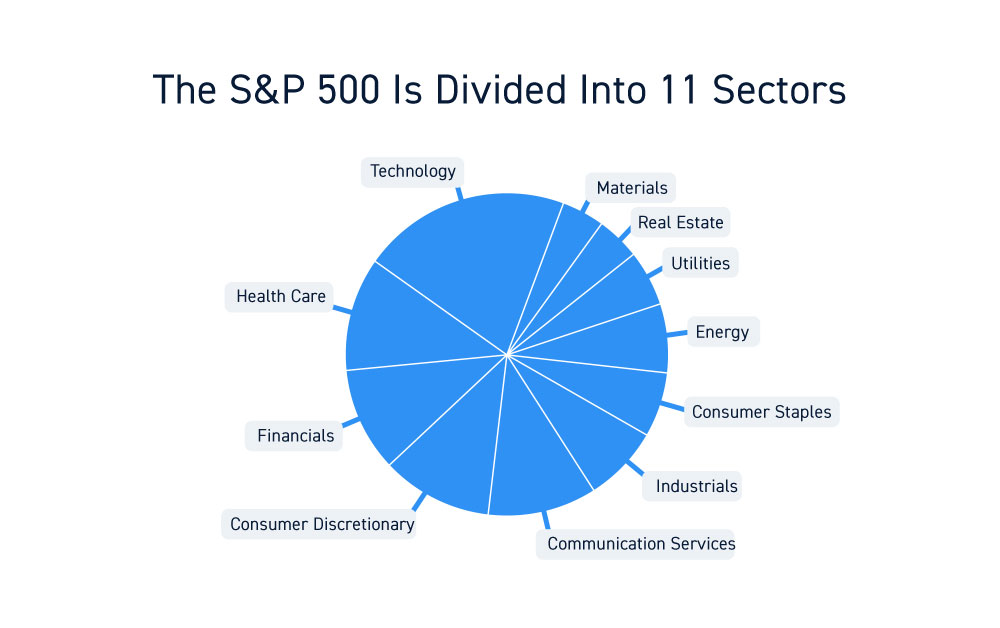
Because the S&P 500 spans 11 different sectors—including technology, healthcare, financials, and consumer staples—it serves as a real-time thermometer for the American corporate environment. When the S&P 500 is in a “Bull Market” (rising), it generally signals investor confidence, corporate profitability, and economic expansion. Conversely, a “Bear Market” (a drop of 20% or more) often precedes or accompanies economic recessions. By watching the index, investors can gauge the overall sentiment of the global financial markets.
Diversification and Risk Management
One of the primary rules of investing is “don’t put all your eggs in one basket.” The S&P 500 inherently solves this problem. By owning a piece of the index, you are effectively betting on the 500 most successful companies in the world’s largest economy. This diversification protects you from the total failure of a single company. While one company in the index might go bankrupt, its impact is diluted by the 499 others that are continuing to operate. Over long horizons, this diversification has historically provided a smoother ride than picking individual stocks.
How to Invest in the S&P 500
You cannot “buy” the S&P 500 index itself because it is simply a mathematical measurement. However, financial institutions have created products that mirror the index with near-perfect accuracy, allowing everyday investors to capture its returns.
Index Funds and ETFs
The most common way to invest in the S&P 500 is through Exchange-Traded Funds (ETFs) or Mutual Funds. Some of the most famous examples include the SPDR S&P 500 ETF Trust (SPY), the Vanguard S&P 500 ETF (VOO), and the iShares Core S&P 500 ETF (IVV).
These funds operate by pooling money from millions of investors and using that capital to buy all 500 stocks in the index at their exact weightings. These are known as “passive” investments. Because there is no high-priced fund manager trying to “beat” the market through active trading, the fees (expense ratios) for these funds are incredibly low—often less than 0.05% per year. This means more of your money stays invested and grows over time.
Long-term Performance and Compounding
Historically, the S&P 500 has delivered an average annual return of approximately 10% before inflation. While the market does not go up every year—sometimes it drops 10%, 20%, or even 30%—the long-term trajectory has been consistently upward. Through the power of compounding, an initial investment in an S&P 500 fund can grow exponentially over decades. This makes it a foundational tool for retirement accounts like 401(k)s and IRAs.
Challenges and Criticisms of an S&P 500-Centric Strategy
While the S&P 500 is a powerhouse, it is not without its flaws. Professional analysts often point out that over-reliance on this single index can lead to specific types of financial exposure that investors might not realize they have.
Concentration Risk in Big Tech
In recent years, the S&P 500 has become increasingly “top-heavy.” Because it is market-cap weighted, a handful of massive technology companies (often referred to as the “Magnificent Seven”) now make up nearly 30% of the entire index.
This creates a concentration risk. If the tech sector faces regulatory hurdles or a sudden shift in consumer behavior, the S&P 500 will suffer disproportionately, even if the other 490 companies are doing well. Investors who think they are “diversified” might actually be very heavily exposed to a single industry.
The Impact of Market Volatility
Finally, it is important to remember that the S&P 500 is an equity index, meaning it is subject to market volatility. In times of global crisis—such as the 2008 financial crash or the 2020 pandemic—the index can lose significant value in a very short period. For investors nearing retirement, being 100% invested in the S&P 500 might be too risky, as they may not have the time to wait for the market to recover.

Conclusion
The S&P 500 is more than just a list of companies; it is the definitive benchmark of American capitalism. By combining a rigorous selection process with a market-cap weighting system, it provides a comprehensive view of the economic landscape. For the modern investor, the “SP” represents an opportunity to participate in the growth of the world’s most successful corporations with low fees and high transparency.
Whether you are a novice starting your first brokerage account or a seasoned professional, understanding the S&P 500 is fundamental to financial literacy. While it faces challenges regarding tech concentration and market cycles, its historical resilience continues to make it the most important “SP” in the world of money. By utilizing index funds and maintaining a long-term perspective, anyone can harness the power of this index to build lasting wealth.
aViewFromTheCave is a participant in the Amazon Services LLC Associates Program, an affiliate advertising program designed to provide a means for sites to earn advertising fees by advertising and linking to Amazon.com. Amazon, the Amazon logo, AmazonSupply, and the AmazonSupply logo are trademarks of Amazon.com, Inc. or its affiliates. As an Amazon Associate we earn affiliate commissions from qualifying purchases.