
For decades, the financial world has sought a “holy grail” of investing—a way to capture market growth, minimize risk through diversification, and keep costs so low that they don’t eat into long-term returns. While no investment is entirely without risk, the Standard & Poor’s 500 Index Fund, commonly referred to as an S&P 500 index fund, comes closer to this ideal than perhaps any other financial instrument.
Often cited by legendary investors like Warren Buffett as the best investment for the average person, an S&P 500 index fund is more than just a ticker symbol on a screen. it is a reflection of the American economy’s heartbeat. It represents a basket of the 500 largest, most successful publicly traded companies in the United States. By purchasing shares in such a fund, you aren’t just betting on one company; you are betting on the collective ingenuity and resilience of the corporate giants that drive global commerce.

Understanding the Mechanics of the S&P 500 Index
To understand the fund, one must first understand the index it tracks. The S&P 500 is a stock market index maintained by S&P Dow Jones Indices. Unlike the Dow Jones Industrial Average, which only tracks 30 companies and is price-weighted, the S&P 500 is widely considered the best single gauge of large-cap U.S. equities because it tracks 500 companies and uses a market-capitalization-weighted methodology.
The Role of Market Capitalization Weighting
In an S&P 500 index fund, not all companies are created equal. The index is “market-cap weighted,” meaning that companies with a higher total market value (share price multiplied by total shares outstanding) have a larger influence on the index’s performance. For example, tech giants like Apple, Microsoft, and Amazon carry much more weight than a smaller company at the bottom of the list. When these mega-cap companies perform well, the entire index tends to move upward. Conversely, their decline has a more significant impact than a decline in a smaller constituent. This structure ensures that the fund naturally tilts toward the most successful and dominant players in the economy.
Selection Criteria and Index Maintenance
A company does not simply “arrive” on the S&P 500 by being large. The S&P Index Committee follows a strict set of eligibility criteria. A company must be a U.S. corporation, have a market cap above a certain threshold (which adjusts with inflation and market conditions), and maintain high liquidity. Crucially, a company must also demonstrate financial viability, typically defined as having positive earnings over the most recent quarter and the sum of the previous four quarters. This “quality filter” ensures that the S&P 500 index fund isn’t just a collection of big companies, but a collection of profitable ones.
The Evolution of the Index
The index is not static. It is rebalanced quarterly to ensure it accurately reflects the current state of the market. When a company fails to meet the criteria or is surpassed by a rising star, it is removed, and a new company is added. This “survival of the fittest” mechanism is one of the primary reasons why S&P 500 index funds have historically performed so well—they automatically discard losers and embrace winners over long time horizons.
Why S&P 500 Index Funds are a Powerhouse for Wealth Building
The primary reason investors flock to S&P 500 index funds is the balance of simplicity and efficiency. In the world of personal finance, complexity often leads to high fees and underperformance. Index funds flip this script by offering a passive approach that consistently outperforms many actively managed portfolios.
The Power of Instant Diversification
One of the core tenets of sound investing is “don’t put all your eggs in one basket.” An S&P 500 index fund provides instant diversification across 11 different sectors, including Information Technology, Healthcare, Financials, Consumer Discretionary, and Energy. When you buy a single share of an S&P 500 fund, you are effectively buying a small piece of everything from the iPhone in your pocket to the gasoline in your car and the medicine in your cabinet. This diversification protects you from the total ruin that can occur if a single company goes bankrupt.
The Efficiency of Low Expense Ratios
In the investing world, you don’t get what you pay for; you get what you don’t pay in fees. Active fund managers charge high fees (often 1% or more) to try and “beat the market.” Research has shown that over a 15-year period, more than 90% of active managers fail to beat the S&P 500. S&P 500 index funds are “passive,” meaning they don’t need a highly-paid team of analysts to pick stocks. As a result, they offer incredibly low expense ratios—sometimes as low as 0.03%. This difference might seem small, but over 30 years, it can save an investor hundreds of thousands of dollars in lost gains.
Historical Returns and the Magic of Compounding
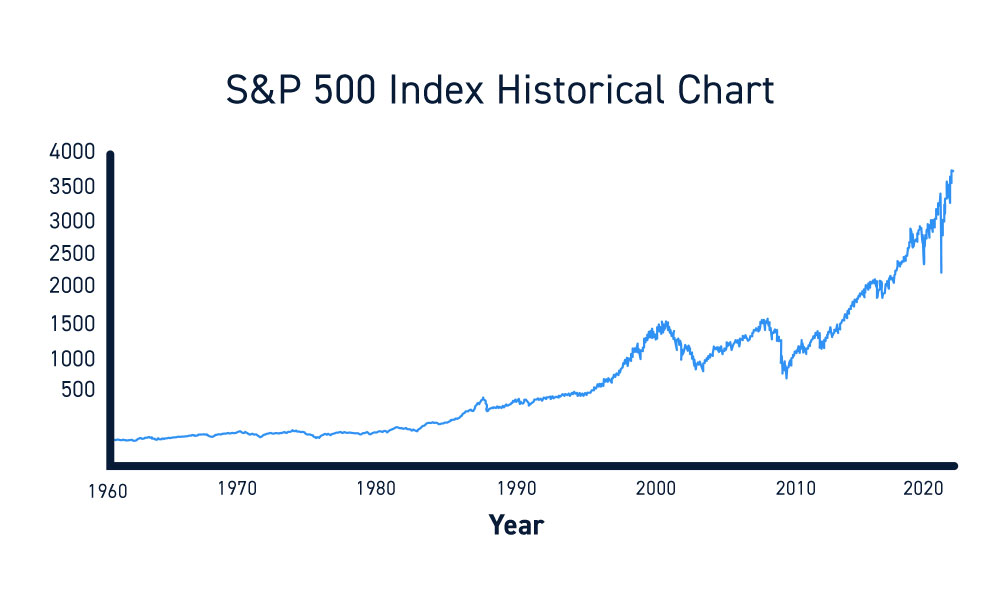
Historically, the S&P 500 has provided an average annual return of approximately 10% before inflation. While the market does not go up every year, the long-term trend has been overwhelmingly positive. Through the power of compound interest, an initial investment in an S&P 500 fund can grow exponentially. If the market continues its historical trend, an investment can double roughly every seven to ten years. This makes the index fund the cornerstone of retirement planning for millions of individuals.
Index Funds vs. Exchange-Traded Funds (ETFs): Choosing Your Vehicle
While “S&P 500 index fund” is often used as a catch-all term, investors actually have two primary ways to access this index: through a traditional Index Mutual Fund or an Exchange-Traded Fund (ETF). Both track the same companies, but they function differently in the marketplace.

Traditional Mutual Fund Structure
An S&P 500 mutual fund (such as those offered by Vanguard or Fidelity) is priced once a day at the end of the trading session. Investors buy into the fund through a brokerage, and many of these funds allow for “automatic investing,” where a set amount of money is pulled from your bank account and invested regardless of the share price. This is ideal for disciplined, long-term investors who want a “set it and forget it” approach.
The Rise of the S&P 500 ETF
ETFs, such as the SPDR S&P 500 ETF (SPY) or the Vanguard S&P 500 ETF (VOO), trade on an exchange just like individual stocks. This means their prices fluctuate throughout the day, and you can buy or sell them at any moment during market hours. ETFs are often more tax-efficient than mutual funds due to their “in-kind” redemption process, which minimizes capital gains distributions. For investors who want liquidity and the ability to use limit orders, the ETF is often the preferred choice.
Which One is Right for You?
The choice between a mutual fund and an ETF often comes down to personal preference and the specific features of your brokerage account. If you prefer to invest small, fractional amounts automatically every payday, a mutual fund might be better. If you want the lowest possible expense ratios and the ability to trade intraday, the ETF is likely the superior option. Regardless of the vehicle, the underlying assets remain the same 500 companies.
Risks and Considerations for Modern Investors
No discussion of investing is complete without addressing risk. While the S&P 500 is a diversified and historically reliable investment, it is not a “guaranteed” path to riches, especially in the short term.
Volatility and Market Cycles
The S&P 500 is subject to market volatility. In years like 2008 or 2022, the index saw significant double-digit declines. Investors who cannot stomach seeing their account balance drop by 20% or 30% in a single year might find the S&P 500 too aggressive for their risk tolerance. It is essential to view this as a long-term (10+ year) investment rather than a short-term savings account.
Concentration Risk in the Modern Era
A growing concern among financial analysts is the increasing “top-heaviness” of the S&P 500. Currently, a handful of technology companies—often referred to as the “Magnificent Seven”—make up a disproportionate percentage of the index’s total value. While these companies are incredibly profitable, it means the index is less “diversified” than it used to be. If the tech sector faces a systemic downturn, the S&P 500 will feel the impact more heavily than it would have twenty years ago.
The Impact of Inflation and Economic Shifts
While the S&P 500 is a great hedge against inflation because companies can raise prices to maintain profit margins, high-interest-rate environments can put pressure on stock valuations. Investors must be aware that the “10% average return” is an average, not a promise. There have been “lost decades” where the index remained flat, emphasizing the need for a long time horizon.
How to Start Investing in an S&P 500 Index Fund
Starting your journey into S&P 500 investing is simpler today than it has ever been in financial history. The barriers to entry have been lowered, and the tools are at your fingertips.
Step 1: Choosing a Brokerage
The first step is opening a brokerage account. Reputable firms like Vanguard, Charles Schwab, and Fidelity offer their own versions of S&P 500 funds with near-zero fees. When choosing a brokerage, look for one that offers commission-free trading and a user-friendly interface.
Step 2: Selecting Your Ticker Symbol
Once your account is funded, you need to choose your fund. If you want an ETF, you might look at VOO (Vanguard) or IVV (iShares). If you prefer a mutual fund, you might look at SWPPX (Schwab) or FXAIX (Fidelity). These funds all track the same index, so the performance will be nearly identical.
Step 3: Implementing Dollar-Cost Averaging
The most successful index investors use a strategy called Dollar-Cost Averaging (DCA). Instead of trying to “time the market” and wait for a dip, you invest a fixed amount of money at regular intervals (e.g., $500 every month). This ensures that you buy more shares when prices are low and fewer shares when prices are high, ultimately lowering your average cost per share over time.
Step 4: Staying the Course
The final, and most difficult, step is to do nothing. S&P 500 index funds work best when they are left alone to grow. The greatest threat to an index investor’s wealth isn’t a market crash—it’s the impulse to sell during a crash. By maintaining a long-term perspective and staying invested through the market’s inevitable ups and downs, you allow the collective power of the world’s greatest companies to work in your favor.
In conclusion, an S&P 500 index fund is the cornerstone of modern wealth management. It offers a unique combination of low costs, broad diversification, and a proven track record of growth. Whether you are a young professional starting your first “grown-up” job or someone looking to simplify their retirement portfolio, the S&P 500 remains the definitive tool for capturing the long-term prosperity of the corporate world.
aViewFromTheCave is a participant in the Amazon Services LLC Associates Program, an affiliate advertising program designed to provide a means for sites to earn advertising fees by advertising and linking to Amazon.com. Amazon, the Amazon logo, AmazonSupply, and the AmazonSupply logo are trademarks of Amazon.com, Inc. or its affiliates. As an Amazon Associate we earn affiliate commissions from qualifying purchases.