
In the world of finance, few terms are uttered with as much reverence and frequency as the “S&P 500.” Whether you are listening to nightly business news, reading a quarterly 401(k) statement, or following the latest trends in global markets, the S&P 500 serves as the primary pulse-check for the health of the American economy. But for many individual investors, the index remains a somewhat abstract concept—a collection of numbers on a screen rather than a structured financial tool.
Understanding the S&P 500 is fundamental to mastering personal finance and long-term wealth building. It is not merely a list of companies; it is a meticulously curated index that represents the performance of the largest publicly traded corporations in the United States. By analyzing its structure, its history, and its mechanics, investors can better position themselves to participate in the growth of the world’s largest economy.

Understanding the Architecture: What Defines the S&P 500?
The Standard & Poor’s 500, commonly known as the S&P 500, is a stock market index tracking the stock performance of 500 of the largest companies listed on stock exchanges in the United States. It is widely regarded as the best single gauge of large-cap U.S. equities. Unlike the Dow Jones Industrial Average, which includes only 30 companies and is price-weighted, the S&P 500 is float-adjusted market-capitalization weighted, meaning it provides a more comprehensive and accurate picture of the market’s overall value.
Eligibility and Selection Criteria
One of the most common misconceptions is that the S&P 500 simply consists of the 500 largest companies in America. In reality, inclusion in the index is determined by a committee at S&P Dow Jones Indices. This committee evaluates companies based on several strict criteria to ensure the index remains a high-quality representation of the economy.
To be eligible, a company must be a U.S. corporation, have a market capitalization of at least $15.8 billion (this threshold is adjusted periodically), and demonstrate high liquidity. Furthermore, a company must have positive reported earnings over the most recent quarter, as well as over the sum of the previous four quarters. This “profitability rule” acts as a filter, ensuring that the index is composed of financially viable enterprises rather than just speculative giants.
The Mechanics of Market-Cap Weighting
The S&P 500 uses a market-capitalization weighting method. This means that companies with higher total market values have a greater impact on the index’s performance. If a trillion-dollar company like Apple or Microsoft sees a 2% shift in its stock price, it will move the S&P 500 significantly more than a similar move by a company at the bottom of the list with a $20 billion market cap.
This structure reflects the reality of the business world: the largest companies drive the lion’s share of economic activity. While critics argue this creates “concentration risk” (where the top 10 companies represent a large percentage of the index), proponents argue it accurately mirrors where the capital in the U.S. economy is actually flowing.
The Sector Breakdown: A Mirror of the Modern Economy
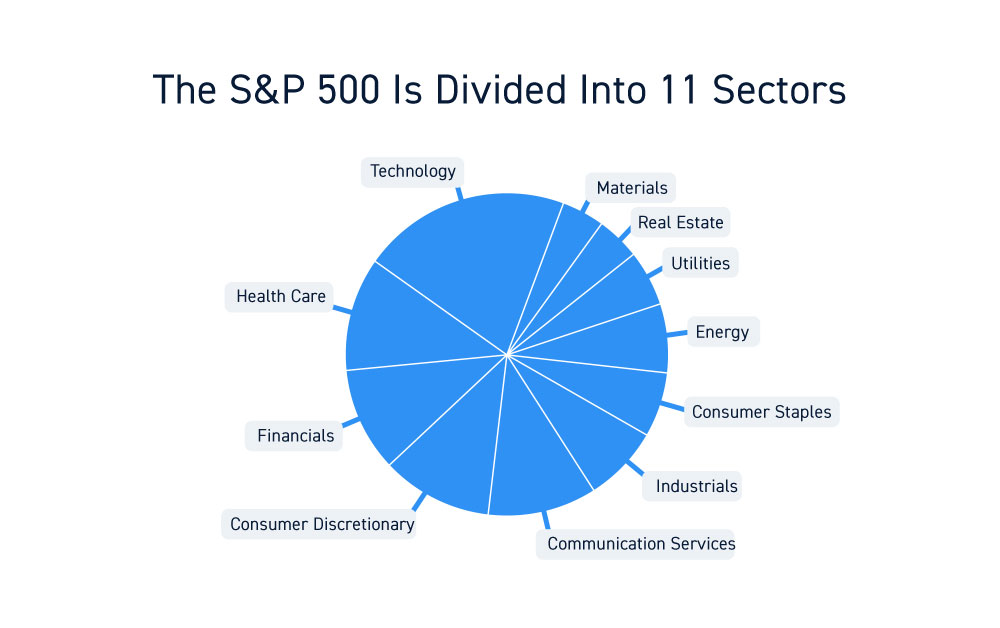
The S&P 500 is not a monolith; it is a diversified basket of businesses categorized into 11 distinct sectors. These sectors, defined by the Global Industry Classification Standard (GICS), allow investors to see which parts of the economy are thriving and which are facing headwinds.
The Evolution of Sector Dominance
Decades ago, the S&P 500 was dominated by industrials, energy, and transportation companies. Today, the landscape is starkly different. Information Technology now holds the largest weight in the index, reflecting the digital transformation of the global economy. This is followed by Health Care, Financials, and Consumer Discretionary sectors.
By following the S&P 500, an investor is essentially following the trajectory of American innovation. When tech giants lead a bull market, the index rises. When inflationary pressures hit the consumer, the impact is felt through the Consumer Staples and Retail segments of the index. This diversity is what makes the S&P 500 such a resilient benchmark; while one sector may struggle, others often provide a stabilizing balance.
Quarterly Rebalancing and Reconstitution
The index is not static. The S&P Index Committee meets quarterly to rebalance the weights and, if necessary, reconstitute the list. Companies that have fallen behind in market cap or failed to meet profitability standards are removed, making way for rising stars.
This “survival of the fittest” mechanism is a built-in advantage for passive investors. When you invest in the S&P 500, you are effectively hiring a committee to ensure that your portfolio only contains the most successful, large-scale businesses in the country. This automatic pruning of “losers” and inclusion of “winners” is a primary reason why the index has historically outperformed most active fund managers over long periods.

Why the S&P 500 is the Gold Standard for Investors
For the individual investor looking to grow their wealth, the S&P 500 is often cited as the ultimate “buy and hold” investment. Its reputation as the gold standard of investing is built on its accessibility, low cost, and historical reliability.
Benchmarking Success
In the financial industry, the S&P 500 is the “yardstick” against which all other investments are measured. If a mutual fund manager claims to have had a “good year,” the first question an analyst asks is, “Did you beat the S&P 500?”
Remarkably, data consistently shows that over a 10-to-15-year period, the vast majority of professional active fund managers fail to outperform the S&P 500. This phenomenon has led to a massive shift toward “passive investing.” Why pay high fees to a manager who is likely to underperform when you can simply “own the market” for a fraction of the cost?
The Power of Compound Growth
The S&P 500 has historically delivered an average annual return of approximately 10% (before adjusting for inflation) over the last several decades. While returns fluctuate wildly from year to year—with some years seeing 20% gains and others 15% losses—the long-term trajectory has been upward.
An investor who puts money into an S&P 500 index fund benefits from the power of compounding. When dividends are reinvested, the growth can be exponential. Because the index represents 500 different companies, it provides a level of diversification that protects the investor from the total failure of any single business. If one company in the 500 goes bankrupt, it is simply replaced, and its impact on the total index is minimal.
Practical Strategies: How to Incorporate the S&P 500 into Your Portfolio
Understanding what the S&P 500 is is the first step; the second is knowing how to use it. You cannot “buy” the S&P 500 directly because it is an index (a mathematical concept). However, you can buy financial products that track it with near-perfect precision.
ETFs vs. Mutual Funds
The two most common ways to invest in the S&P 500 are through Exchange-Traded Funds (ETFs) and Index Mutual Funds.
- ETFs: Popular choices include the SPDR S&P 500 ETF Trust (SPY), the iShares Core S&P 500 ETF (IVV), and the Vanguard S&P 500 ETF (VOO). These trade like stocks on an exchange throughout the day and are known for their extremely low expense ratios—often as low as 0.03%.
- Mutual Funds: Companies like Fidelity and Vanguard offer S&P 500 mutual funds. These are ideal for investors who want to set up automatic recurring contributions (such as $500 every month) regardless of the current share price.
The Role of Dividend Reinvestment (DRIP)
A significant portion of the S&P 500’s total return comes from dividends. Many of the 500 companies are mature, profitable firms that pay out a portion of their earnings to shareholders. By utilizing a Dividend Reinvestment Plan (DRIP), an investor automatically uses those payouts to buy more shares of the index fund. Over twenty or thirty years, this process creates a “snowball effect” that can significantly increase the size of a retirement nest egg.
Risk Management and Long-Term Expectations
While the S&P 500 is an incredible wealth-creation tool, it is not without risk. Investing in the stock market requires a high tolerance for volatility and a long-term perspective.
Understanding Market Volatility
The S&P 500 is subject to “systemic risk”—the risk that the entire market will decline due to a recession, geopolitical event, or financial crisis. We saw this during the 2008 financial crisis and the 2020 COVID-19 pandemic. During these periods, the index can lose 30% or more of its value in a very short time.
The key for investors is to understand that these “drawdowns” are a natural part of the market cycle. Historically, every single market crash in the S&P 500 has eventually been followed by a recovery and a climb to new all-time highs. The danger lies not in the market’s fluctuation, but in the investor’s potential to panic and sell at the bottom.
Time in the Market vs. Timing the Market
The most successful S&P 500 investors are those who prioritize “time in the market” over “timing the market.” Trying to predict when the S&P 500 will peak or trough is a losing game for most. Instead, a strategy of Dollar-Cost Averaging—consistently investing a fixed amount of money at regular intervals—allows an investor to buy more shares when prices are low and fewer when prices are high.
In conclusion, the S&P 500 is more than just a financial metric; it is the cornerstone of modern passive investing. By capturing the collective strength of 500 of America’s most influential companies, it provides a path for ordinary individuals to participate in the rewards of corporate success. Whether you are a novice starting your first side hustle or a seasoned professional managing a corporate retirement plan, the S&P 500 remains one of the most powerful tools in the pursuit of financial independence.
aViewFromTheCave is a participant in the Amazon Services LLC Associates Program, an affiliate advertising program designed to provide a means for sites to earn advertising fees by advertising and linking to Amazon.com. Amazon, the Amazon logo, AmazonSupply, and the AmazonSupply logo are trademarks of Amazon.com, Inc. or its affiliates. As an Amazon Associate we earn affiliate commissions from qualifying purchases.