
When investors, news anchors, and financial analysts refer to “the market,” they are rarely talking about the entirety of the global financial system. More often than not, they are referring to the S&P 500. The Standard & Poor’s 500 Index, commonly known as the S&P 500, is arguably the most important stock market index in the world. It tracks the performance of 500 of the largest companies listed on stock exchanges in the United States and serves as a primary barometer for the health of the U.S. economy.
Understanding the S&P market is fundamental for anyone looking to navigate the world of personal finance and investing. Whether you are a seasoned institutional trader or a novice investor opening your first retirement account, the S&P 500 represents the “gold standard” of equity performance. This guide explores the mechanics of the index, how it is constructed, its historical significance, and how individual investors can leverage it to build long-term wealth.
Understanding the Foundation of the S&P 500 Index
To understand the S&P market, one must first understand what an index is. An index is essentially a statistical measure of change in an economy or a securities market. In the case of the S&P 500, it provides a snapshot of the market value of the leading 500 publicly traded companies in the U.S.
The History and Evolution of Standard & Poor’s
The index has a storied history dating back to 1923, when the Standard Statistics Company created its first stock market index. In 1941, Standard Statistics merged with Poor’s Publishing to form Standard & Poor’s. The modern S&P 500 as we know it today was officially launched on March 4, 1957. Over the decades, it has evolved from a simple tracking tool into the primary benchmark against which all professional money managers are measured.
Market Capitalization Weighting: How the Math Works
Unlike the Dow Jones Industrial Average, which is price-weighted (meaning higher stock prices give companies more influence), the S&P 500 is a float-adjusted market-capitalization-weighted index. This means that the impact of a single company’s price movement on the index is proportional to its total market value.
For example, a 1% move in a trillion-dollar company like Apple has a much larger effect on the index than a 1% move in a company with a $20 billion market cap. This method is widely considered more accurate because it reflects the actual dollar value of the companies within the market.
The Selection Process: Who Gets In?
A common misconception is that the S&P 500 simply consists of the 500 largest companies in America. In reality, membership is determined by a committee at S&P Dow Jones Indices. To be eligible, a company must meet strict criteria:
- U.S. Company Status: It must be a U.S.-based corporation.
- Market Cap: It must have a high unadjusted market capitalization (currently billions of dollars).
- Liquidity: The stock must be highly liquid, meaning it is easy to buy and sell.
- Profitability: The company must have reported positive earnings over the most recent quarter and the sum of the previous four quarters.
The Components and Sector Diversification
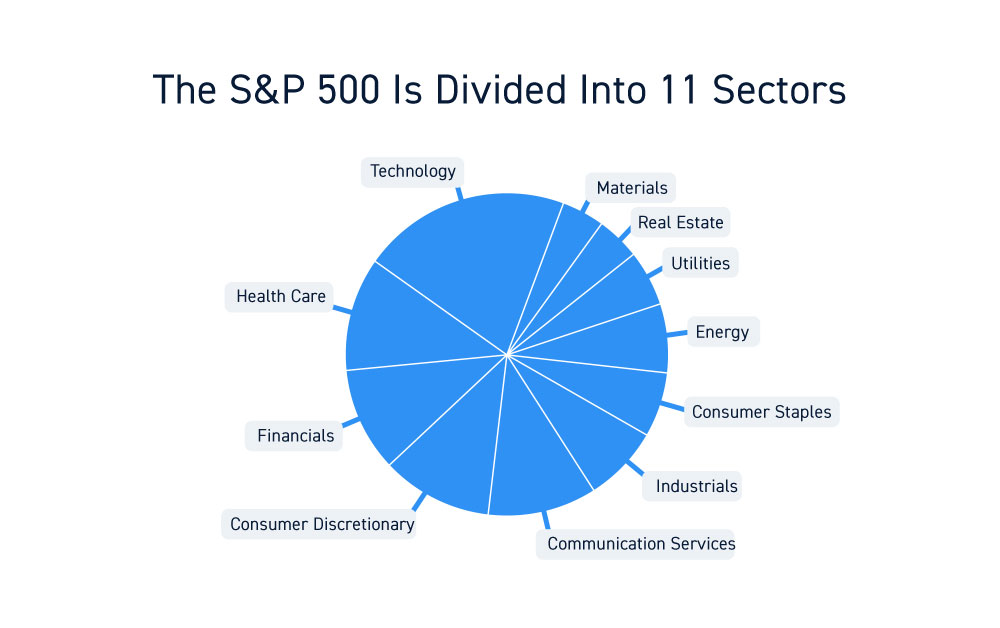
The S&P 500 is often praised for its diversification, but its internal dynamics have shifted significantly over the last decade. While it covers 500 companies, it is divided into 11 GICS (Global Industry Classification Standard) sectors, providing a comprehensive view of the entire economic landscape.
The Dominance of Information Technology
In the modern S&P market, the Information Technology sector carries the most weight. Companies like Microsoft, Apple, and NVIDIA have grown to such massive proportions that the “Tech” sector now represents a significant chunk of the index’s total value. This concentration has led to the rise of the “Magnificent Seven”—a group of high-growth tech stocks that have historically driven the majority of the index’s gains. For investors, this means that when tech thrives, the S&P 500 usually follows suit.
Defensive and Cyclical Sectors
Beyond technology, the S&P 500 offers exposure to essential industries that behave differently depending on the economic cycle.
- Financials: Banks and insurance companies that often benefit from rising interest rates.
- Healthcare: Pharmaceutical and medical device companies that tend to remain stable even during recessions.
- Consumer Staples: Companies producing essential goods like food and household products.
- Energy and Industrials: Sectors that are closely tied to global manufacturing and resource demand.
By spreading value across these sectors, the S&P 500 reduces the risk that a downturn in one specific industry will destroy an investor’s entire portfolio.
The Role of Rebalancing
The S&P 500 is not a static list. It is rebalanced quarterly to ensure it remains an accurate representation of the market. Struggling companies that no longer meet the criteria are dropped, and rising stars—such as Tesla or Uber in recent years—are added. This “survival of the fittest” mechanism is one of the reasons the index has historically performed so well; it naturally sheds “losers” and adds “winners.”

Why the S&P 500 is the Gold Standard for Investors
For most people interested in “Money” and wealth building, the S&P 500 is the most important tool in their arsenal. It is the yardstick by which investment success is measured.
Historical Performance and the 10% Rule
Historically, the S&P 500 has provided an average annual return of approximately 10% (before inflation) over long periods. While there are years where the market might drop 20% or gain 30%, the long-term trajectory has been consistently upward. This reliable growth makes it the cornerstone of retirement planning. If an investor can match the S&P 500’s returns over 30 years, they are likely to outperform the vast majority of active stock pickers.
The Power of Dividends
While price appreciation (the stock price going up) is the most visible part of the S&P market, dividends play a massive role in total returns. Many of the companies in the S&P 500 pay out a portion of their profits to shareholders. When these dividends are reinvested to buy more shares, the “compounding effect” is accelerated. Over several decades, reinvested dividends can account for nearly half of the total wealth generated by the index.
Benchmarking: The “Beat the Market” Challenge
In the world of professional finance, “the market” usually means the S&P 500. Hedge fund managers and mutual fund analysts are paid millions of dollars to try and “beat” the S&P 500. Interestingly, research shows that over a 15-year horizon, more than 90% of professional fund managers fail to outperform this index. This reality has fueled the massive shift toward passive investing, where individuals simply buy the index rather than trying to outsmart it.
How to Invest in the S&P Market
You cannot “buy” the S&P 500 index directly because it is just a list of numbers. However, you can invest in financial products that track the index with near-perfect accuracy.
Index Funds and ETFs
The most common way to access the S&P market is through Exchange-Traded Funds (ETFs) or Index Mutual Funds.
- ETFs (e.g., SPY, VOO, IVV): These trade like stocks on an exchange throughout the day. They are highly liquid and generally have very low fees.
- Index Mutual Funds: These are priced once at the end of the day and are often used in 401(k) plans.
The primary advantage of these vehicles is the “Expense Ratio.” Because there is no expensive team of analysts picking stocks—only a computer replicating the index—the fees are incredibly low, often less than 0.05% per year.
Passive vs. Active Management
Investing in the S&P 500 is the definition of passive management. Instead of trying to predict which specific company will be the next big winner, you are betting on the collective success of the American economy. This strategy removes the emotional stress of day-trading and allows the investor to benefit from broad economic growth.
Risks to Consider: Volatility and Concentration
While the S&P 500 is diversified, it is not risk-free.
- Market Volatility: The S&P can experience “bear markets” where the index drops 20% or more. Investors must have the stomach to hold through these periods.
- Concentration Risk: Because it is market-cap weighted, the top 10 companies now make up a historically high percentage of the index. If those few tech giants stumble, the entire index suffers, even if the other 490 companies are doing well.
The Future of the S&P 500 in a Changing Economy
As we look toward the future, the S&P market continues to adapt. The rise of Artificial Intelligence, the transition to green energy, and shifts in global trade are all being reflected in the index’s composition.
The Evolution of Value
The S&P 500 of 1970 was dominated by oil and manufacturing. Today, it is dominated by software and data. The “S&P market” of 2050 will likely look entirely different, perhaps dominated by biotech or aerospace companies that are currently in their infancy. The beauty of the index is its self-cleansing nature; it will always represent the current titans of industry.

Conclusion: Is the S&P Market Right for You?
The S&P 500 is more than just a ticker symbol on a news screen; it is a representation of human innovation and corporate profitability. For the vast majority of people, an S&P 500 index fund is the most efficient, cost-effective, and historically proven way to build wealth. By owning the S&P market, you are essentially owning a piece of the 500 most successful corporations in the world’s largest economy. While it requires patience and a tolerance for occasional volatility, the S&P 500 remains the ultimate tool for achieving financial independence.
aViewFromTheCave is a participant in the Amazon Services LLC Associates Program, an affiliate advertising program designed to provide a means for sites to earn advertising fees by advertising and linking to Amazon.com. Amazon, the Amazon logo, AmazonSupply, and the AmazonSupply logo are trademarks of Amazon.com, Inc. or its affiliates. As an Amazon Associate we earn affiliate commissions from qualifying purchases.