
In the world of high-stakes investing, few names command as much attention as NVIDIA (NVDA). As the primary architect of the hardware fueling the global artificial intelligence revolution, the company’s stock price has experienced a meteoric rise that few could have predicted a decade ago. For many retail investors, this rapid appreciation creates a barrier to entry: a single share price reaching into the thousands of dollars. To address this, NVIDIA has historically utilized stock splits. Understanding when NVIDIA split its stock, why it did so, and what these moves mean for your portfolio is essential for any modern investor looking to navigate the tech-heavy financial landscape.
Understanding NVIDIA’s Stock Split Journey: Timelines and Mechanics
Stock splits are often viewed by the market as a sign of strength and corporate confidence. When a company’s share price rises to a level that might discourage smaller investors, the board of directors may authorize a split to lower the nominal price per share while increasing the total number of shares outstanding. For NVIDIA, this has been a recurring theme throughout its history as a public company.
The Landmark 10-for-1 Split of June 2024
The most recent and perhaps most significant event in NVIDIA’s financial history occurred on June 7, 2024. Following a massive surge in valuation driven by the demand for H100 GPUs and AI infrastructure, NVIDIA executed a 10-for-1 forward stock split. Before the split, shares were trading north of $1,200. Following the adjustment, shareholders received nine additional shares for every one they owned, and the price was recalibrated to approximately $120 per share. This move was designed to make ownership “more accessible to employees and investors,” as stated in the company’s quarterly earnings report.
Historical Splits: Tracking the Growth Cycle
Prior to the 2024 blockbuster split, NVIDIA had a long history of managing its share price through similar interventions.
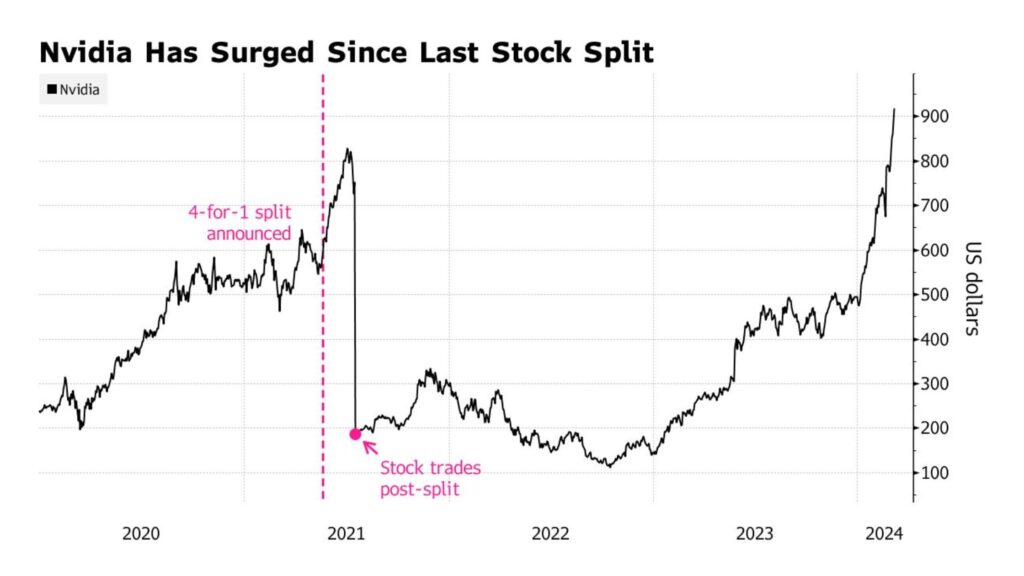
- July 2021 (4-for-1): As the gaming and data center businesses began to converge during the pandemic-era tech boom, NVIDIA split its stock 4-for-1.
- The Early 2000s Era: Between 2000 and 2007, NVIDIA underwent four separate splits (three 2-for-1 splits and one 3-for-2 split). These reflected the company’s early dominance in the PC gaming market and its initial steps into professional visualization and mobile processing.
By looking at the timeline, investors can see a clear pattern: NVIDIA tends to split its stock whenever the price consistently maintains a level that could be perceived as “expensive” for the average brokerage account holder.
Why NVIDIA Chooses to Split: The Strategic Rationale
From a purely mathematical standpoint, a stock split is a “zero-sum” event. If you have one $1,000 bill and exchange it for ten $100 bills, your net worth has not changed. However, in the psychology of the financial markets, the rationale for a split goes much deeper than simple arithmetic.
Increasing Accessibility for Retail Investors
The primary driver for NVIDIA’s splits is accessibility. While many modern brokerages offer fractional shares, many legacy platforms and international investors still prefer or require the purchase of whole shares. When a stock price hits $1,000, it becomes difficult for a small-scale investor to engage in “dollar-cost averaging” or to build a diversified portfolio without NVIDIA becoming an oversized position. By resetting the price to the $100 range, NVIDIA invites a broader base of retail participants, which can stabilize the stock by diversifying the ownership base away from purely institutional hands.
Employee Compensation and Equity Incentives
NVIDIA competes for the world’s top engineering talent. A significant portion of tech compensation is delivered via Restricted Stock Units (RSUs) and Employee Stock Purchase Plans (ESPPs). When a share price is excessively high, it becomes difficult for the company to grant precise amounts of equity to employees. A lower share price allows for more granular and flexible compensation packages, ensuring that even junior employees can see the direct impact of their work reflected in the number of shares they accumulate.
Market Liquidity and Index Inclusion
A lower share price often leads to higher trading volume, which increases market liquidity. For an institutional investor or a market maker, high liquidity means they can enter and exit positions with minimal “slippage” or impact on the price. Furthermore, a split can make a company more attractive for inclusion in price-weighted indices, such as the Dow Jones Industrial Average (DJIA). Because the Dow is weighted by share price rather than market capitalization, a $1,200 stock would exert too much influence on the index, whereas a $120 stock fits perfectly within the index’s structure.

The Financial Impact of Splits on Your Portfolio
When an investor hears the news of a split, the immediate reaction is often one of excitement. However, it is vital to separate the hype from the financial reality of how these adjustments affect your personal holdings and tax obligations.
Do Splits Create Value? Psychological vs. Fundamental Impact
Strictly speaking, a stock split does not create fundamental value. It does not increase revenue, improve profit margins, or change the company’s competitive moat. However, the “announcement effect” often leads to a short-term price increase. Investors perceive the split as a signal that management expects the price to continue rising. This positive sentiment can drive demand in the weeks leading up to the split date. For the long-term investor, the value comes from the underlying business growth, while the split merely serves as a tool to manage the price of the “container” that holds that value.
Cost Basis Adjustments and Tax Considerations
For tax purposes, a stock split is generally a non-taxable event. If you bought one share of NVIDIA for $600 and it splits 10-for-1, your new cost basis is simply $60 per share. The IRS views this as a change in the form of your investment, not a sale or exchange that triggers capital gains taxes. It is crucial for investors to keep accurate records of these adjustments, although most modern brokerage platforms automate this process. When you eventually sell your shares, you will use the adjusted cost basis to calculate your gains.
Fractional Shares vs. Whole Shares in the Post-Split Era
The rise of fintech has changed the necessity of splits. Platforms like Robinhood, Fidelity, and Charles Schwab allow investors to buy $5 worth of NVIDIA regardless of whether the share price is $100 or $1,000. However, the psychological barrier remains. Investors often feel more “significant” owning 100 shares of a $120 stock than owning 10 shares of a $1,200 stock. This sentiment, while not backed by math, influences market flows and can lead to increased volatility around the split execution date.
Investing in NVIDIA Post-Split: Long-Term Outlook
Once the dust settles on a stock split, the focus of the intelligent investor must shift back to the fundamentals of the business. A split is a historical marker, but the future return on investment depends on NVIDIA’s ability to maintain its market leadership.
Analyzing Market Performance Following a Split
Statistically, companies that split their stocks tend to outperform the broader S&P 500 index in the twelve months following the announcement. This is usually because only healthy, growing companies find themselves in a position to need a split. For NVIDIA, the post-split performance is intrinsically tied to the “AI Capex” cycle. As long as big tech companies (Microsoft, Google, Meta) continue to spend billions on data centers, NVIDIA’s financial health—and its stock price—will likely remain robust, regardless of how many times the shares are divided.
The Role of AI in NVIDIA’s Financial Future
Investors must look past the “nominal” price of the stock and evaluate the Price-to-Earnings (P/E) ratio and revenue growth. NVIDIA’s shift from a gaming-centric company to an AI-first powerhouse has fundamentally changed its earnings profile. The massive margins on H100 and Blackwell chips provide the cash flow necessary to fund further R&D, creating a virtuous cycle. When assessing NVIDIA post-split, the question isn’t “is the stock cheap at $120?” but rather “is the company’s valuation justified by its projected earnings over the next five years?”

Conclusion: Lessons for the Modern Investor
NVIDIA’s stock split history is a roadmap of the company’s ascent to the pinnacle of the financial world. From its early days as a niche hardware provider to its current status as a trillion-dollar titan, each split has marked a new chapter of growth and accessibility. For the personal investor, a split should be viewed as a logistical adjustment rather than a fundamental change in strategy.
The core lesson is simple: do not buy a stock simply because it is splitting, but do not ignore the positive signaling that a split represents. A split is an invitation for more participants to join the journey. By maintaining a focus on the underlying business metrics—revenue growth, market share, and technological innovation—investors can use stock splits as useful milestones in a long-term wealth-building strategy. Whether NVIDIA is trading at $1,000 or $100, the value lies in the silicon and the software, not the number of shares in your account.
aViewFromTheCave is a participant in the Amazon Services LLC Associates Program, an affiliate advertising program designed to provide a means for sites to earn advertising fees by advertising and linking to Amazon.com. Amazon, the Amazon logo, AmazonSupply, and the AmazonSupply logo are trademarks of Amazon.com, Inc. or its affiliates. As an Amazon Associate we earn affiliate commissions from qualifying purchases.