
The question “what about the stock market?” is often the starting point for individuals looking to transition from savers to investors. In a world characterized by inflationary pressures and shifting economic paradigms, the stock market remains one of the most effective vehicles for building long-term wealth. However, the complexity of global finance can often feel overwhelming to the uninitiated. To succeed, one must look past the daily fluctuations of the ticker tape and understand the underlying mechanics, strategies, and psychological disciplines that govern successful investing.
This guide explores the foundational principles of the stock market, the strategies for building a resilient portfolio, and the modern tools that have democratized access to the world of finance.

Understanding the Foundations of Equity Investing
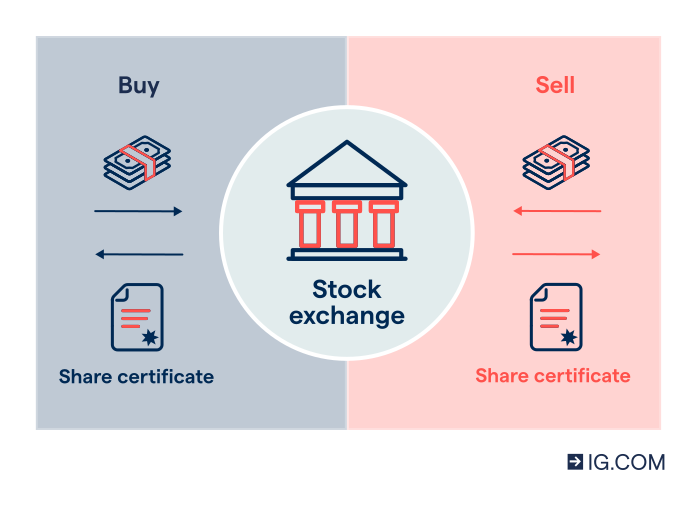
Before committing capital, an investor must understand what the stock market actually represents. At its core, the stock market is a marketplace where ownership shares of publicly traded companies are bought and sold. It serves a dual purpose: it allows companies to raise capital for expansion without taking on debt, and it provides the public with an opportunity to participate in the company’s future profits.
How the Stock Market Functions
When you buy a share of stock, you are purchasing a fractional piece of a corporation. This entitles you to a portion of the company’s earnings and, in some cases, voting rights on corporate policy. The price of these shares is determined by supply and demand, which are influenced by a company’s performance, economic forecasts, and investor sentiment. The “market” is not a single entity but a network of exchanges, such as the New York Stock Exchange (NYSE) or the NASDAQ, where these transactions are facilitated with high transparency and regulation.
The Role of Exchanges and Indices
Market indices, such as the S&P 500, the Dow Jones Industrial Average, and the Nasdaq Composite, act as barometers for the overall health of the market. The S&P 500, for instance, tracks the performance of 500 of the largest companies in the United States. When people ask “how the market is doing,” they are usually referring to the movement of these indices. Understanding these benchmarks is critical because they provide a standard against which individual portfolio performance can be measured. For many, matching the performance of an index is a more sustainable goal than attempting to “beat” the market through speculative trading.
Building a Diversified Portfolio
The cornerstone of any successful investment strategy is diversification. The stock market is inherently volatile; individual companies can fail, and specific sectors can underperform due to technological disruption or regulatory changes. Diversification is the practice of spreading investments across various assets to reduce the impact of any single failure.
Asset Allocation and Risk Tolerance
Asset allocation is the process of deciding how to divide your money among different categories, such as stocks, bonds, and cash. Your allocation should be dictated by your risk tolerance—your ability and willingness to lose some or all of your original investment in exchange for greater potential returns—and your time horizon. A younger investor with decades before retirement can afford to be “stock-heavy,” as they have time to recover from market downturns. Conversely, someone nearing retirement may prioritize capital preservation through a higher concentration of bonds and fixed-income assets.
Choosing Between Growth and Value Stocks
Within the equity portion of a portfolio, investors often choose between two primary styles: growth and value.
- Growth Investing focuses on companies that are expected to grow at a rate significantly above the average for the market. These companies often reinvest their earnings into research and development rather than paying dividends.
- Value Investing involves looking for companies that appear to be trading for less than their intrinsic value. These are often established companies with steady cash flows that may be temporarily out of favor with the market.
A balanced portfolio often incorporates both styles to capture the upside of innovation while maintaining the stability of established industry leaders.
The Power of Index Funds and ETFs
For the individual investor, picking individual “winning” stocks is notoriously difficult. This is why Exchange-Traded Funds (ETFs) and index funds have become so popular. These financial instruments allow you to buy a basket of stocks in a single transaction. For example, buying an S&P 500 ETF gives you instant exposure to 500 different companies. This approach lowers costs, reduces the risk associated with individual stock selection, and historically provides competitive returns over the long term.

Analyzing Market Trends and Economic Indicators
To navigate the stock market effectively, one must understand the macro-environment. Stocks do not exist in a vacuum; they are deeply influenced by the broader economy and the monetary policies enacted by central banks.
The Impact of Interest Rates and Inflation
Interest rates are perhaps the most significant driver of stock prices. When the Federal Reserve raises interest rates to combat inflation, the cost of borrowing increases for companies. This can lead to lower profit margins and reduced consumer spending, often causing stock prices to cool. Conversely, low interest rates make borrowing cheaper, encouraging expansion and typically driving stock prices higher. Investors must remain vigilant about inflationary trends, as high inflation erodes the purchasing power of future corporate earnings, particularly affecting high-growth companies.
Fundamental vs. Technical Analysis
There are two primary schools of thought when it comes to analyzing stocks.
- Fundamental Analysis involves looking at the “internals” of a company: its earnings reports, balance sheets, management quality, and competitive advantages. The goal is to determine the company’s true value.
- Technical Analysis focuses on market action, using charts and statistical trends (such as moving averages and volume) to predict future price movements.
While professional traders may rely heavily on technical analysis for short-term gains, long-term wealth builders generally find more success focusing on the fundamental health of the businesses they own.
Psychologically Mastering the Market Cycles
The greatest obstacle to success in the stock market is often not a lack of knowledge, but a lack of emotional control. The market moves in cycles of “bull” (rising) and “bear” (falling) markets. Human psychology is hardwired to feel the pain of a loss more intensely than the joy of a gain, which often leads to poor decision-making during periods of volatility.
Dealing with Volatility and Market Corrections
A “correction” is generally defined as a decline of 10% or more from a recent peak. While these events can be frightening, they are a natural and healthy part of the market cycle. History shows that the market has recovered from every single crash and correction it has ever faced. Successful investors view these downturns not as a reason to panic, but as an opportunity to buy high-quality assets at a “discount.”
The Pitfalls of Emotional Trading
The two emotions that drive markets are greed and fear. Greed leads to “FOMO” (fear of missing out), causing investors to buy at the top of a bubble. Fear leads to “panic selling” at the bottom of a crash. To counter these instincts, investors should adopt a “set it and forget it” mentality through strategies like Dollar-Cost Averaging (DCA). By investing a fixed amount of money at regular intervals, regardless of the price, you naturally buy more shares when prices are low and fewer when prices are high, smoothing out the cost basis of your investment over time.
Modern Tools and Technology for the Individual Investor
The “what about the stock market” question has changed significantly in the last decade thanks to the digital revolution. Investing is no longer the exclusive domain of wealthy individuals with private brokers.
Leveraging Fintech and Digital Brokerages
The rise of zero-commission trading platforms and mobile apps has removed the barrier to entry for millions. Features such as fractional shares—which allow you to buy $5 worth of an expensive stock like Amazon or Berkshire Hathaway—have made it possible to start building a portfolio with very little capital. However, the ease of use of these apps can be a double-edged sword; the “gamification” of trading can encourage impulsive behavior. It is vital to use these tools as a gateway to long-term investing rather than short-term gambling.
Automating Wealth through Robo-Advisors
For those who prefer a hands-off approach, robo-advisors use algorithms to manage your portfolio based on your goals and risk profile. These platforms handle everything from asset allocation to tax-loss harvesting and automatic rebalancing. By removing the human element from day-to-day management, robo-advisors help eliminate emotional bias and ensure that your investment strategy remains disciplined and consistent.
In conclusion, the stock market remains a premier destination for those looking to secure their financial future. By understanding the basics of equity, maintaining a diversified approach, keeping an eye on economic indicators, and—most importantly—mastering one’s own psychological responses to volatility, an individual can navigate the complexities of the market with confidence. The key is not to find a “get rich quick” scheme, but to participate consistently in the growth of the global economy.
aViewFromTheCave is a participant in the Amazon Services LLC Associates Program, an affiliate advertising program designed to provide a means for sites to earn advertising fees by advertising and linking to Amazon.com. Amazon, the Amazon logo, AmazonSupply, and the AmazonSupply logo are trademarks of Amazon.com, Inc. or its affiliates. As an Amazon Associate we earn affiliate commissions from qualifying purchases.