
In the world of global finance, few terms carry as much weight or evoke as much excitement as “the Nasdaq.” For the modern investor, the Nasdaq is more than just a ticker scrolling across a news screen; it is a barometer for innovation, a sanctuary for growth-oriented capital, and a primary driver of wealth creation in the 21st century. Whether you are a seasoned portfolio manager or a retail investor just starting your journey toward financial independence, understanding the nuances of the Nasdaq is essential for navigating the complexities of the equity markets.

This guide explores the Nasdaq through the lens of personal finance and investing, breaking down its structure, its most significant indices, and the practical ways you can leverage its performance to build a robust financial future.
1. Decoding the Nasdaq: Origins and Economic Significance
To understand the Nasdaq index, one must first distinguish between the exchange and the indices that track it. Founded in 1971 by the National Association of Securities Dealers (NASD), the Nasdaq began as the world’s first electronic stock market. At its inception, it didn’t have a physical trading floor like the New York Stock Exchange (NYSE); instead, it relied on a computerized system to provide transparent, fast-moving quotes.
The Shift from Exchange to Indicator
While the Nasdaq is a marketplace where thousands of companies are listed, the term “Nasdaq Index” usually refers to one of two major benchmarks: the Nasdaq Composite or the Nasdaq-100. Over the decades, these indices have evolved from mere list-trackers into global indicators of economic health. Because the exchange historically attracted younger, high-growth companies that didn’t meet the listing requirements of the legacy NYSE, it became the natural home for the burgeoning technology sector.
Why It Matters for Your Money
For an investor, the Nasdaq represents “growth.” While the Dow Jones Industrial Average tracks 30 blue-chip industrial giants and the S&P 500 offers a broad look at the U.S. economy, the Nasdaq is where the “New Economy” lives. It reflects the shift from a manufacturing-based economy to one driven by information, biotechnology, and consumer services. Understanding its movements allows investors to gauge market sentiment regarding risk appetite and future innovation.
2. The Twin Pillars: Nasdaq Composite vs. Nasdaq-100
When you hear a news anchor say, “The Nasdaq was up 2% today,” they are usually referring to the Nasdaq Composite. However, for those looking to invest in specific funds, the Nasdaq-100 is often the more relevant benchmark. Distinguishing between these two is critical for strategic asset allocation.
The Nasdaq Composite Index
The Nasdaq Composite is a broad-based index that includes almost all stocks listed on the Nasdaq Stock Exchange. With over 3,000 component companies, it offers a wide-angle lens on the market. It includes everything from trillion-dollar tech titans to small-cap speculative plays. For an investor, the Composite is useful for tracking the overall “breath” of the tech-heavy market, but it is rarely used as a direct investment vehicle because of its sheer size and the inclusion of many illiquid stocks.
The Nasdaq-100: The Elite Tier
The Nasdaq-100 is a more concentrated, modified market-capitalization-weighted index. It consists of the 100 largest non-financial companies listed on the Nasdaq exchange.
- Exclusion of Financials: One unique aspect of the Nasdaq-100 is that it excludes banks and investment companies, focusing instead on retail, technology, telecommunications, and healthcare.
- The Powerhouses: This index is home to the “Magnificent Seven”—companies like Apple, Microsoft, Alphabet, and Amazon. Because these companies carry immense weight, the Nasdaq-100 is often seen as a proxy for the performance of global large-cap growth stocks.
Comparative Performance and Volatility
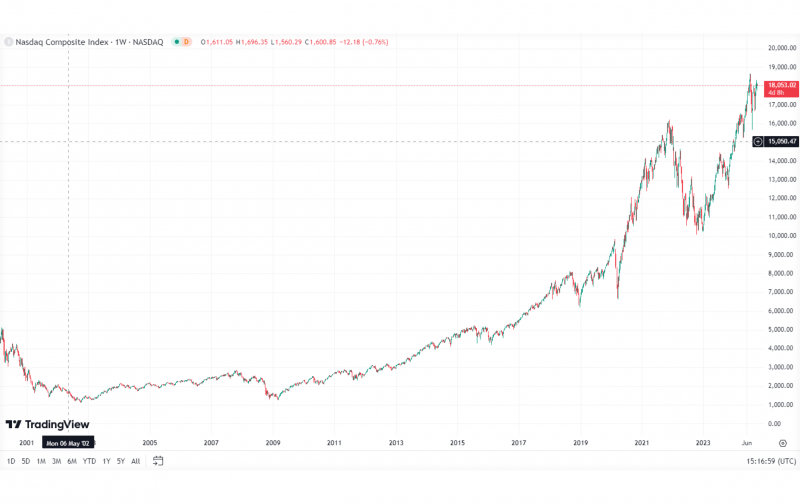
Historically, the Nasdaq-100 has outperformed the broader S&P 500 during bull markets, particularly those driven by digital transformation. However, investors must be aware that this performance comes with higher volatility. Because the index is concentrated in a few sectors, it can experience sharper drawdowns during periods of rising interest rates or sector-specific downturns.
3. Methodology and Composition: How the Index is Built
An index is only as good as its underlying math. The Nasdaq indices utilize a market-capitalization-weighting scheme, which has significant implications for how your investment dollars perform.
Market-Cap Weighting Explained
In a market-cap-weighted index, the companies with the highest total market value have the greatest influence on the index’s price movements. For example, a 1% move in Apple’s stock price will have a much larger impact on the Nasdaq-100 than a 10% move in a smaller component. This “winner-takes-most” structure means that when you invest in a Nasdaq-based fund, you are essentially betting on the continued dominance of the world’s largest companies.
Sector Concentration: Beyond Just “Tech”
While “Nasdaq” is often used as a synonym for “Technology,” its composition is more nuanced:
- Technology: Software, semiconductors, and hardware usually make up about 50% or more of the index.
- Consumer Services: This includes e-commerce giants and media companies.
- Health Care: Biotechnology is a massive component of the Nasdaq, making it a hotspot for investors looking for pharmaceutical innovation.
- Consumer Discretionary: Modern retail and automotive companies (like Tesla) play a significant role.
Rebalancing and Eligibility
The Nasdaq-100 undergoes an annual reconstitution every December, with quarterly rebalancing. This ensures that the index remains “fresh,” dropping companies that have shrunk in value and adding rising stars. This automated “pruning” is one of the reasons the index has remained a top performer; it systematically removes losers and adds winners, doing the hard work of portfolio management for the investor.
4. Investing in the Nasdaq: Practical Strategies for Wealth Building
Understanding what the index is serves little purpose if you don’t know how to use it to grow your net worth. Since you cannot buy an index directly, you must use financial instruments that track it.
Exchange-Traded Funds (ETFs)
The most popular way to invest in the Nasdaq is through ETFs. The most famous of these is the Invesco QQQ Trust (QQQ), which tracks the Nasdaq-100.
- Liquidity and Cost: QQQ is one of the most liquid assets in the world, making it easy to buy and sell. However, for long-term “buy and hold” investors, newer versions like QQQM (Invesco Nasdaq 100 ETF) offer a lower expense ratio, meaning more of your money stays in your pocket over decades of compounding.
- Sector-Specific ETFs: For those who want more targeted exposure, there are ETFs that track the Nasdaq Biotechnology Index or the Nasdaq Internet Index.
Mutual Funds and Index Funds
Many brokerage firms offer traditional index mutual funds that mirror the Nasdaq-100. These are excellent for investors who want to set up automatic monthly contributions from their bank accounts. They provide the benefit of diversification across 100 of the world’s most innovative companies without the need to research individual stocks.
The Role of Dividends
It is important to note that the Nasdaq is generally not a high-dividend-yield environment. Most companies listed on the Nasdaq reinvest their profits into Research and Development (R&D) to fuel further growth. While some giants like Microsoft and Apple do pay dividends, the primary “Money” play here is capital appreciation (the stock price going up) rather than passive income through checks in the mail.
5. Risk Management and the Future of the Nasdaq
No investment discussion is complete without a sober look at risk. The Nasdaq’s growth potential is matched by its sensitivity to macroeconomic shifts.
Interest Rate Sensitivity
Growth stocks are valued based on their future earnings. When interest rates rise, the “discount rate” applied to those future earnings increases, making the stocks less valuable today. This is why the Nasdaq often struggles when the Federal Reserve raises rates to fight inflation. As an investor, it is crucial to balance your Nasdaq exposure with other assets—like bonds or value stocks—to cushion against these cycles.
Valuation Concerns
Because the Nasdaq often trades at a higher Price-to-Earnings (P/E) ratio than the broader market, there is always the risk of “paying too much” for growth. Investors should monitor whether the earnings growth of these companies justifies their high stock prices. A disciplined approach, such as Dollar-Cost Averaging (investing a fixed amount regularly regardless of price), can help mitigate the risk of buying at a market peak.
Conclusion: Why the Nasdaq Belongs in a Modern Portfolio
The Nasdaq Index represents the collective ambition of the world’s most innovative minds. For the individual investor, it offers a streamlined way to capture the growth of the digital economy. By understanding the difference between the Composite and the Nasdaq-100, recognizing the impact of market-cap weighting, and choosing the right investment vehicles like ETFs, you can position your finances to benefit from the technological revolutions of tomorrow. While volatility is a constant companion, the long-term trajectory of the Nasdaq has historically rewarded those with the patience to stay invested in the future.
aViewFromTheCave is a participant in the Amazon Services LLC Associates Program, an affiliate advertising program designed to provide a means for sites to earn advertising fees by advertising and linking to Amazon.com. Amazon, the Amazon logo, AmazonSupply, and the AmazonSupply logo are trademarks of Amazon.com, Inc. or its affiliates. As an Amazon Associate we earn affiliate commissions from qualifying purchases.