
For many, the journey to homeownership is the most significant financial undertaking of their lives. At the heart of this journey lies a single, often fluctuating percentage: the mortgage rate. When potential homebuyers ask, “What is a typical mortgage rate?” they are often looking for a benchmark to determine if they are getting a “good deal.” However, the concept of a “typical” rate is a moving target, influenced by a complex interplay of personal financial metrics, national economic policy, and global market trends.
Understanding mortgage rates is not just about looking at a daily ticker; it is about understanding the cost of borrowing over time and how that cost impacts your long-term wealth accumulation. In this deep dive, we will explore the factors that define a typical mortgage rate, the economic engines that drive these numbers, and strategies for securing a rate that serves your personal financial goals.
The Personal Determinants of Your Mortgage Rate
While news outlets may report a national average for a 30-year fixed mortgage, the rate you are actually offered by a lender is highly individualized. Lenders view mortgage rates as a reflection of risk; the more “risky” a borrower appears, the higher the interest rate they will be charged to compensate the lender for that risk.
Credit Score and Financial Health
Your credit score is arguably the most influential personal factor in determining your specific mortgage rate. Lenders typically use FICO scores to categorize borrowers. A “typical” rate for someone with a score above 760 (considered excellent) will be significantly lower than the rate offered to someone with a score in the mid-600s. Even a 0.5% difference in your interest rate, caused by a lower credit score, can result in tens of thousands of dollars in extra interest payments over the life of a 30-year loan.
Down Payment Size and Loan-to-Value (LTV) Ratio
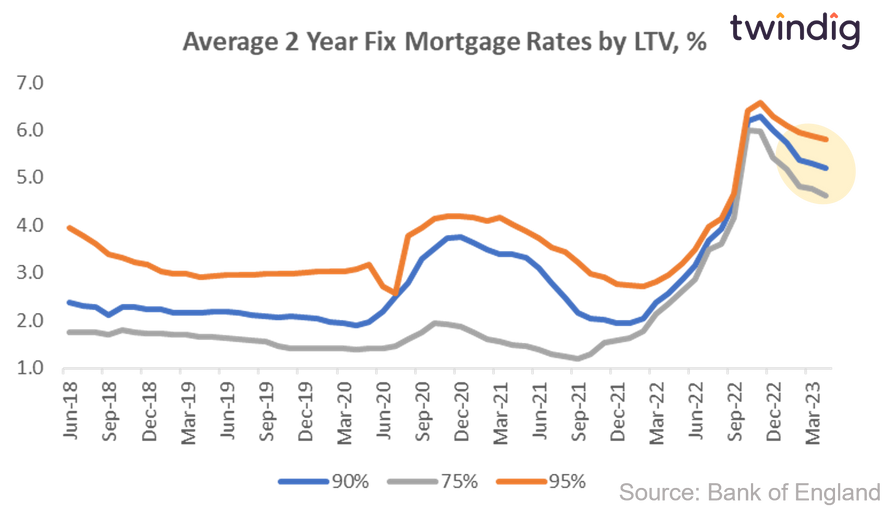
The amount of equity you put into the home upfront also dictates your rate. The Loan-to-Value (LTV) ratio is the percentage of the home’s value that you are borrowing. A borrower who provides a 20% down payment (an 80% LTV) is seen as less risky than someone putting down only 3%. A higher down payment often unlocks “typical” prime rates, whereas low down payment loans may come with higher interest rates or the added cost of Private Mortgage Insurance (PMI), which increases the overall effective rate.
Loan Term and Type
The structure of the loan itself changes what is considered “typical.” Historically, a 15-year fixed-rate mortgage carries a lower interest rate than a 30-year fixed-rate mortgage because the lender is exposed to interest rate risk for a shorter duration. Similarly, Adjustable-Rate Mortgages (ARMs) often start with a lower “teaser” rate than fixed-rate loans, though they carry the risk of increasing later. When researching rates, it is crucial to compare like-for-like products.
The Macroeconomic Drivers of Interest Rates
Individual finances only tell half the story. The baseline from which all mortgage rates start is determined by the broader economy. If the “typical” rate today is 7%, but it was 3% two years ago, that shift is driven by forces far beyond any single borrower’s control.
The Role of the Federal Reserve and Monetary Policy
While the Federal Reserve does not directly set mortgage rates, its influence is profound. The Fed sets the federal funds rate—the interest rate at which commercial banks borrow and lend to each other overnight. When the Fed raises rates to combat inflation, the cost of borrowing increases across the board, including for mortgages. Lenders raise their rates to maintain profit margins, meaning a “typical” rate in a high-inflation environment will naturally be higher as the central bank tightens the money supply.
Inflation and Economic Growth
Inflation is the enemy of fixed-income investors. Because mortgages are essentially long-term bonds for the institutions that hold them, inflation erodes the value of the future payments the lender will receive. If inflation is high, lenders demand higher interest rates to ensure their “real” return (the rate minus inflation) remains positive. Conversely, in a sluggish economy where inflation is low, mortgage rates typically drop to encourage borrowing and stimulate spending.

The 10-Year Treasury Yield
A common mistake is thinking mortgage rates follow the stock market. In reality, they are most closely tied to the bond market, specifically the 10-year Treasury note yield. Mortgage-backed securities (MBS) compete with Treasuries for investors. When the yield on the 10-year Treasury rises, mortgage rates almost always follow suit. Monitoring the “spread”—the difference between the 10-year Treasury yield and the average 30-year mortgage rate—is a professional method for determining if current mortgage rates are priced fairly relative to the market.
Historical Context vs. Modern Reality
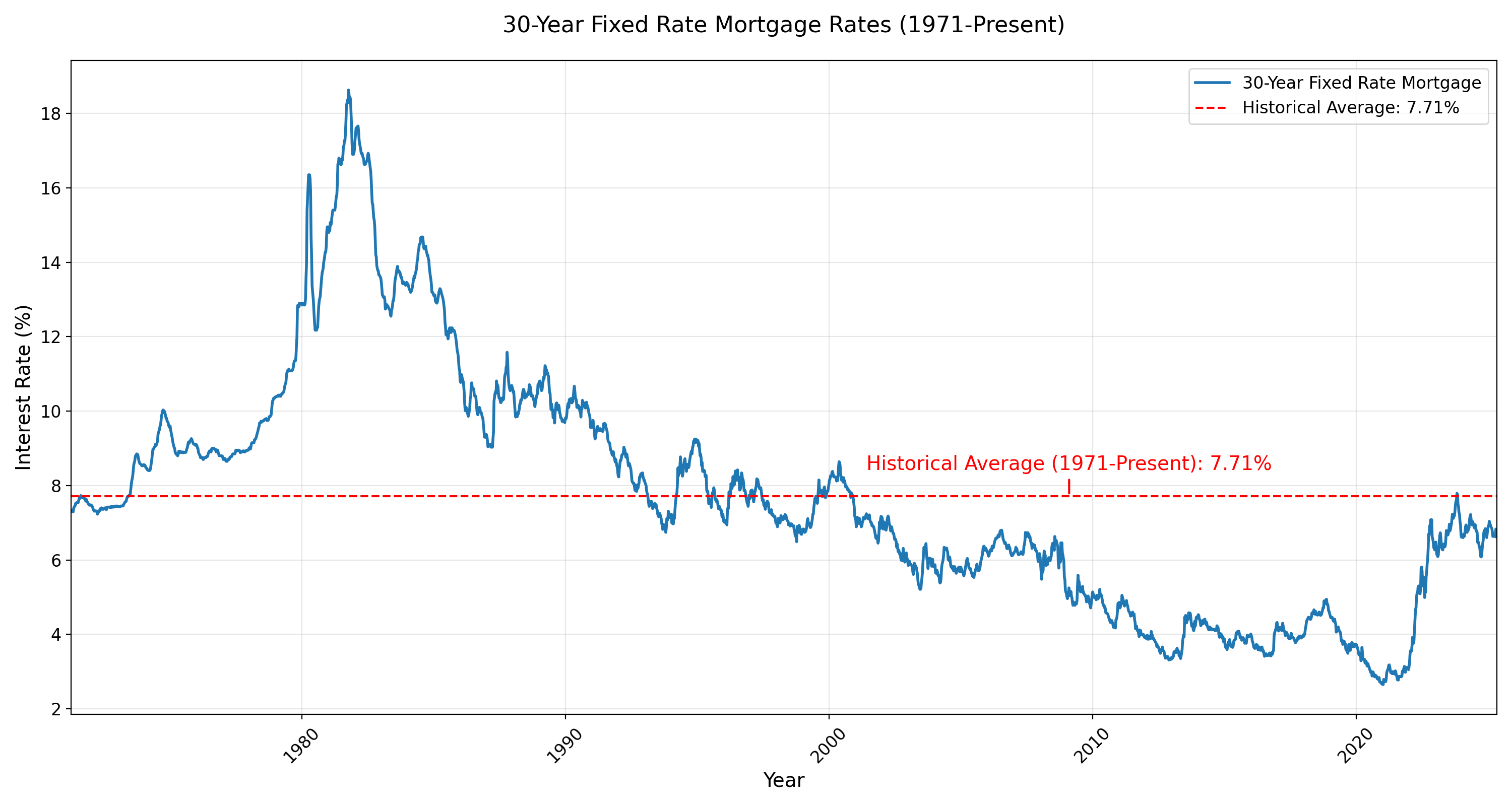
To understand if a current rate is truly “typical,” one must look at history. Public perception of mortgage rates is often skewed by the “recency bias” of the extremely low-rate environment seen between 2008 and 2021.
Looking Back: The Highs and Lows of Past Decades
In the early 1980s, typical mortgage rates peaked at over 18% as the Federal Reserve fought rampant stagflation. In contrast, the post-2008 financial crisis era and the COVID-19 pandemic saw rates plummet to historic lows near 2% or 3%. When viewed through a 50-year lens, a “typical” mortgage rate is actually somewhere between 6% and 8%. Understanding this historical context helps borrowers realize that while current rates might feel high compared to three years ago, they are often quite average when viewed against long-term historical data.
Navigating Current Market Volatility
In the current financial landscape, volatility has become the new normal. Factors such as geopolitical tensions, supply chain shifts, and changing labor market dynamics mean that a “typical” rate can change by a quarter of a percentage point in a single week. For the modern homebuyer, this means that “timing the market” is increasingly difficult. Instead, the focus has shifted toward “affordability”—calculating whether the monthly payment at the current rate fits within a sustainable personal budget, rather than waiting for a return to “unicorn” rates of the past.
Strategies to Secure a Below-Average Rate
Even when market rates are high, there are professional financial strategies that savvy borrowers use to secure a rate that is lower than the national “typical” average.
Shopping Around and Comparing Lenders
Many borrowers make the mistake of only checking with their primary bank. However, mortgage rates can vary significantly between retail banks, credit unions, and online mortgage brokers. Credit unions, being member-owned, often offer rates slightly below the national average. Mortgage brokers, on the other hand, have access to a variety of wholesale lenders and can shop your profile to find the most competitive “niche” rate available for your specific financial situation.
Paying Points and Rate Locks
A “discount point” is an upfront fee paid to the lender at closing in exchange for a lower interest rate over the life of the loan. One point typically costs 1% of the total loan amount and lowers the interest rate by approximately 0.25%. For those planning to stay in their home for a long time (7–10+ years), paying points can be a mathematically sound investment. Additionally, because rates fluctuate daily, utilizing a “rate lock” during the home-buying process ensures that if rates rise while you are in escrow, your lower quoted rate is protected.
The Importance of the Annual Percentage Rate (APR)
When comparing what is “typical,” it is essential to look at the APR, not just the nominal interest rate. The interest rate is the cost of borrowing the principal, but the APR includes the interest rate plus other costs such as broker fees, points, and loan origination fees. A loan might have a “typical” interest rate of 6.5%, but if the fees are high, the APR might be 7.1%. Always use the APR as the true barometer for comparing the total cost of the loan.
Conclusion: Why “Typical” is Ultimately Personal
In the world of personal finance, a “typical” mortgage rate is a useful benchmark but a poor final goal. While the national average provides a pulse on the economy, your personal financial profile—your credit, your debt-to-income ratio, and your chosen loan product—will ultimately dictate your reality.
A professional approach to mortgages involves looking beyond the headline number. It requires an understanding of how the Federal Reserve’s decisions trickle down to your monthly payment, how historical trends provide perspective on current volatility, and how strategic choices like paying points can alter your long-term wealth trajectory. Ultimately, the best mortgage rate is not necessarily the lowest one in history, but the one that allows you to build equity safely and predictably within the context of your broader financial plan. Homeownership is a marathon, and the mortgage rate is simply the pace you set at the starting line. By staying informed and financially disciplined, you can ensure that your rate—no matter the market conditions—is one that works for you, rather than against you.
aViewFromTheCave is a participant in the Amazon Services LLC Associates Program, an affiliate advertising program designed to provide a means for sites to earn advertising fees by advertising and linking to Amazon.com. Amazon, the Amazon logo, AmazonSupply, and the AmazonSupply logo are trademarks of Amazon.com, Inc. or its affiliates. As an Amazon Associate we earn affiliate commissions from qualifying purchases.