
Purchasing a vehicle is one of the most significant financial commitments the average consumer will make, second only to buying a home. While the sticker price of the car often commands the most attention, the mechanism used to pay for it—the auto loan—frequently dictates the true cost of ownership. Central to this financial arrangement is the interest rate. Understanding what interest rates on car loans are, how they are calculated, and what factors influence them is essential for anyone looking to navigate the modern credit landscape effectively.
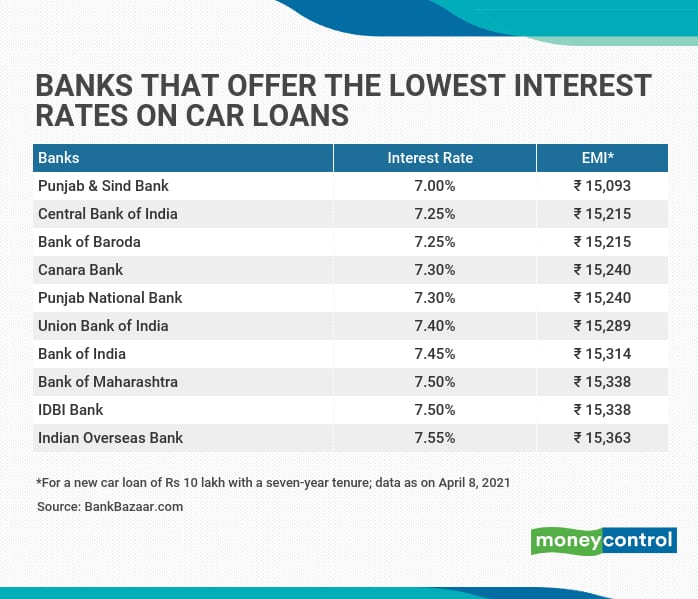
In the simplest terms, an interest rate is the cost you pay a lender for the privilege of borrowing their money. However, in the realm of personal finance, this “cost” is a moving target influenced by global economics, individual behavior, and institutional risk. To master your personal economy, you must look beyond the monthly payment and understand the mechanics of the interest you are being charged.
Understanding the Fundamentals: Interest Rates vs. APR
When shopping for a car loan, you will encounter two primary figures: the nominal interest rate and the Annual Percentage Rate (APR). While they are often used interchangeably in casual conversation, they represent different financial realities.
The Difference Between Base Interest and APR
The interest rate is the specific percentage of the loan principal that the lender charges annually. If you borrow $30,000 at a 5% interest rate, that percentage applies directly to the balance of your loan. However, the interest rate does not tell the whole story.
The APR is a more comprehensive measure of the cost of credit. It includes the interest rate plus any additional fees or costs associated with the loan, such as origination fees, documentation fees, or prepaid interest. For the savvy borrower, the APR is the most important number because it represents the “all-in” cost of the loan. When comparing offers from different lenders, a loan with a lower interest rate but higher fees might actually be more expensive than a loan with a slightly higher interest rate and no fees.
How Simple Interest Works in Auto Loans
Most car loans utilize a “simple interest” calculation. Unlike credit cards, which often use compound interest (charging interest on interest), simple interest is calculated based on the principal balance on the day the payment is due.
This structure benefits the proactive borrower. Because interest is calculated based on the remaining balance, making extra payments or paying more than the minimum each month reduces the principal faster. As the principal drops, the amount of interest accrued each month also drops, potentially saving the borrower thousands of dollars over the life of the loan. Understanding this “Money” principle allows you to use your cash flow to actively de-leverage your debt.
The Determinants of Your Auto Loan Rate
Interest rates are not one-size-fits-all. They are highly personalized, reflecting the lender’s assessment of the risk that you might default on the loan. To secure the best rate, you must understand the variables that lenders weigh most heavily.
The Impact of Credit Scores
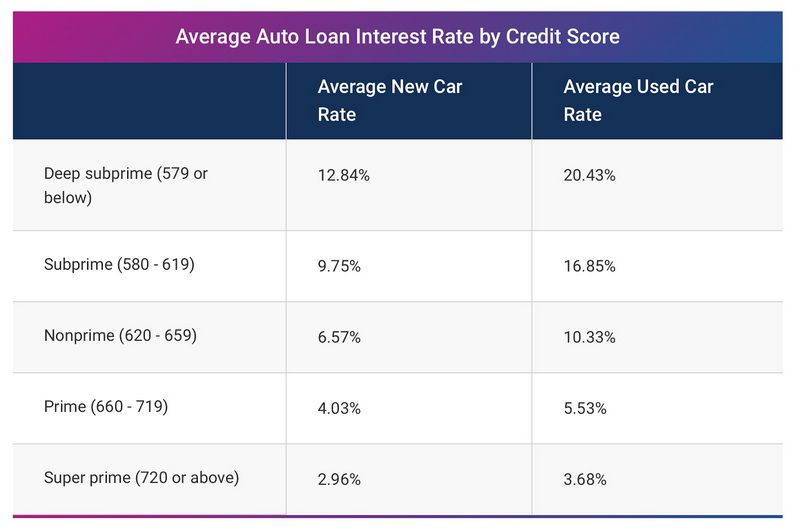
Your credit score is the single most influential factor in determining your car loan interest rate. Lenders typically categorize borrowers into “tiers” based on their FICO or VantageScore.
- Super Prime (781–850): These borrowers receive the lowest rates, often near the “floor” of what the market allows.
- Prime (661–780): These borrowers still receive competitive rates and have a wide choice of lenders.
- Nonprime (601–660): Rates begin to climb significantly here as the perceived risk increases.
- Subprime and Deep Subprime (300–600): Borrowers in these categories face the highest interest rates, sometimes exceeding 15% or 20%, as lenders mitigate the high probability of default.
Improving your credit score by even 30 or 40 points before applying for a loan can result in an interest rate reduction that saves significant money over a five-year term.

Loan Term Length and Its Cost
The duration of the loan—the “term”—also dictates the interest rate. Historically, 36-month and 48-month loans were the standard. Today, 72-month and even 84-month loans have become common as car prices have risen.
From a personal finance perspective, longer terms are a double-edged sword. While they lower the monthly payment, they almost always come with higher interest rates. Lenders charge more for longer terms because they are exposed to risk for a longer period. Furthermore, the longer the loan, the more interest you pay in total. A borrower with a 72-month loan will pay far more for the same car than a borrower with a 48-month loan, even if their interest rates were identical.
New vs. Used Vehicle Rates
Generally, interest rates on new cars are lower than those on used cars. This may seem counterintuitive since a new car is more expensive, but the logic lies in the collateral. A new car is easier for a lender to value and easier to resell if they have to repossess it. Used cars carry more uncertainty regarding their mechanical condition and remaining lifespan, which increases the lender’s risk. Consequently, even a borrower with perfect credit will likely pay 1% to 2% more for a loan on a used vehicle than on a brand-new one.
External Economic Factors Influencing the Market
While your personal financial health dictates your “spread” above the baseline, the baseline itself is determined by the broader economy. You do not control these factors, but understanding them allows you to time your purchase more effectively.
The Role of the Federal Reserve
In the United States, the Federal Reserve’s Federal Funds Rate serves as the benchmark for almost all consumer interest rates. When the Fed raises rates to combat inflation, the cost for banks to borrow money increases. To maintain their profit margins, banks pass these costs on to consumers in the form of higher APRs on auto loans. Conversely, in a sluggish economy, the Fed may lower rates to encourage spending, making it a “cheaper” time to finance a vehicle.
Inflation and Lender Risk Assessment
Inflation impacts interest rates in two ways. First, it triggers the central bank actions mentioned above. Second, inflation erodes the purchasing power of the dollars the lender will receive back in the future. If a lender expects high inflation, they will demand a higher interest rate to ensure that the “real” value of their return remains profitable. Additionally, in inflationary environments, lenders often tighten their credit standards, reserving the best rates only for the most qualified borrowers to hedge against potential economic volatility.
Strategies to Secure the Lowest Possible Rate
Navigating car loan interest rates requires a proactive approach. You should never treat the first rate you are offered as a finality. In the world of finance, interest rates are often negotiable or at least “shoppable.”
Shopping Around: Credit Unions vs. Banks vs. Dealerships
One of the most common mistakes consumers make is accepting “captive financing”—the loans offered directly through the dealership. While convenient, dealership rates often include a “markup.” The dealer acts as an intermediary, finds a rate from a bank, and then adds a percentage point or two as a commission.
To find the best “Money” deal, start with credit unions. Because credit unions are member-owned non-profits, they frequently offer interest rates that are 1% to 1.5% lower than big national banks. Obtaining a pre-approval from a credit union or an online lender gives you leverage. When you walk into a dealership with a pre-approved rate of 5%, the dealer is forced to beat that rate if they want your financing business.
The Power of a Down Payment
A substantial down payment does more than just lower your monthly obligation; it can actually lower your interest rate. Lenders look at the “Loan-to-Value” (LTV) ratio. If you are financing 100% of the car’s value, the lender is at high risk if you default. If you put 20% down, the LTV is 80%, meaning the lender is much more likely to recoup their money in a sale. Lower risk for the lender almost always translates to a lower interest rate for the borrower.
Refinancing as a Future Option
Interest rates are not necessarily a life sentence for your vehicle. If you were forced to take a high-interest loan because of a poor credit score or high market rates, you can look into refinancing. Once your credit score improves or the Federal Reserve lowers benchmark rates, you can replace your existing high-interest loan with a new, lower-interest one. In the context of personal finance management, periodic “debt audits” to check for refinancing opportunities are a hallmark of a sophisticated investor.
By understanding that an interest rate is a reflection of risk, economic policy, and market competition, you move from being a passive consumer to an active participant in your financial life. Whether you are buying a modest used sedan or a luxury SUV, the interest rate you secure will define the efficiency of your capital for years to come.
aViewFromTheCave is a participant in the Amazon Services LLC Associates Program, an affiliate advertising program designed to provide a means for sites to earn advertising fees by advertising and linking to Amazon.com. Amazon, the Amazon logo, AmazonSupply, and the AmazonSupply logo are trademarks of Amazon.com, Inc. or its affiliates. As an Amazon Associate we earn affiliate commissions from qualifying purchases.