
Tax season is often met with a mixture of anxiety and procrastination. For many, the complexity of the tax code feels like an insurmountable barrier to financial clarity. However, viewing tax preparation not as a chore, but as a critical pillar of your personal finance strategy, can change your perspective. Proper tax preparation ensures you remain compliant with the law while maximizing your potential for a refund or minimizing your liability.
To navigate this process successfully, you need more than just a calculator; you need a systematic approach to documentation. Whether you are a traditional W-2 employee, a freelancer in the gig economy, or a seasoned investor, having the right paperwork ready is the difference between a smooth filing experience and a frantic scramble against the April deadline. This guide outlines everything you need to organize your financial life for tax season.
1. Gathering Essential Personal Information and Identification
Before you even look at your income or expenses, you must establish the “who” of your tax return. The Internal Revenue Service (IRS) requires precise identification to ensure that your records match their database and to prevent identity theft.
Social Security Numbers and Dependents
The most fundamental pieces of information are the Social Security Numbers (SSNs) or Individual Taxpayer Identification Numbers (ITINs) for everyone listed on the return. This includes yourself, your spouse (if filing jointly), and any dependents you are claiming.
If you have welcomed a new child into the family during the tax year, ensure you have applied for and received their Social Security card well before the filing deadline. For those claiming elderly parents or other qualifying relatives, you will need their personal details and proof of support to justify their status as dependents. Accurate numbers are non-negotiable; a single transposed digit can lead to a rejected return or a significant delay in processing.
Filing Status and Personal Records
Your filing status—Single, Married Filing Jointly, Married Filing Separately, Head of Household, or Qualifying Surviving Spouse—dictates your standard deduction and tax brackets. To determine the most financially advantageous status, you may need legal documents such as marriage licenses or divorce decrees, particularly if your status changed during the calendar year.
Bank Information for Direct Deposit
In the modern financial landscape, paper checks are an outdated and slow method for receiving a tax refund. To expedite the process, gather your bank account number and routing number. Direct deposit is the fastest way to receive funds and is significantly more secure than waiting for a check in the mail. If you plan to split your refund into multiple accounts—such as putting a portion into a high-yield savings account and the rest into a checking account—have all those details ready.
2. Documenting Your Income Streams
The core of your tax return is a comprehensive accounting of every dollar earned during the year. The IRS receives copies of most of these forms from your employers and financial institutions, so your records must match theirs to avoid red flags.
Traditional Employment: W-2s and Salaries
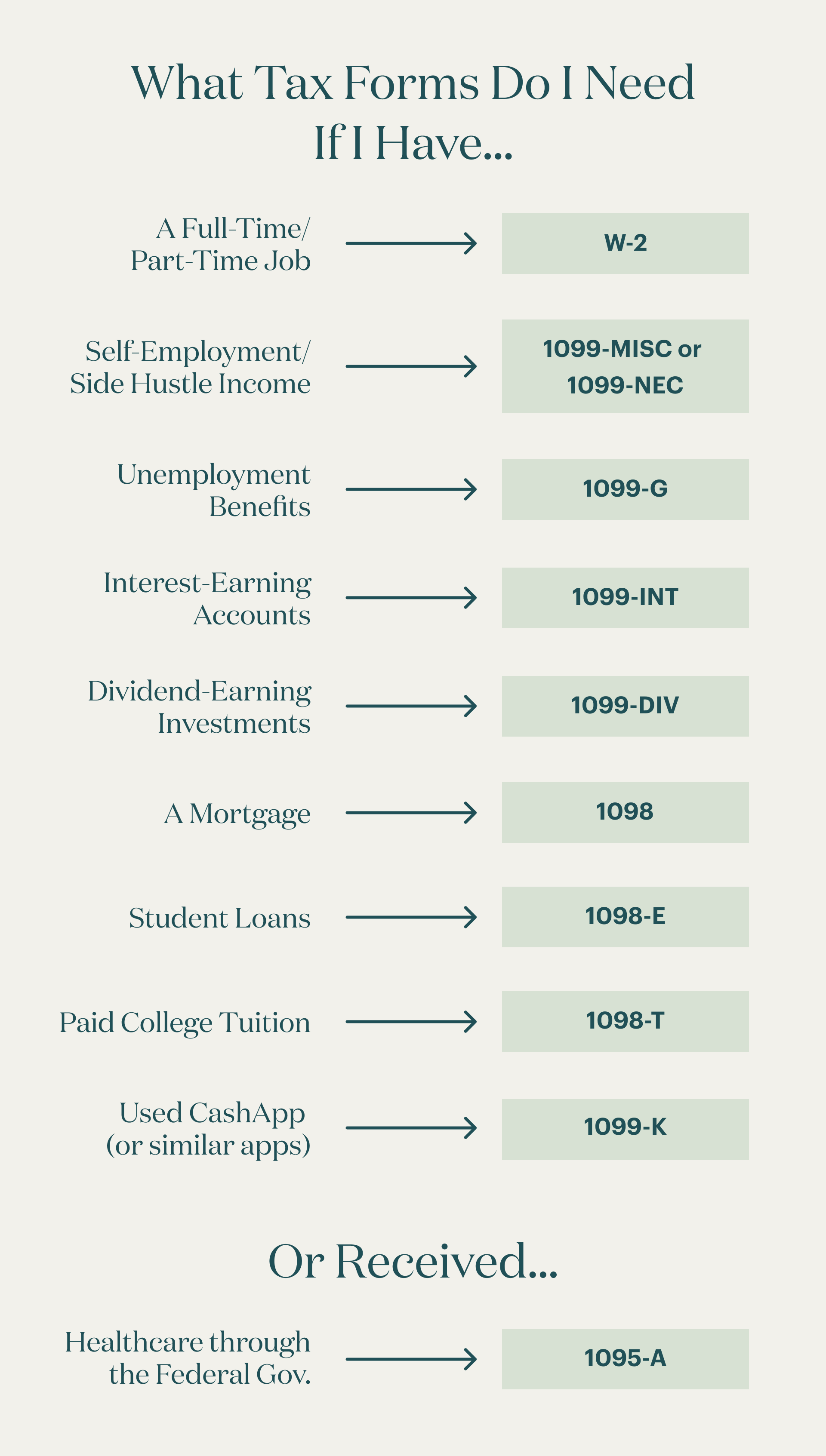
If you are an employee, your primary document is the Form W-2. Your employer is legally required to send this to you by January 31st. This form summarizes your total earnings, the federal and state income taxes withheld, and your contributions to Social Security and Medicare. If you worked multiple jobs during the year, you must collect a W-2 from every single employer, even if you only worked there for a few weeks.
The Gig Economy and Self-Employment: 1099 Forms
The rise of the “side hustle” has complicated tax prep for many. If you performed contract work, freelanced, or participated in the gig economy (such as driving for a rideshare service or selling items online), you will likely receive various 1099 forms.
- 1099-NEC: This is used for non-employee compensation of $600 or more.
- 1099-K: This reports payments received through third-party networks (like PayPal, Venmo, or Etsy) if you met certain thresholds.
- 1099-MISC: This is used for miscellaneous income such as rent or prizes.
It is crucial to keep your own ledger of income throughout the year. Sometimes companies fail to send 1099s, but you are still legally obligated to report that income to the IRS.
Investment and Passive Income
Your money making money is also taxable. You will need to gather documentation for interest earned in savings accounts (1099-INT) and dividends from stocks or mutual funds (1099-DIV).
Furthermore, if you sold stocks, bonds, or real estate, you will need Form 1099-B, which lists your proceeds and, ideally, your cost basis (what you originally paid). In the realm of digital assets, the IRS has increased its focus on cryptocurrency. You must report all capital gains or losses from crypto trades, and many exchanges now provide specialized tax reports to help with this.

3. Maximizing Deductions and Credits
Deductions and credits are the primary tools for reducing your taxable income and your overall tax bill. Understanding the difference between the two—and knowing which you qualify for—is essential for effective personal finance management.
Standard vs. Itemized Deductions
Most taxpayers take the standard deduction, which is a fixed dollar amount that reduces the income you’re taxed on. However, if your eligible expenses exceed the standard deduction amount, you should “itemize” using Schedule A. To do this, you need records of:
- Mortgage Interest: Provided on Form 1098 by your lender.
- State and Local Taxes (SALT): Including property taxes and either state income tax or sales tax.
- Charitable Contributions: Receipts for cash donations and acknowledgments from charities for non-cash donations (like clothing or household goods).
- Medical Expenses: Unreimbursed costs that exceed a certain percentage of your adjusted gross income.
Education and Healthcare Expenses
The government provides financial incentives for investing in education and maintaining health coverage. If you paid tuition for higher education, you should receive Form 1098-T, which may qualify you for the American Opportunity Tax Credit (AOTC) or the Lifetime Learning Credit (LLC). Additionally, if you paid interest on student loans, you will receive Form 1098-E, which allows you to deduct that interest even if you don’t itemize.
Regarding healthcare, if you purchased insurance through a government marketplace, you will need Form 1095-A to reconcile your premium tax credits. If you have a Health Savings Account (HSA), keep records of your contributions, as these are often tax-deductible and grow tax-free.
Retirement Contributions and Tax Advantages
Contributing to retirement accounts is one of the smartest “money moves” you can make. Contributions to a traditional IRA or a 401(k) can lower your taxable income. While 401(k) contributions are typically captured on your W-2, you need to track independent IRA contributions yourself. Conversely, while Roth IRA contributions aren’t deductible, reporting them ensures you are tracking your “basis” for future tax-free withdrawals.
4. Choosing the Right Financial Tools and Preparation Method
How you file is just as important as what you file. The tools you choose should align with the complexity of your financial situation.
Modern Tax Software vs. Professional CPAs
For many with straightforward income (a single W-2 and the standard deduction), tax software is a cost-effective and efficient tool. These programs use interview-style questions to guide you through the process, ensuring you don’t miss common credits.
However, if you own a business, have complex rental properties, or have significant foreign investments, hiring a Certified Public Accountant (CPA) or a tax professional is often a better investment. A professional can provide year-round tax planning advice that software cannot, potentially saving you thousands of dollars through strategic financial structuring.
Record-Keeping Throughout the Year
The best way to do your taxes is to work on them all year long. Using financial tools like bookkeeping apps, expense trackers, or even a simple dedicated folder for receipts prevents the “shoebox method” of tax prep. Digital scans of receipts are generally accepted by the IRS and are much easier to organize than fading thermal paper. By maintaining a clean digital trail of your expenses, especially for business or home office deductions, you protect yourself in the event of an audit.
5. Final Review and Electronic Filing
Once the data is entered, the final stage is quality control. Errors in filing can lead to penalties, interest, and unnecessary stress.
Avoiding Common Filing Errors
The most frequent mistakes are often the simplest: misspelled names, incorrect Social Security numbers, and math errors. If you are filing manually or using basic spreadsheets, double-check every calculation. If you are using software, ensure you haven’t skipped any sections.
One often-overlooked area is the “Foreign Bank Account Report” (FBAR). If you have more than $10,000 in foreign accounts at any time during the year, you must disclose this to the Treasury Department. Failure to do so can result in massive financial penalties.

Deadlines and Extension Protocols
The standard tax deadline is April 15th, unless it falls on a weekend or holiday. If you find that you are missing a crucial document—such as a late Schedule K-1 from a partnership—you should file for an extension using Form 4868.
It is a common misconception that an extension gives you more time to pay. An extension only gives you more time to file your paperwork. If you owe money, you must estimate the amount and pay it by the April deadline to avoid interest and late-payment penalties. Filing electronically (e-filing) remains the gold standard, providing an immediate acknowledgment of receipt from the IRS and significantly reducing the turnaround time for any potential refund.
By treating tax preparation as a structured financial audit, you gain a clearer picture of your net worth, your spending habits, and your progress toward long-term wealth. Organizing your documents is not just about compliance; it is about taking control of your financial future.
aViewFromTheCave is a participant in the Amazon Services LLC Associates Program, an affiliate advertising program designed to provide a means for sites to earn advertising fees by advertising and linking to Amazon.com. Amazon, the Amazon logo, AmazonSupply, and the AmazonSupply logo are trademarks of Amazon.com, Inc. or its affiliates. As an Amazon Associate we earn affiliate commissions from qualifying purchases.