
Tax season often brings a mixture of anticipation and anxiety. For many investors, the complexity of reporting various income streams can feel overwhelming, particularly when dealing with fixed-income assets like U.S. savings bonds. As interest rates have shifted in recent years, many taxpayers are finding themselves with significant interest income reported on Form 1099-INT.
Whether you are using H&R Block’s online platform or their desktop software, correctly reporting this income is vital to ensure compliance with the IRS while maximizing your potential refunds. This guide provides a comprehensive walkthrough of the process, specifically focusing on the nuances of savings bonds and how to leverage financial software to streamline your personal finance management.

Understanding the Importance of Form 1099-INT in Your Tax Strategy
Form 1099-INT is the standard IRS document used to report interest income. Most financial institutions, including banks, credit unions, and the U.S. Department of the Treasury, are required to issue this form if they paid you $10 or more in interest during the calendar year. While it may seem like a minor detail compared to a W-2 or a 1099-B (for stock sales), failing to report this interest is one of the most common reasons for receiving an automated IRS notice.
The Thresholds of Interest Reporting
The IRS receives a copy of every 1099-INT issued in your name. Their automated matching system compares the income reported by the payer with the income you claim on your return. Even if you did not receive a physical form in the mail—perhaps due to a move or a preference for paperless delivery—you are still legally obligated to report the income if it meets the $10 threshold. For those holding Series EE or Series I savings bonds, this interest is often deferred until the bond is cashed or reaches maturity, making the year of redemption a critical tax event.
Why Interest from Bonds is Unique
Unlike standard bank account interest, interest from U.S. Treasury securities and savings bonds carries specific tax advantages. While this income is fully taxable at the federal level, it is generally exempt from state and local income taxes. This is a crucial distinction in the “Money” niche: if you incorrectly categorize bond interest as standard bank interest, you may end up overpaying your state taxes. High-quality tax software like H&R Block is designed to handle this distinction, provided you enter the data into the correct boxes.
A Step-by-Step Guide to Inputting 1099-INT Data in H&R Block
H&R Block has designed its user interface to be intuitive, but the specific path to reporting bond interest requires attention to detail. Whether you are a seasoned investor or a side-hustler managing your first investment accounts, following a structured approach ensures nothing is missed.
Navigating to the Income Section
Once you have logged into your H&R Block account and completed the initial personal information sections, you will need to head to the “Federal” tab. From there, look for the “Income” category. You will see a list of common income types. Look for the sub-section labeled “Interest and Dividends” or “1099-INT.”
- Select “Add Interest Income”: Click the button to start a new entry.
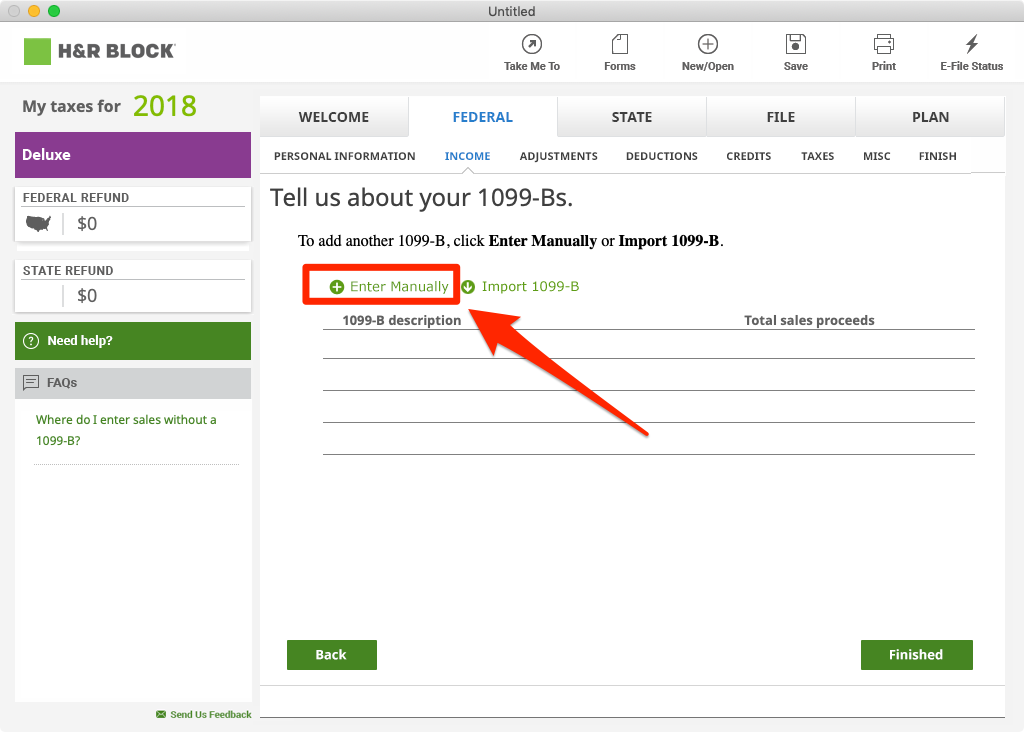
- Choose Your Method: H&R Block offers the ability to import data directly from many major financial institutions. If your bonds are held in a brokerage account, this is the fastest and most accurate method. However, if you are reporting physical paper bonds or bonds held directly through TreasuryDirect, you will likely need to select “Enter Manually.”
Manual Data Entry: Matching the Boxes
The manual entry screen will mirror the physical Form 1099-INT you received. Accuracy here is paramount.
- Payer’s Information: Enter the name of the institution (e.g., “U.S. Treasury” or your specific bank).
- Box 1 (Interest Income): This is where you enter standard taxable interest.
- Box 3 (Interest on U.S. Savings Bonds and Treasury Obligations): This is the most critical box for bondholders. By entering your savings bond interest here rather than in Box 1, the software knows to exclude this amount from your state taxable income calculations.
- Box 4 (Federal Income Tax Withheld): It is rare for interest to have backup withholding, but if your form shows an amount here, ensure it is entered accurately so you receive credit for taxes already paid.
Reviewing for Accuracy
After entering the data, H&R Block will present a summary screen. Take a moment to compare the “Total Interest” shown on the screen with the sum of all your physical 1099-INT forms. Small typos in these fields can lead to “math error” notices from the IRS, which can delay your refund by weeks or months.
The Nuances of Savings Bonds: Series EE and I Bond Tax Implications
U.S. Savings Bonds, particularly the inflation-protected Series I bonds, have become a popular tool for personal finance over the last few years due to their competitive yields. However, the way they are taxed is unique compared to other fixed-income assets.
Cash Basis vs. Accrual Basis Reporting
The IRS allows two methods for reporting savings bond interest. Most individual taxpayers use the “cash basis” method, meaning they report all the interest in the year they cash the bond, the bond reaches final maturity, or the bond is disposed of.
Alternatively, you can choose to report the interest annually as it accrues. While this is less common, it can be a savvy financial move for those in a very low tax bracket (such as a child) who expect to be in a higher bracket when the bond is eventually cashed. If you choose the accrual method, you must continue to do so for all bonds you own and any you acquire in the future. H&R Block allows for this adjustment, but it requires manual calculation since the 1099-INT is typically only issued upon redemption.
The Education Tax Exclusion
One of the most powerful “Money” strategies involving savings bonds is the Education Savings Bond Program. If you cashed Series EE or I bonds issued after 1989 to pay for qualified higher education expenses for yourself, your spouse, or your dependents, you may be able to exclude the interest from your income entirely.
To claim this in H&R Block, you will need to look for Form 8815 within the software. There are income limitations (Modified Adjusted Gross Income or MAGI) that apply to this exclusion. If your income exceeds certain thresholds, the tax benefit begins to phase out. Using the software to calculate this is much safer than attempting the manual worksheet, as the phase-out math can be complex.
Optimizing Your Return: Common Mistakes and Tax-Advantaged Strategies
When dealing with personal finance and tax filing, the goal is always to minimize liability while remaining fully compliant with the law. Even with sophisticated tools like H&R Block, the “garbage in, garbage out” rule applies. Understanding common pitfalls can save you significant money.
Avoiding Double Taxation on Transferred Bonds
A common mistake occurs when bonds are transferred due to death or as a gift. If a bond was transferred to you and the previous owner had been reporting the interest annually (accrual basis), you only owe taxes on the interest earned after the transfer. If you mistakenly report the entire lifetime interest of the bond upon redemption, you are essentially paying taxes twice on the same income. Always review the history of inherited or gifted bonds before hitting “submit” on your tax software.
Impact on Adjusted Gross Income (AGI)
Every dollar of interest reported on your 1099-INT increases your Adjusted Gross Income. This is a critical metric in personal finance because your AGI determines your eligibility for various credits and deductions, such as the Child Tax Credit, the Earned Income Tax Credit, and even the deductibility of IRA contributions. If you are near a “cliff” for one of these benefits, the timing of when you cash your savings bonds can have a massive impact on your overall financial picture.
Strategic bondholders often wait until a lower-income year to redeem large amounts of savings bonds to stay under these AGI thresholds. This type of forward-looking financial planning is what separates a basic tax filer from a savvy wealth manager.
The Importance of Record Keeping
Finally, regardless of how seamless the H&R Block interface is, your digital records are your first line of defense. Keep digital copies of your 1099-INT forms and any worksheets generated by the software for at least seven years. If you are claiming the education exclusion, keep your tuition receipts and Form 1098-T alongside your 1099-INT. In the world of personal finance, documentation is the currency of security.
By understanding the specific boxes on the 1099-INT, the unique state-tax-exempt status of bond interest, and the potential for education-related exclusions, you can navigate your H&R Block filing with confidence. Taking the time to accurately report your interest income not only keeps you in the good graces of the IRS but also ensures that you aren’t leaving any of your hard-earned money on the table.
aViewFromTheCave is a participant in the Amazon Services LLC Associates Program, an affiliate advertising program designed to provide a means for sites to earn advertising fees by advertising and linking to Amazon.com. Amazon, the Amazon logo, AmazonSupply, and the AmazonSupply logo are trademarks of Amazon.com, Inc. or its affiliates. As an Amazon Associate we earn affiliate commissions from qualifying purchases.