
In the landscape of global finance, few entities command as much attention as Meta Platforms, Inc. Formerly known as Facebook, Meta is a trillion-dollar behemoth that dominates the social media, digital advertising, and emerging metaverse sectors. For the savvy investor or the curious observer of corporate finance, the question of “who owns Meta” is more complex than a single name. While Mark Zuckerberg is the face of the company, the reality of its ownership involves a sophisticated hierarchy of institutional investors, mutual funds, and a unique dual-class share structure that defines how power is wielded in the boardroom.
Understanding the ownership of Meta is a foundational exercise in business finance. It reveals how capital is concentrated in the modern economy and how a founder can maintain absolute control over a public company even while owning a minority of its total equity.
The Dual-Class Share Structure: The Engine of Control
The most critical element in Meta’s ownership architecture is its dual-class stock system. To understand who “owns” the company in terms of decision-making power, one must distinguish between economic interest and voting power. Meta’s capital structure is divided primarily into Class A and Class B common stock.
Class A vs. Class B Shares
Class A shares are those traded publicly on the NASDAQ under the ticker symbol “META.” Each Class A share entitles the holder to one vote. These are the shares held by the general public, retail investors, and the majority of institutional players.
In contrast, Class B shares are not traded on public exchanges. They are held primarily by Mark Zuckerberg and a small group of insiders. The defining characteristic of Class B shares is their disproportionate weight: each Class B share carries ten votes. This mechanism is a hallmark of “founder-friendly” corporate governance, designed to protect the leadership’s long-term vision from the short-term pressures of Wall Street.
Mark Zuckerberg’s Voting Hegemony
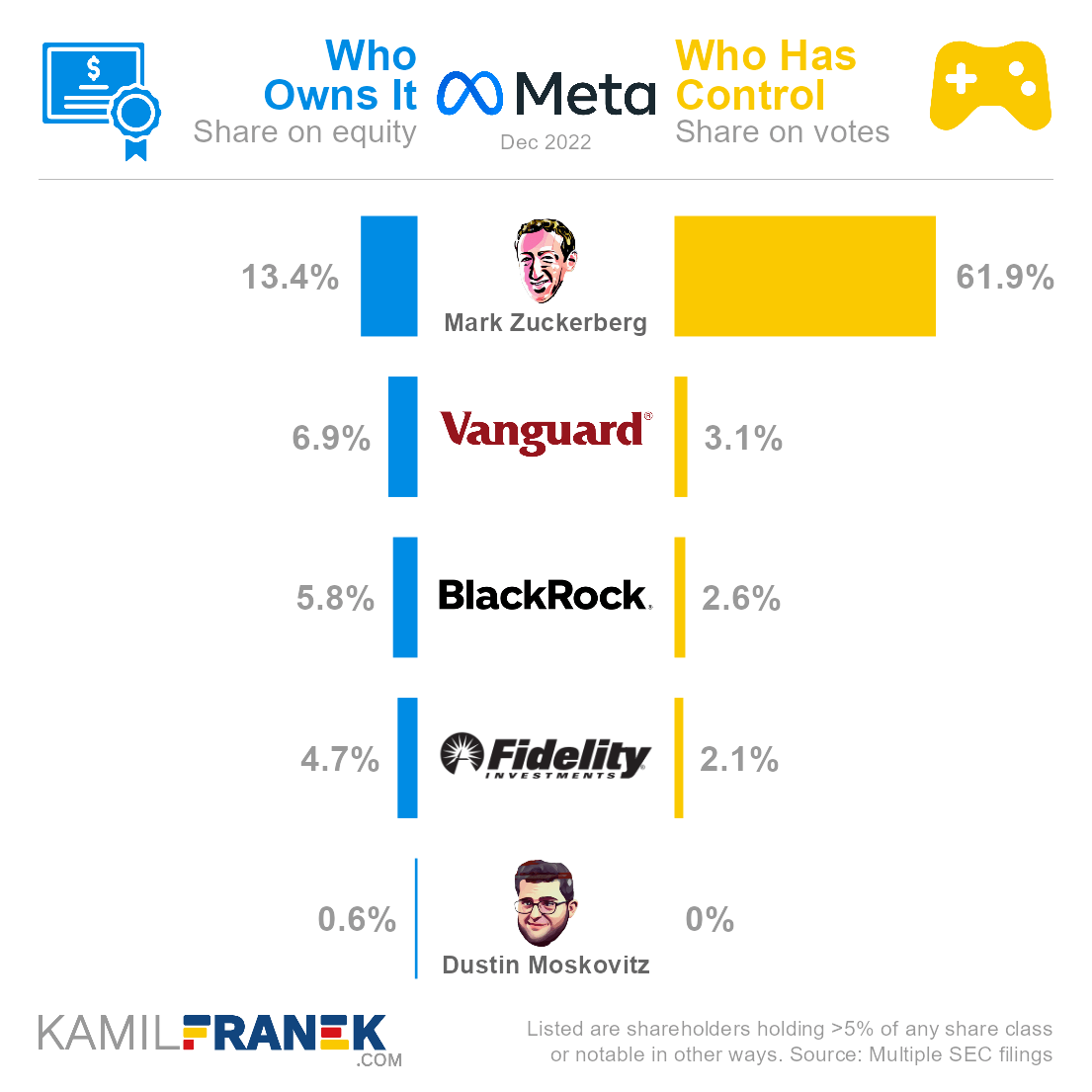
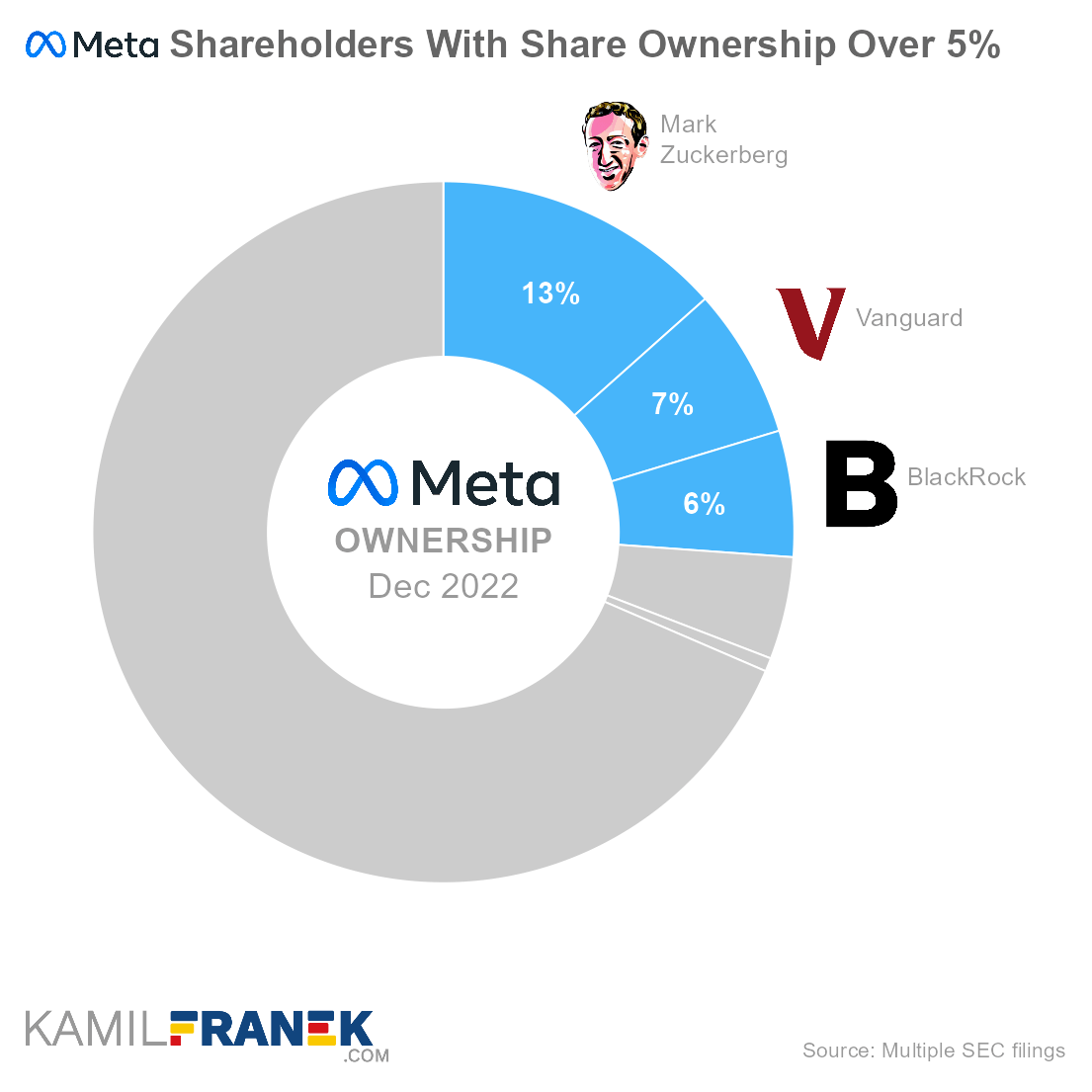
While Mark Zuckerberg’s total equity stake in Meta usually fluctuates around 13% to 15% of the total outstanding shares, his voting power is a different story. Because he holds the vast majority of Class B shares, Zuckerberg controls approximately 61% of the total voting power of the company.
From a business finance perspective, this means that Meta is, for all intents and purposes, a controlled company. Zuckerberg has the unilateral power to elect board members, approve mergers, and set the strategic direction of the company. This concentration of power is a double-edged sword for investors: it provides stability and a clear vision, but it also means that minority shareholders have virtually no say in how the company is managed.
Institutional Giants: The Largest Shareholders of Meta
While Zuckerberg holds the reins of power, the “economic” ownership of Meta—the right to its profits and the lion’s share of its equity—resides with massive institutional investors. These institutions manage the retirement accounts, pension funds, and savings of millions of people worldwide.
The Role of The Vanguard Group
As of recent filings, The Vanguard Group is typically the largest institutional shareholder of Meta Platforms. Vanguard does not own these shares for its own profit in the traditional sense; rather, it holds them on behalf of the investors in its various index funds and ETFs. Because Meta is a staple of the S&P 500 and the NASDAQ-100, any fund tracking these indices must hold a significant position in Meta. This passive ownership is a pillar of the modern financial system, providing Meta with a stable base of long-term capital.
BlackRock and State Street
Following closely behind Vanguard are BlackRock, Inc. and State Street Corporation. These “Big Three” asset managers collectively hold a massive percentage of Meta’s Class A shares. Their influence is felt not through direct management, but through their “stewardship” teams, which engage with Meta’s board on issues of ESG (Environmental, Social, and Governance) and executive compensation. For an investor, seeing these names at the top of the shareholder list provides a degree of institutional validation and liquidity.
Fidelity and Active Management
Beyond the passive indexers, active management firms like Fidelity Investments often hold significant stakes. Unlike Vanguard, Fidelity’s portfolio managers may increase or decrease their holdings based on their assessment of Meta’s financial health and growth prospects. When active managers buy into Meta, it signals a professional belief that the stock is undervalued relative to its future earnings potential.
Insider Ownership and the Executive Suite
Beyond Mark Zuckerberg, a small group of current and former executives and directors hold substantial amounts of Meta stock. This insider ownership is a vital metric for investors, as it aligns the interests of the management team with those of the shareholders.
Current Executive Holdings
High-ranking officers, such as the Chief Operating Officer and Chief Financial Officer, receive a significant portion of their compensation in the form of Restricted Stock Units (RSUs). Over years of service, these holdings can grow into multi-million dollar stakes. In the world of personal finance and executive compensation, this is known as “skin in the game.” If the company prospers, the executives’ personal wealth increases, theoretically incentivizing them to maximize shareholder value.
The Influence of the Board of Directors
The board of directors, including figures like venture capitalist Marc Andreessen, also hold equity. Their ownership serves as a signal of confidence in the company’s long-term pivot toward AI and the metaverse. For the financial analyst, tracking the buying and selling patterns of these insiders (through SEC Form 4 filings) provides invaluable “boots on the ground” insight into how those closest to the company view its current valuation.
Meta as a Financial Asset: Revenue, Dividends, and Buybacks
Ownership is not just about voting; it is about the right to a company’s cash flows. To understand the value of owning Meta, one must look at how the company distributes its massive wealth to its shareholders.
The Profit Machine: Ad Revenue and Margins
Meta’s ownership value is fundamentally derived from its ability to monetize its user base of over 3 billion people. The company’s primary engine is digital advertising. From a business finance standpoint, Meta boasts some of the highest profit margins in the S&P 500. Its “capital-light” model—where users create the content and Meta provides the platform—allows it to generate billions in free cash flow. This cash flow is what makes the shares attractive to institutional giants like BlackRock.
The Evolution of Capital Return: Dividends and Buybacks
For most of its history, Meta did not pay a dividend, choosing instead to reinvest profits into R&D and acquisitions (like Instagram and WhatsApp). However, in a landmark shift for its financial strategy, Meta recently initiated its first-ever quarterly dividend. This move marked Meta’s transition from a pure “growth” stock to a “total return” stock, making it an eligible investment for dividend-focused mutual funds and conservative income investors.
In addition to dividends, Meta is one of the most aggressive practitioners of share buybacks. By spending billions to buy its own shares back from the open market, Meta reduces the total number of shares outstanding. For the remaining owners, this means their “slice of the pie” becomes larger without them having to spend an extra dime.
The Risks and Rewards of Concentrated Ownership
When you buy a share of Meta, you are entering into a specific financial relationship characterized by a unique risk-reward profile. The ownership structure influences everything from the stock’s volatility to its susceptibility to regulatory pressure.
The “Zuckerberg Risk”
In financial circles, “key man risk” refers to the danger of a company being overly dependent on one individual. Because of the voting structure, Meta has extreme key man risk. If Zuckerberg’s vision for the Metaverse fails to yield a return on investment, shareholders have limited recourse to force a change in strategy. This concentration of power can lead to a “governance discount” in the stock price, where the market values Meta slightly lower than it would if it had a more traditional democratic voting structure.
Regulatory and Antitrust Pressures
Ownership of Meta also brings exposure to global regulatory shifts. Governments in the US and EU have frequently scrutinized Meta’s dominant market position. The financial implication of “owning” a monopoly is the constant threat of fines or forced divestitures. If Meta were forced to spin off WhatsApp or Instagram, the ownership structure would be dramatically altered, likely resulting in shareholders receiving shares in the new, independent companies.
The Future: AI and the Metaverse
As Meta invests heavily in artificial intelligence and Reality Labs, the nature of its ownership value is shifting. Investors are no longer just buying a social media company; they are buying a stake in the future of human-computer interaction. The high cost of this transition—often billions of dollars per quarter—requires a shareholder base with high conviction and deep pockets.

Conclusion: Who Truly Owns Meta?
In the final analysis, “who owns Meta” depends on whether you are looking for power, profit, or presence.
Mark Zuckerberg owns the power. Through his Class B shares, he remains the undisputed architect of the company’s destiny.
The Institutional Giants like Vanguard and BlackRock own the presence. They provide the liquidity and stability that allow Meta to exist as a cornerstone of the global financial markets.
The Public and Retail Investors own the profit potential. Through Class A shares, millions of individuals participate in the growth of the digital economy, bolstered by Meta’s new commitment to dividends and buybacks.
For the investor, understanding this hierarchy is essential. To own Meta is to trust in a single founder’s vision while leaning on the structural support of the world’s largest financial institutions. It is a masterclass in corporate finance, representing the pinnacle of how modern technology companies are built, funded, and controlled.
aViewFromTheCave is a participant in the Amazon Services LLC Associates Program, an affiliate advertising program designed to provide a means for sites to earn advertising fees by advertising and linking to Amazon.com. Amazon, the Amazon logo, AmazonSupply, and the AmazonSupply logo are trademarks of Amazon.com, Inc. or its affiliates. As an Amazon Associate we earn affiliate commissions from qualifying purchases.