
In the realm of personal and business finance, numbers are the language of progress. Whether you are calculating the interest on a high-yield savings account, determining the tax obligation on your year-end bonus, or evaluating the performance of a stock portfolio, one mathematical concept reigns supreme: the percentage. Understanding how to work out a percentage of an amount is more than just a classroom exercise; it is a fundamental pillar of financial literacy that empowers you to make informed decisions, optimize your spending, and accelerate your wealth-building journey.
Percentages allow us to standardize information, making it easier to compare different financial products and opportunities. A $500 return might sound impressive until you realize it represents only a 1% gain on a $50,000 investment. Conversely, a $50 saving on a $100 utility bill is a staggering 50% reduction. By mastering the mechanics of percentages, you gain the clarity needed to navigate the complex world of money with confidence.
The Core Mechanics of Percentages in Personal Finance
Before diving into complex investment strategies or corporate tax structures, one must master the basic arithmetic that governs all percentage-based calculations. At its heart, the word “percent” originates from the Latin per centum, meaning “by the hundred.” Therefore, any percentage is essentially a fraction with a denominator of 100.
The Basic Formula: Translating “Per Cent” to “Per Hundred”
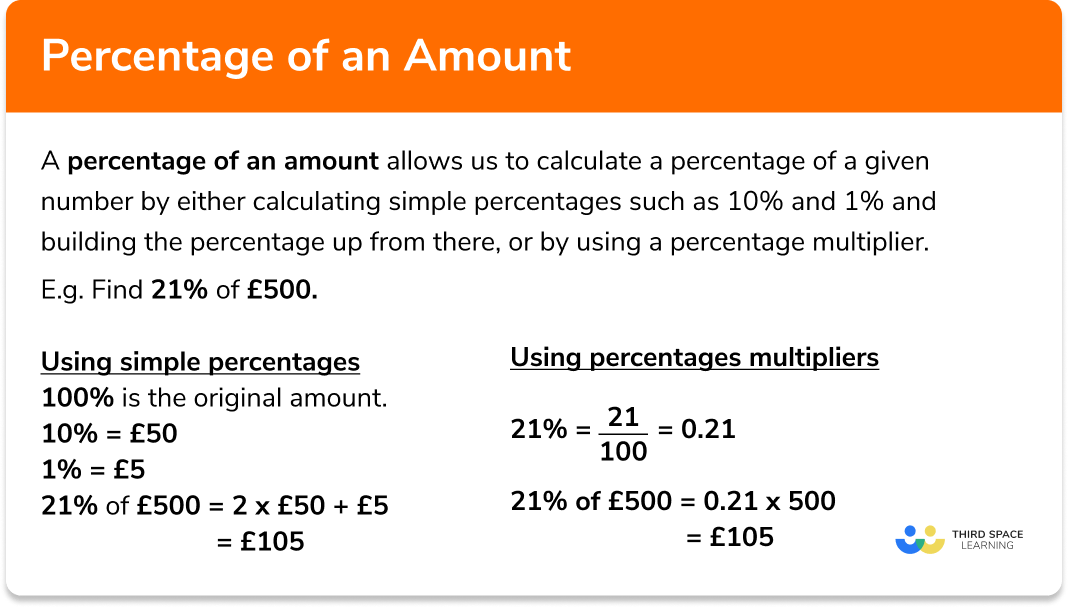
To work out a percentage of an amount, the most straightforward method involves a simple three-step process: convert the percentage to a decimal, then multiply it by the total amount.
The formula is: (Percentage / 100) × Total Amount = Part.
For example, if you want to set aside 15% of a $4,500 monthly salary for retirement, you would first divide 15 by 100 to get 0.15. You then multiply 0.15 by $4,500. The result is $675. This fundamental calculation is the basis for almost every financial decision you will make, from calculating sales tax at the register to determining your debt-to-income ratio when applying for a mortgage.
Mental Math Shortcuts for Real-World Financial Decisions
In fast-paced financial environments—such as negotiating a deal or calculating a tip at a business lunch—you may not always have a calculator at hand. Developing mental math shortcuts for percentages is an invaluable skill for the financially savvy individual.
The “10% Rule” is perhaps the most useful shortcut. To find 10% of any amount, simply move the decimal point one place to the left. If a restaurant bill is $85.00, 10% is $8.50. From there, you can easily calculate other percentages. To find 20%, simply double the 10% figure ($17.00). To find 5%, halve the 10% figure ($4.25). By layering these simple movements, you can calculate complex percentages in seconds, allowing you to maintain a professional edge in any financial conversation.
Navigating Taxes and Income Management
For most professionals and entrepreneurs, the most significant “percentage” they deal with annually is their tax rate. Income management is not about how much you earn, but how much you keep after the government and various expenses take their share.
Calculating Gross vs. Net Income
Understanding the percentage of your income that goes toward deductions is vital for accurate budgeting. Your “Gross Income” is the total amount earned before any deductions, while your “Net Income” (or take-home pay) is what remains after taxes, social security, and health insurance premiums.
To analyze your financial health, you should calculate your “Retention Percentage.” If your gross pay is $6,000 and your take-home pay is $4,200, you are retaining 70% of your earnings ($4,200 / $6,000 = 0.70). Knowing this percentage helps you understand the true cost of your lifestyle and allows for better planning when considering raises or new job offers.
Understanding Marginal Tax Brackets and Effective Rates
One common financial misconception involves tax brackets. Many people fear that a raise might push them into a higher bracket, resulting in less money overall. This is rarely the case because tax systems typically use a “Marginal” percentage.
A marginal tax rate means that only the portion of your income within a specific range is taxed at that percentage. To calculate your “Effective Tax Rate”—which is the actual percentage of your total income paid in taxes—you divide your total tax bill by your total taxable income. For instance, if you earn $100,000 but only pay $18,000 in total taxes, your effective tax rate is 18%, regardless of whether your highest marginal bracket is 24%. Mastery of these percentages prevents emotional decision-making regarding career advancement and tax planning.
The Role of Percentages in Wealth Building and Investing
In the world of investing, percentages are the primary metric for success. Whether you are looking at dividends, capital gains, or expense ratios, the “amount” is often secondary to the “percentage of growth.”
Calculating Return on Investment (ROI)

The most critical calculation for any investor or side-hustler is the Return on Investment (ROI). This percentage tells you how efficiently your money is working for you.
The formula is: [(Current Value – Initial Cost) / Initial Cost] × 100.
If you invest $10,000 in a digital asset and sell it a year later for $12,500, your profit is $2,500. To find the percentage gain, divide $2,500 by the original $10,000 to get 0.25, or a 25% ROI. Comparing the ROI percentages of different assets—such as real estate versus index funds—is the only way to objectively determine where your capital should be deployed for maximum growth.
Asset Allocation: The Percentage-Based Strategy for Risk Management
Successful wealth management relies on diversification, which is almost always managed through percentage-based asset allocation. A common strategy for a balanced portfolio might be 60% stocks and 40% bonds.
As market values fluctuate, these percentages will shift. If stocks perform exceptionally well, they might grow to represent 70% of your portfolio. “Rebalancing” involves working out the current total value of your portfolio and calculating how much you need to sell or buy to return to your original 60/40 percentage split. This disciplined, percentage-based approach forces you to “buy low and sell high,” a cornerstone of sophisticated investing.
The Compounding Effect: How Small Percentages Create Massive Wealth
Perhaps the most powerful concept in finance is compound interest. The difference between a 5% return and a 7% return might seem negligible in a single year, but over 30 years, that 2% difference can result in hundreds of thousands of dollars in additional wealth. Understanding how to calculate these percentages allows you to see the “long game.” By reinvesting your percentage gains, you begin to earn interest on your interest, creating an exponential growth curve that is the secret to long-term financial independence.
Business Finance: Margins, Markups, and Profitability
For those involved in business finance or running a side hustle, percentages are the difference between a thriving enterprise and a failing one. Revenue is a vanity metric; margins are a sanity metric.
Gross vs. Net Profit Margins
To understand the health of a business, you must be able to calculate profit margins. The Gross Profit Margin reflects the percentage of revenue remaining after subtracting the Cost of Goods Sold (COGS).
Formula: [(Revenue – COGS) / Revenue] × 100.
However, the Net Profit Margin is even more critical, as it accounts for all operating expenses, taxes, and interest. If your business generates $100,000 in revenue but only $10,000 in net profit, your net margin is 10%. By monitoring these percentages, a business owner can identify if expenses are rising too fast relative to sales and adjust pricing or operations accordingly.
Discount Strategy and Break-Even Analysis
When running a promotion, you must calculate the percentage of a discount carefully to ensure you aren’t selling at a loss. If you offer a 20% discount on a product, you aren’t just losing 20% of the price; you are often losing a much higher percentage of your profit. For example, if your margin was 40%, a 20% discount slashes your profit by half. Understanding these relationships allows entrepreneurs to design sales strategies that drive volume without compromising the financial integrity of the business.
Digital Tools and Automation for Precision Calculations
While mental math and manual formulas are essential for quick checks, modern financial management relies on digital tools for precision and automation.
Spreadsheet Mastery: Percentage Formulas in Excel and Google Sheets
For anyone serious about their finances, spreadsheets are the ultimate tool. In Excel, working out a percentage is streamlined. If your total is in cell A1 and your part is in cell B1, the formula =B1/A1 followed by clicking the “Percent Style” button will give you an instant, accurate result. Spreadsheets allow you to track percentage changes over time, such as the month-over-month increase in your net worth or the percentage of your budget spent on discretionary items.

Using Financial Calculators for Amortization and Inflation
Finally, complex financial percentages—such as the amortization of a 30-year fixed-rate mortgage or the impact of a 3% inflation rate on your future purchasing power—are best handled by specialized financial tools. These tools use the same basic percentage logic but apply it over time and multiple variables. By inputting your data into these calculators, you can visualize how a small percentage change in your mortgage interest rate can save you tens of thousands of dollars over the life of the loan.
In conclusion, the ability to work out a percentage of an amount is the master key to the world of money. It transforms raw data into actionable insights, allowing you to budget effectively, invest wisely, and manage business ventures with surgical precision. By integrating these calculations into your daily financial life, you move from being a passive observer of your bank account to an active architect of your financial future.
aViewFromTheCave is a participant in the Amazon Services LLC Associates Program, an affiliate advertising program designed to provide a means for sites to earn advertising fees by advertising and linking to Amazon.com. Amazon, the Amazon logo, AmazonSupply, and the AmazonSupply logo are trademarks of Amazon.com, Inc. or its affiliates. As an Amazon Associate we earn affiliate commissions from qualifying purchases.