
The history of the calculator is not a story of a single “discovery” in a vacuum, but rather a relentless technological progression that spans millennia. While we often associate the calculator with the plastic handheld devices of the 1980s or the apps on our modern smartphones, its lineage is rooted in the fundamental human drive to automate complexity. From the mechanical gears of the 17th century to the sophisticated neural networks of today, the “discovery” of the calculator is the story of how humanity externalized logic into hardware and software.

In the context of modern technology, the calculator represents the earliest form of a “dedicated device”—a precursor to the computer itself. Understanding who invented the calculator and how it evolved provides a critical lens through which we can view current trends in AI, software development, and digital automation.
The Mechanical Pioneers: Engineering the First Computing Hardware
The journey toward modern computation began long before the first silicon chip was etched. The earliest “calculators” were analog tools like the abacus, but the leap into true mechanical computation occurred during the scientific revolution.
Blaise Pascal and the Pascaline (1642)
While various cultures utilized counting frames, the first person credited with inventing a mechanical calculator was the French mathematician and physicist Blaise Pascal. In 1642, at just 19 years old, Pascal developed the “Pascaline” to assist his father, a tax collector, with laborious arithmetic.
The Pascaline was a marvel of 17th-century tech. It utilized a series of linked gears and wheels; turning the wheels allowed the user to add and subtract through a carry mechanism. Although it was expensive and difficult to produce, the Pascaline proved that logic could be encoded into physical machinery. This was the first “hardware” solution to a data-processing problem.
Gottfried Wilhelm Leibniz and the Stepped Reckoner
Three decades later, German polymath Gottfried Wilhelm Leibniz expanded on Pascal’s work. In 1673, he debuted the “Stepped Reckoner.” While Pascal’s machine was limited to addition and subtraction, Leibniz’s invention introduced a drum mechanism—the “Leibniz wheel”—that allowed for multiplication and division through repeated addition.
Leibniz is a towering figure in tech history not just for his hardware, but for his advocacy of the binary system. He envisioned a world where all logic could be reduced to 0s and 1s—a visionary concept that remains the bedrock of every digital tool we use today.
The Arithmometer: Moving Toward Mass Production
It wasn’t until 1820 that Thomas de Colmar transformed these experimental designs into the first commercially successful mechanical calculator: the Arithmometer. This device remained the industry standard for nearly a century, proving that there was a viable market for dedicated computing gadgets in business and engineering.
The Digital Revolution: From Vacuum Tubes to the Microchip
The mid-20th century marked a paradigm shift. The transition from mechanical gears to electronic pulses redefined what a calculator could be. This era saw the “discovery” of portability and the miniaturization of power.
The ANITA and the Birth of Electronic Desktop Calculation
In 1961, the British firm Bell Punch Co. released the ANITA (A New Inspiration To Arithmetic/Accounting). It was the world’s first all-electronic desktop calculator. Unlike its mechanical predecessors, it didn’t use gears; instead, it relied on vacuum tubes and cold-cathode switching tubes. It was silent, fast, and signaled the end of the mechanical era. However, it was the size of a typewriter and required a wall outlet, limiting its utility for the burgeoning tech-savvy workforce.
Texas Instruments and the “Cal-Tech” Breakthrough
The true “Holy Grail” of 20th-century calculator tech was portability. In 1967, a team at Texas Instruments (TI), led by Jack Kilby (the co-inventor of the integrated circuit), developed the “Cal-Tech” prototype. This was the first handheld electronic calculator.
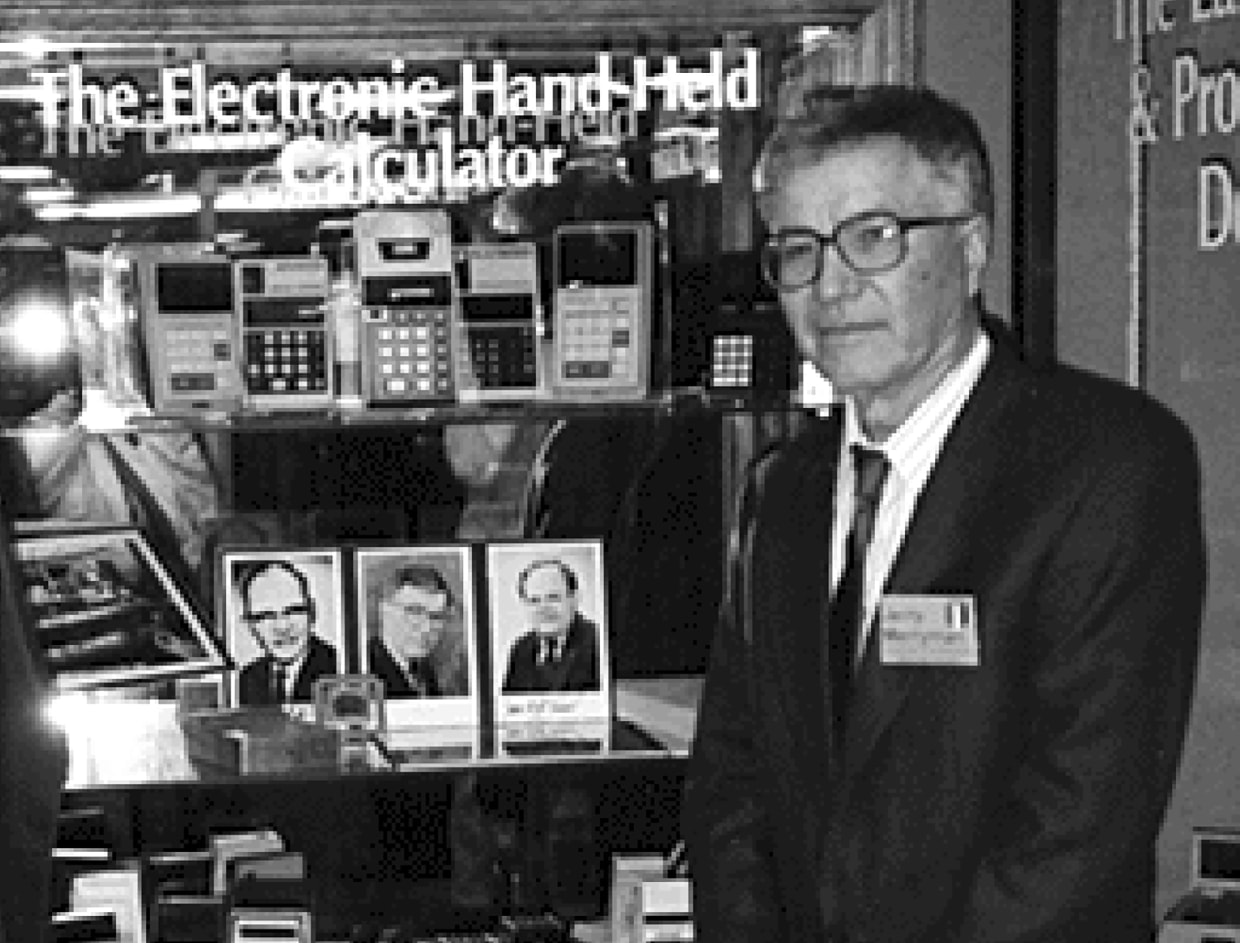
The Cal-Tech was a landmark piece of hardware. It demonstrated that integrated circuits could perform complex logic on a tiny scale. While it was a prototype, it paved the way for the 1970s explosion of portable consumer electronics. By 1971, the introduction of the Bowmar Brain brought handheld calculation to the masses, forever changing the “gadget” landscape.
The Hewlett-Packard HP-35: The First Pocket Scientist
In 1972, Hewlett-Packard released the HP-35. This was the world’s first handheld scientific calculator. It replaced the slide rule, a tool that had been used by engineers and scientists for centuries. The HP-35 was a tech masterpiece because it utilized “Reverse Polish Notation” (RPN) and could handle trigonometric and exponential functions. It proved that a handheld device could be a professional-grade tool, not just a simple arithmetic toy.
The Software Shift: How Calculators Became Apps
As the 1980s and 90s progressed, the calculator underwent another transformation. It moved from being a standalone piece of hardware to becoming a software feature within larger operating systems.
The Integration of Calculation in Personal Computing
With the rise of the PC, the calculator was “rediscovered” as a software utility. Apple’s Macintosh and Microsoft Windows included calculator accessories from their earliest versions. This period saw the development of graphing calculators, most notably from Texas Instruments (like the TI-81 and TI-83). These devices were essentially specialized computers with high-resolution screens and the ability to plot functions, becoming an indispensable tutorial tool for STEM students worldwide.
The Smartphone as the Universal Calculator
The launch of the App Store in 2008 signaled the “death” of the basic standalone calculator for the general consumer. Why carry a dedicated gadget when your iPhone or Android device has a native calculator app? Software developers began creating specialized calculation tools—apps for unit conversion, financial modeling, and complex scientific research. The calculator was no longer a thing you bought; it was a function you accessed.
Cloud-Based Computational Engines
Today, we see the rise of tools like WolframAlpha. These aren’t just calculators; they are “computational intelligence engines.” By utilizing massive cloud-based databases and symbolic manipulation, WolframAlpha can solve complex calculus, provide socioeconomic data, and generate visual charts. This represents the pinnacle of software-driven calculation, where the “tool” is a gateway to the world’s structured knowledge.
The AI Frontier: The Future of Automated Logic
The current era of technology is characterized by Artificial Intelligence and Machine Learning. In this niche, the calculator is evolving once again—shifting from a tool that follows rigid rules to one that can interpret intent.
AI-Powered Math Solvers
Modern educational tech tools, such as Photomath or Microsoft Math Solver, use Computer Vision (CV) to “see” a handwritten equation and solve it instantly. These apps don’t just provide an answer; they use AI to explain the steps, serving as a personalized AI tutor. This is a far cry from Pascal’s gears; it is the synthesis of hardware, software, and artificial intelligence.
Large Language Models and Symbolic Math
With the advent of LLMs like ChatGPT and Claude, the way we interact with “calculators” is becoming conversational. While early versions of LLMs struggled with basic arithmetic (due to their nature as linguistic predictors), integration with Python environments and Wolfram plugins has made them incredibly powerful computational partners. You no longer need to know the specific formula; you simply describe the problem, and the AI selects the appropriate mathematical logic to execute.
Digital Security and Cryptographic Calculation
In the realm of digital security, “calculators” take the form of encryption algorithms. Every time you make a secure transaction, your device is performing incredibly complex modular arithmetic and prime number factorization. This specialized form of calculation is the backbone of the modern internet, ensuring that our data remains private through “computational hardness”—the idea that a problem is easy to verify but nearly impossible to reverse-calculate without a key.

Conclusion: The Perpetual Discovery
Who discovered the calculator? It was not one person, but a relay of visionaries. Pascal discovered that logic could be mechanical. Kilby discovered that logic could be microscopic. Modern software engineers discovered that logic could be ubiquitous and cloud-based.
Today, the calculator remains one of the most vital “Tech” niches. Whether it is a simple app on your wrist or a massive AI model running in a data center, the calculator continues to be our most essential tool for navigating a complex, data-driven world. As we look toward the future of quantum computing, the “calculator” will likely undergo its next great transformation, moving beyond binary logic into a realm of probability and superposition that we are only just beginning to explore.
aViewFromTheCave is a participant in the Amazon Services LLC Associates Program, an affiliate advertising program designed to provide a means for sites to earn advertising fees by advertising and linking to Amazon.com. Amazon, the Amazon logo, AmazonSupply, and the AmazonSupply logo are trademarks of Amazon.com, Inc. or its affiliates. As an Amazon Associate we earn affiliate commissions from qualifying purchases.