
In the realm of personal finance and wealth management, numbers are the primary language. However, the most critical dialect within that language is the percentage. Whether you are calculating the interest on a high-yield savings account, determining the impact of a market downturn on your portfolio, or simply trying to figure out a fair tip at a business lunch, understanding how to find a percent of a number is a foundational skill.
While basic arithmetic is taught in primary school, the application of these concepts in a high-stakes financial environment requires a deeper level of fluency. This guide moves beyond the classroom to explore the mechanics of percentage calculations and how they serve as the backbone of strategic financial decision-making.

The Fundamentals of Percentage in Personal Finance
To master your money, you must first master the “per hundred” concept. The word “percent” originates from the Latin per centum, meaning “by the hundred.” In financial terms, a percentage represents a portion of a whole, scaled to a standard of 100. This standardization allows investors and savers to compare disparate financial products on an equal playing field.
Converting Fractions and Decimals for Quick Analysis
Before performing a calculation, it is essential to understand that a percentage is simply a decimal or a fraction in disguise. For instance, 25% is the same as 0.25 or 1/4. In a professional financial context, converting percentages to decimals is the most efficient way to perform calculations on a handheld calculator or within a spreadsheet.
To convert any percentage to a decimal, you simply move the decimal point two places to the left. Thus, 7.5% becomes 0.075. Understanding this conversion is the first step in avoiding “fat-finger” errors when calculating interest rates or tax liabilities.
The Multiplication Method for Quick Calculations
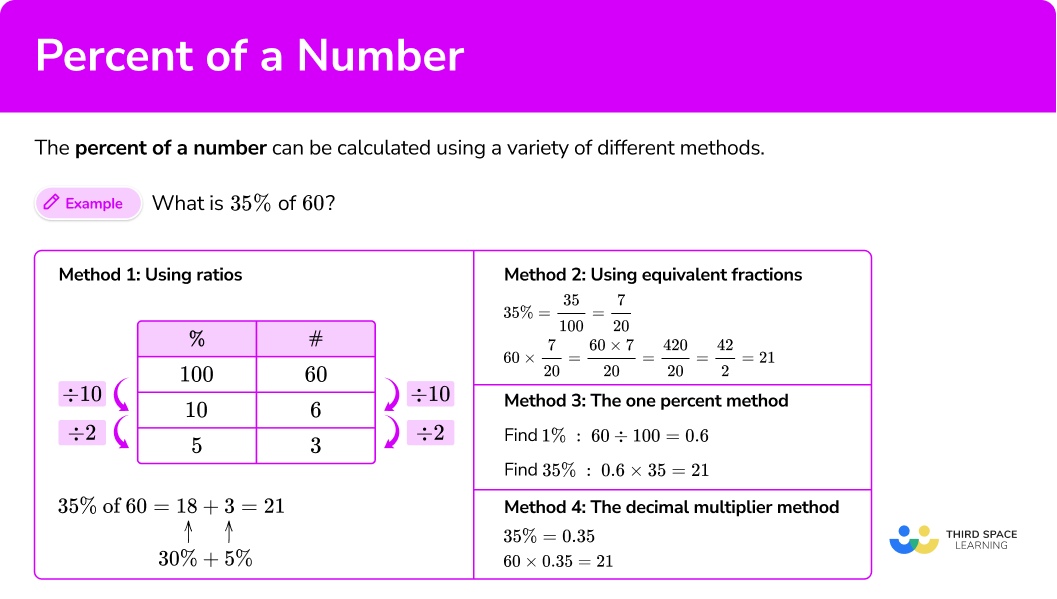
The most direct way to find the percent of a number is the multiplication method. The formula is straightforward:
Total Value × (Percentage / 100) = Percentage Amount.
For example, if you are looking to set aside a 20% down payment for a property valued at $450,000, the calculation would be:
$450,000 × 0.20 = $90,000.
In a professional setting, being able to perform these calculations mentally or with a quick mobile tool is invaluable. If you need to find 10% of any number, simply move the decimal one place to the left ($45,000). To find 20%, double that number ($90,000). This “rule of ten” is a vital mental shortcut for quick financial assessments during negotiations or budget reviews.
Percentage as a Tool for Smart Budgeting
Budgeting is not just about tracking dollars; it is about managing ratios. Successful financial planners rarely look at absolute numbers in isolation. Instead, they look at what percentage of a client’s income is being directed toward specific categories. This allows for a scalable financial strategy that works whether a person earns $50,000 or $500,000 a year.
The 50/30/20 Rule: Allocation as a Percentage
One of the most enduring frameworks in personal finance is the 50/30/20 rule. This strategy suggests allocating your after-tax income into three distinct percentage-based buckets:
- 50% for Needs: Housing, utilities, groceries, and insurance.
- 30% for Wants: Dining out, travel, and hobbies.
- 20% for Savings and Debt Repayment: Building an emergency fund or paying down principal on loans.
To implement this, you must be able to calculate these percentages against your net monthly income. If your take-home pay is $6,200, finding 20% for your retirement account involves multiplying $6,200 by 0.20 ($1,240). By focusing on percentages rather than fixed dollar amounts, your budget automatically scales as your career progresses and your income grows.
Tracking Month-over-Month Expense Changes
Another critical application of percentage math in budgeting is calculating “percent change.” This helps you identify lifestyle creep or inflationary pressures. The formula for percent change is:
[(New Value – Old Value) / Old Value] × 100.
If your grocery bill was $400 last month and rose to $460 this month, the percentage increase is 15%. Seeing a “15% increase” often carries more psychological weight than seeing a “$60 increase,” prompting a more rigorous review of spending habits. Professional money managers use this same logic to track the volatility of assets and the growth of corporate earnings.
Calculating Growth: Investment Returns and Compound Interest
In the world of investing, percentages are the yardstick of performance. Whether you are analyzing a stock’s dividend yield or the annual percentage yield (APY) of a bond, the “how-to” of finding these percentages determines how you perceive risk and reward.

Understanding ROI (Return on Investment)
Return on Investment, or ROI, is perhaps the most important percentage in the financial world. It represents the efficiency of an investment. To find the ROI, you take the net profit of the investment, divide it by the original cost, and multiply by 100.
If you purchase shares in a technology fund for $10,000 and sell them a year later for $11,200, your profit is $1,200.
($1,200 / $10,000) × 100 = 12%.
Knowing that you achieved a 12% return allows you to compare that investment against the S&P 500 average or the interest rate of a “risk-free” Treasury bill. Without the ability to find these percentages, an investor is essentially flying blind.
The Rule of 72 and Compounded Growth Percentages
Compound interest is often called the eighth wonder of the world, and it is entirely governed by percentages. While calculating compound interest involves exponents, a quick way to understand the power of a percentage is the “Rule of 72.”
This is a simplified way to determine how long it will take for an investment to double given a fixed annual rate of interest. You simply divide 72 by the annual percentage return.
- At a 6% return, your money doubles in 12 years (72/6).
- At a 10% return, your money doubles in about 7.2 years (72/10).
This highlights why even a 1% or 2% difference in investment fees or interest rates is so significant. Over a 30-year horizon, a 1% fee can “eat” a massive percentage of your total wealth. Understanding how to calculate that percentage is the difference between a comfortable retirement and an extended working life.
Protecting Your Wealth: Inflation and Tax Percentages
Wealth management is as much about defense as it is about offense. Two of the greatest threats to capital are inflation and taxation, both of which are calculated using percentages.
Adjusting for Purchasing Power Loss
Inflation is the percentage by which the general level of prices for goods and services rises. If the annual inflation rate is 3%, the “real” value of your cash is decreasing by that same percentage. Finding 3% of your total liquid savings tells you exactly how much “purchasing power” you are losing each year by not investing that capital.
For a professional with $100,000 in a zero-interest checking account, a 3% inflation rate represents a $3,000 loss in value in just twelve months. When you can visualize this loss as a concrete number, the necessity of seeking out yield through investments becomes much clearer.
Effective Tax Rates vs. Marginal Tax Brackets
Taxation is another area where a lack of percentage fluency can lead to poor financial decisions. Many people confuse their “marginal tax bracket” with their “effective tax rate.”
- Marginal Tax Bracket: The percentage of tax paid on the last dollar earned.
- Effective Tax Rate: The actual percentage of your total income that goes to the government.
Calculating your effective tax rate (Total Tax Paid / Total Taxable Income) provides a clearer picture of your actual financial burden. If you earn $150,000 and pay $30,000 in taxes, your effective rate is 20%, even if your top marginal bracket is 24%. Understanding how to find these percentages helps in tax planning, such as deciding whether to contribute to a Pre-Tax 401(k) or a Roth IRA.
Leveraging Financial Tools and Digital Calculators
In the modern era, you don’t always have to do the math by hand, but you must know how to direct the tools at your disposal. Efficiency in money management often comes down to how well you can use technology to automate these calculations.
Excel Functions for Percentage Automation
For anyone serious about their finances, Microsoft Excel or Google Sheets are the ultimate tools. They handle percentage calculations with built-in precision. To find a percentage in Excel, you simply use the asterisk (*) for multiplication. If cell A1 contains $5,000 and you want to find 15% in cell B1, you enter =A1*0.15.
Furthermore, formatting cells as “Percentage” allows you to enter “15” and have the software treat it as “0.15.” Mastering these small technical nuances prevents the mathematical errors that can derail a corporate budget or a personal financial plan.
When to Use Specialized Financial Apps
While a general-purpose calculator is fine for finding 15% of a bill, specialized financial apps are better for complex percentage-based scenarios like mortgage amortization or debt snowballing. These tools allow you to input a percentage—such as a 6.5% interest rate on a 30-year fixed mortgage—and instantly see the percentage of each payment that goes toward interest versus principal.
By understanding the logic behind the “how to find a percent of a number,” you become a more sophisticated user of these apps. You move from being a passive observer of your financial data to an active strategist who can verify the numbers and adjust variables to optimize your net worth.
Conclusion
Finding a percent of a number is more than just a mathematical operation; it is a vital skill for navigating the complexities of the modern economy. From the micro-decisions of daily budgeting to the macro-strategies of long-term investing, percentages provide the clarity needed to make informed choices. By mastering these calculations, you gain the ability to measure growth, mitigate loss, and ultimately build a more secure financial future. In the world of money, the person who understands the percentage is the person who controls the outcome.
aViewFromTheCave is a participant in the Amazon Services LLC Associates Program, an affiliate advertising program designed to provide a means for sites to earn advertising fees by advertising and linking to Amazon.com. Amazon, the Amazon logo, AmazonSupply, and the AmazonSupply logo are trademarks of Amazon.com, Inc. or its affiliates. As an Amazon Associate we earn affiliate commissions from qualifying purchases.