
For many Americans, Social Security serves as the bedrock of retirement planning. There is a common misconception, however, that these benefits are entirely tax-free. While that was true for the first several decades of the program’s existence, legislative changes in 1983 and 1993 introduced a “tier” system that renders a portion of Social Security benefits taxable for those whose income exceeds specific thresholds.
Understanding how to calculate the taxable portion of your Social Security is not just a matter of compliance; it is a vital component of a sophisticated personal finance strategy. If you are unprepared, the “tax torpedo”—a phenomenon where an extra dollar of income triggers taxation on more of your Social Security—can significantly erode your purchasing power in retirement.
Understanding the Thresholds: Is Your Social Security Taxable?
The Internal Revenue Service (IRS) does not tax Social Security benefits based solely on the amount of the benefit itself. Instead, it uses a specific metric called “combined income” (also known as provisional income). Before you can calculate how much you owe, you must understand where you fall within the IRS brackets.
The Concept of Combined Income (Provisional Income)
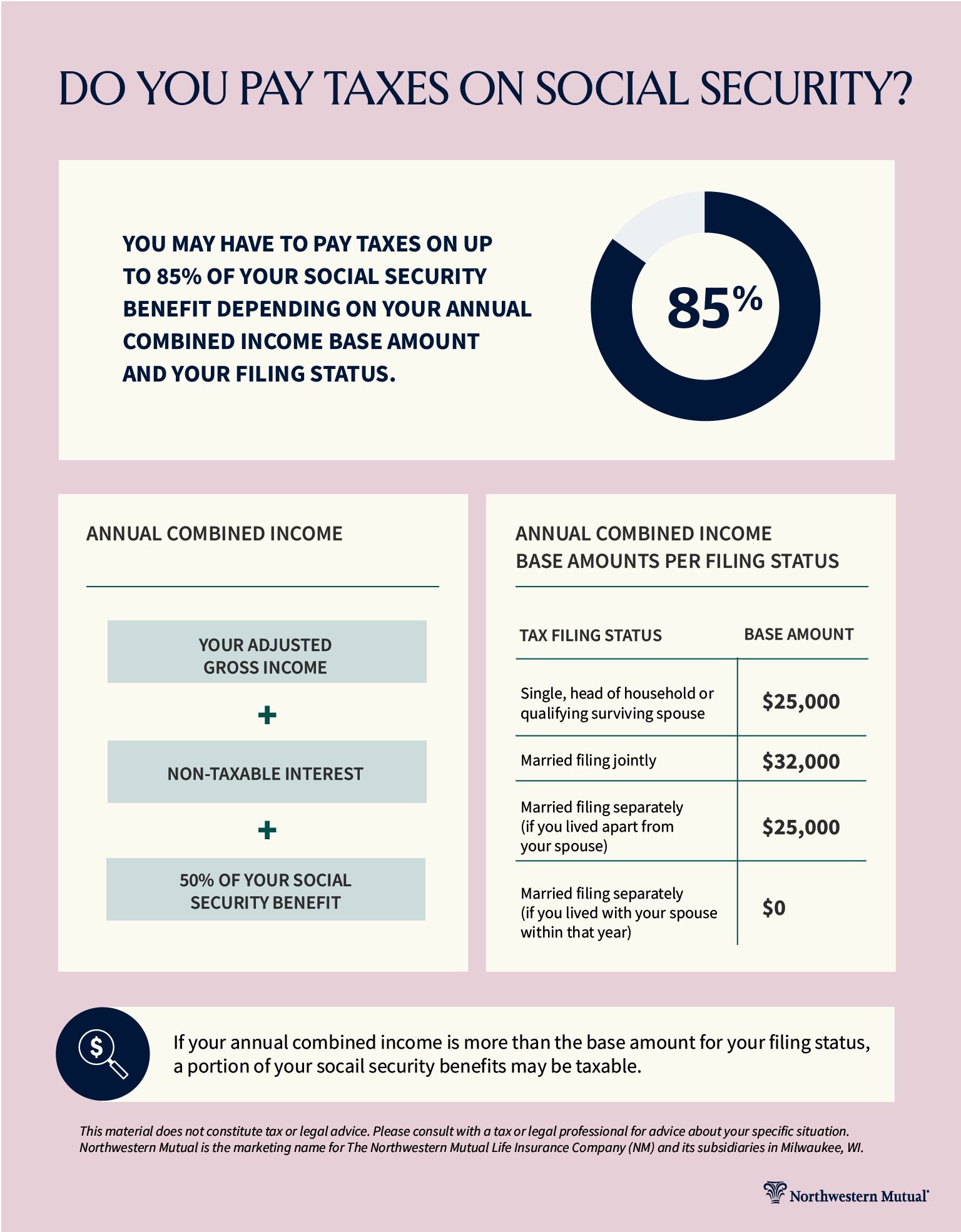
To determine if your benefits are taxable, the IRS looks at your combined income. This is a unique calculation that differs from your standard Adjusted Gross Income (AGI). The formula is as follows:
Combined Income = Adjusted Gross Income + Nontaxable Interest + ½ of Your Social Security Benefits.
By including nontaxable interest (such as interest from municipal bonds), the IRS ensures that high-net-worth individuals cannot shield their Social Security from taxation simply by shifting assets into tax-exempt vehicles.
Filing Status and Income Brackets
Once you have calculated your combined income, you must compare it against the base amounts for your filing status. The thresholds are currently set as follows:
- Individual Filers (Single, Head of Household, or Qualifying Widow/er):
- If your combined income is between $25,000 and $34,000, you may have to pay income tax on up to 50% of your benefits.
- If your combined income is more than $34,000, up to 85% of your benefits may be taxable.
- Joint Filers (Married Filing Jointly):
- If you and your spouse have a combined income between $32,000 and $44,000, you may have to pay income tax on up to 50% of your benefits.
- If your combined income is more than $44,000, up to 85% of your benefits may be taxable.
It is important to note that these thresholds have not been adjusted for inflation since they were implemented, meaning a growing number of retirees find themselves crossing these limits every year.
The Step-by-Step Calculation Process
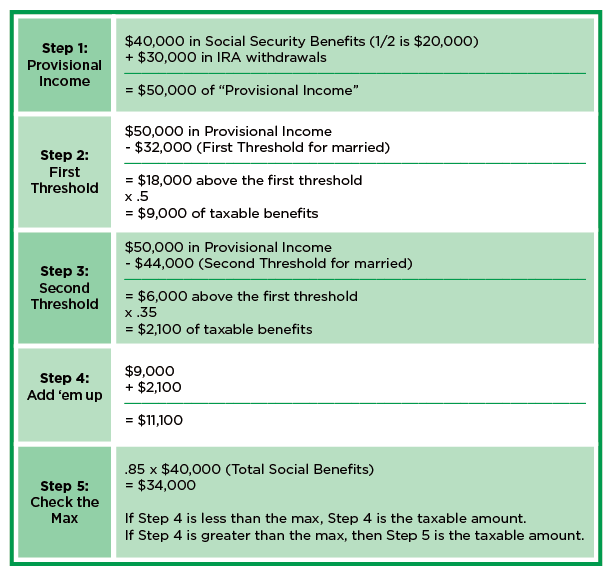
Calculating the exact dollar amount of taxable Social Security can be complex because it involves a “filling the buckets” approach. You do not simply multiply your total benefit by 50% or 85%; you apply the percentages to the portions of income that fall within specific ranges.
Step 1: Summing Your Adjusted Gross Income (AGI)
Start by calculating your AGI. This includes your wages (if you are still working), taxable pensions, interest, dividends, and capital gains. Basically, this is your total income before the standard deduction or any itemized deductions are applied. For many retirees, this stage involves totaling distributions from traditional IRAs or 401(k) plans.
Step 2: Adding Nontaxable Interest and Half of Your Benefits
Take the total amount of tax-exempt interest you received during the year (often found on Box 8 of Form 1099-INT) and add it to your AGI. Then, refer to your Form SSA-1099, which Social Security sends every January. Take the total amount in Box 5 (Net Benefits) and divide it by two. Add this “half-benefit” to your AGI and nontaxable interest. This final figure is your Combined Income.

Step 3: Applying the Tiered Brackets
If your combined income exceeds the first threshold ($25,000 for individuals / $32,000 for couples), you begin calculating the taxable portion.
- The 50% Tier: You take 50% of the income that falls between the first and second threshold.
- The 85% Tier: If you exceed the second threshold, you add 85% of the income above that limit to the amount calculated in the first tier.
The final result is compared to 85% of your total Social Security benefit. The IRS requires you to pay taxes on whichever amount is lower.
Determining the Percentage: The 50% and 85% Rules
A common point of confusion is the belief that 50% or 85% is the tax rate. In reality, these percentages represent the portion of the benefit that is added to your taxable income. That income is then taxed at your ordinary marginal income tax rate (e.g., 10%, 12%, 22%, etc.).
The 50% Rule for Moderate Earners
For those in the middle bracket, the taxation is relatively modest. If a single filer has a combined income of $30,000, only a fraction of their Social Security is being taxed. They are $5,000 over the base threshold. Under the 50% rule, $2,500 of their Social Security benefits would be added to their taxable income. If their marginal tax rate is 12%, they would owe $300 in taxes on their benefits.
The 85% Rule for Higher Earners
Once you cross the upper threshold ($34,000 for individuals / $44,000 for couples), the math becomes more aggressive. The IRS “captures” more of your benefit to ensure higher-income retirees contribute more to the tax base. Because the thresholds are so low, many middle-class retirees with modest 401(k) distributions quickly find themselves in the 85% category.
Practical Scenarios and the “Tax Torpedo”
The interaction between Social Security taxation and other income creates a “tax torpedo.” For example, if you are in the 85% range, taking an extra $1,000 out of your traditional IRA doesn’t just increase your taxable income by $1,000. It also makes an additional $850 of your Social Security benefits taxable. Suddenly, you are being taxed on $1,850 for only $1,000 of actual cash flow. This effectively pushes your marginal tax rate much higher than the bracket suggests.
Strategies to Minimize Tax Exposure on Benefits
Effective financial planning focuses on keeping your “combined income” below the thresholds or managing distributions to avoid the 85% tier. Because Social Security taxation is based on specific income types, you have several levers to pull.
Roth Conversions and Tax-Free Distributions
One of the most effective ways to lower your future taxable Social Security is to utilize Roth IRAs. Distributions from a Roth IRA are not included in your AGI, nor are they included in the calculation for combined income. By converting traditional IRA funds to a Roth IRA before you begin claiming Social Security, you reduce the “required minimum distributions” (RMDs) that could otherwise push you into the 85% taxation bracket.
Strategic Withdrawal Sequencing
The order in which you tap into your accounts matters. If you have a mix of taxable brokerage accounts, tax-deferred IRAs, and tax-free Roth accounts, you can “bracket manage.” In years where you need extra cash for a large purchase (like a car or a home renovation), you should draw from the Roth account. This provides the cash you need without increasing your combined income, thus keeping your Social Security taxation stable.
Qualified Charitable Distributions (QCDs)
For retirees over age 70½, Qualified Charitable Distributions are a powerful tool. A QCD allows you to donate up to $105,000 (as of 2024) directly from your IRA to a qualified charity. This distribution counts toward your RMD but is not included in your AGI. By lowering your AGI, you lower your combined income, which can potentially drop you from the 85% tier to the 50% tier, or even make your Social Security benefits entirely tax-free.
Conclusion: Integrating Tax Logic into Your Financial Plan
Calculating taxable Social Security is more than a mathematical exercise; it is a fundamental part of wealth preservation. For the modern retiree, the goal is not just to maximize the gross benefit received from the Social Security Administration, but to maximize the net benefit after the IRS takes its share.
By understanding the “combined income” formula and the thresholds of $25,000/$32,000 and $34,000/$44,000, you can make informed decisions about when to work, when to draw from retirement accounts, and how to structure your charitable giving. While the rules may seem punitive, proactive tax planning—such as utilizing Roth accounts and being mindful of the 85% rule—can help you navigate the complexities of retirement finance and keep more of your hard-earned benefits in your pocket.
aViewFromTheCave is a participant in the Amazon Services LLC Associates Program, an affiliate advertising program designed to provide a means for sites to earn advertising fees by advertising and linking to Amazon.com. Amazon, the Amazon logo, AmazonSupply, and the AmazonSupply logo are trademarks of Amazon.com, Inc. or its affiliates. As an Amazon Associate we earn affiliate commissions from qualifying purchases.