
In the world of finance, numbers tell a story. Whether you are tracking the performance of a stock portfolio, evaluating the health of a startup, or managing your personal savings, the ability to quantify progress is essential. Growth percentage is the primary metric used to translate raw data into actionable insights. It allows investors and business owners to strip away the noise of absolute figures and understand the underlying momentum of their financial endeavors.
Understanding how to calculate growth percentage—and more importantly, how to interpret it—is a fundamental skill for anyone looking to build wealth or scale a commercial enterprise. This guide explores the mathematical foundations, the nuances of different growth metrics, and the strategic applications of these figures in the realm of money and finance.
Understanding the Fundamentals of Growth Percentage in Finance
At its core, a growth percentage represents the change in value of a specific metric over a defined period, expressed as a fraction of the initial value. In finance, this could refer to revenue, net profit, share price, or the total value of an investment account.
The Basic Growth Formula
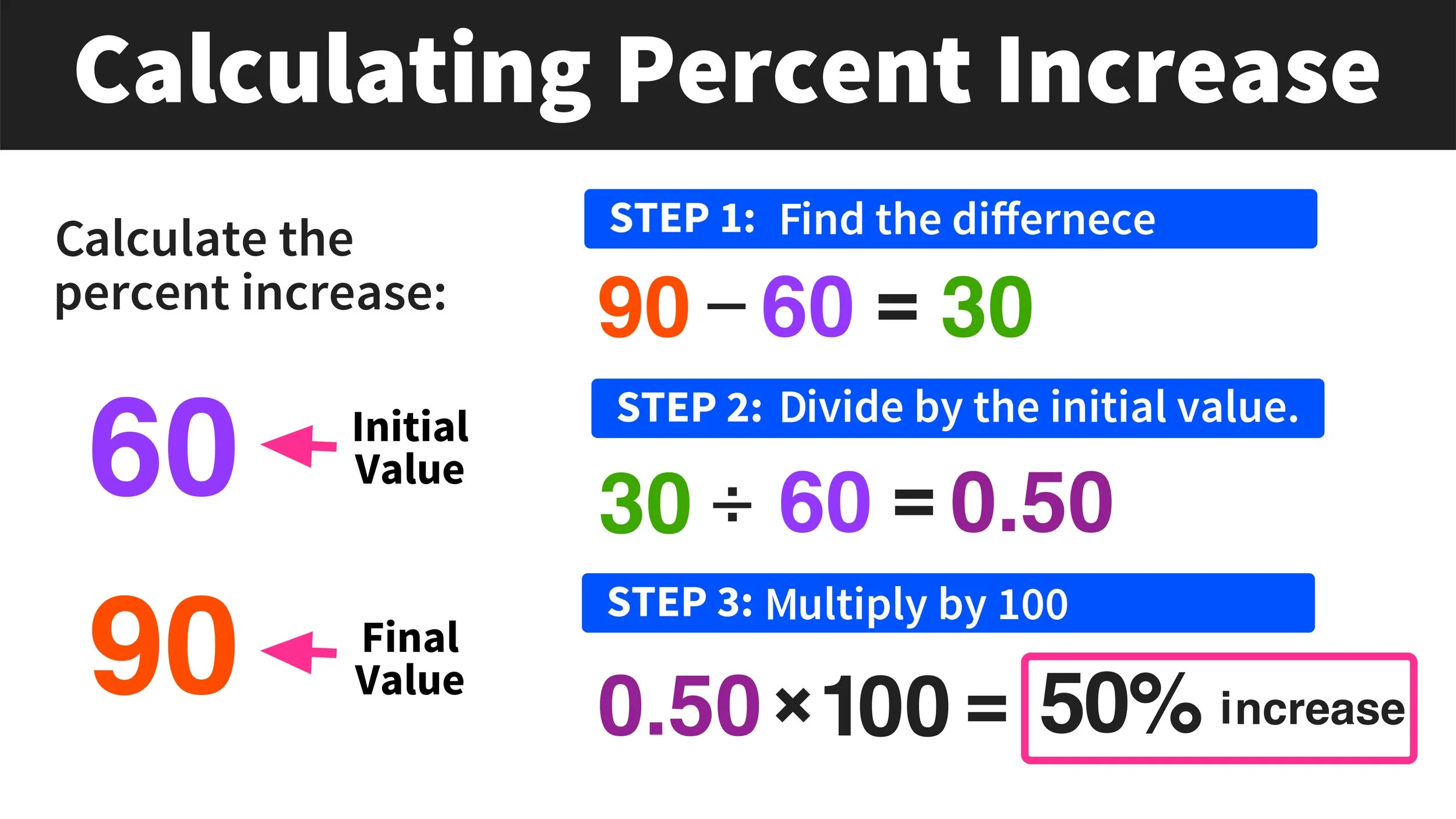
The mathematical formula for calculating growth percentage is straightforward, yet it serves as the building block for nearly every complex financial model. To find the percentage increase or decrease, you use the following equation:
((Current Value – Original Value) / Original Value) * 100 = Growth Percentage
For example, if a business earned $100,000 in revenue last year and $125,000 this year, the calculation would be (($125,000 – $100,000) / $100,000) * 100. This results in a 25% growth rate. If the result is negative, it indicates a contraction or loss.
Why Growth Percentage Matters for Your Net Worth
In personal finance, tracking growth percentage is often more revealing than tracking the total balance of your accounts. A $5,000 gain on a $50,000 portfolio (10% growth) is significantly more impressive than a $5,000 gain on a $500,000 portfolio (1% growth). By focusing on percentages, you can compare the efficiency of different asset classes—such as real estate versus equities—on an equal playing field. It helps you identify where your capital is working the hardest and where it might be stagnating.
Measuring Business Performance: Revenue and Profit Growth
For business owners and corporate analysts, growth percentages are the “vital signs” of a company. They indicate whether a business is capturing market share, improving operational efficiency, or facing systemic decline.
Year-Over-Year (YoY) vs. Month-Over-Month (MoM)
When analyzing business growth, the timeframe you choose is critical.
- Year-Over-Year (YoY): This compares a period against the same period in the previous year (e.g., Q3 2023 vs. Q3 2022). YoY growth is the gold standard for financial reporting because it accounts for seasonality. For a retail business, comparing December sales to November sales might show massive growth, but comparing December to the previous December reveals whether the business is truly expanding.
- Month-Over-Month (MoM): This is used for high-growth startups or businesses in volatile markets. While MoM growth shows immediate momentum, it can be misleading due to short-term fluctuations or external events (like a one-time marketing boost).
Identifying Organic vs. Inorganic Growth
In business finance, it is vital to distinguish how the growth percentage was achieved.
- Organic Growth refers to the increase in output or sales achieved through the company’s own internal processes, such as expanding the customer base or launching new products.
- Inorganic Growth results from external factors, such as mergers or acquisitions.
If a company shows a 50% growth in revenue but achieved it solely by buying a competitor, the “growth percentage” might look impressive on a balance sheet, but the operational efficiency of the original business may not have improved at all. Understanding this distinction is key to making sound investment decisions.
Investment Growth: Evaluating Portfolio Success
For the individual investor, calculating growth isn’t just about looking at a single number; it’s about understanding the velocity of wealth accumulation over time.

Calculating Return on Investment (ROI)
ROI is the most common application of growth percentage in the investing world. It measures the gain or loss generated on an investment relative to the amount of money invested. The formula is identical to the basic growth formula but specifically focuses on the “cost of investment” as the denominator.
However, simple ROI can be deceptive because it doesn’t account for the time the money was tied up. A 50% return is fantastic if it takes one year, but much less impressive if it takes twenty years.
Compound Annual Growth Rate (CAGR)
To solve the “time problem” in investment growth, professional investors use the Compound Annual Growth Rate (CAGR). CAGR provides a smoothed annual growth rate, representing the geometric progression ratio that provides a constant rate of return over the time period.
The formula for CAGR is:
[(Ending Value / Beginning Value)^(1 / Number of Years)] – 1
CAGR is essential for comparing the performance of different investments over different time horizons. It allows an investor to see through the “volatility” of year-to-year swings and understand the “true” annual growth their capital is achieving.
Accounting for Inflation and Real Growth
A common mistake in financial planning is focusing on “nominal” growth rather than “real” growth. If your investment portfolio grew by 5% last year, but inflation was 6%, your purchasing power actually decreased by 1%. To calculate real growth percentage, you must subtract the inflation rate from your nominal growth rate. In the world of money, protecting the purchasing power of your capital is just as important as increasing the numerical value of your accounts.
Common Pitfalls and How to Interpret the Data
While the math behind growth percentage is simple, the interpretation can be fraught with errors. Being aware of these pitfalls is what separates a novice from a sophisticated financial analyst.
The Problem with Small Base Numbers
The “Law of Small Numbers” often skews growth percentages. If a side hustle makes $10 in its first month and $100 in its second month, the growth percentage is a staggering 900%. However, this doesn’t necessarily mean the business is a unicorn; it simply means it started from a very small base. Conversely, a multi-billion dollar corporation growing at 5% is generating significantly more absolute value than the small business growing at 900%. When evaluating growth, always look at the absolute dollar amounts alongside the percentages to maintain perspective.
Distinguishing Between Growth and Profitability
In the modern economy, particularly in the venture capital space, “growth” is often prioritized over “profit.” A company might show a 100% growth in revenue (top-line growth) while its losses are also doubling (bottom-line decline). For an investor, a high growth percentage is only sustainable if there is a clear path to profitability. Calculating the “Growth-to-Burn” ratio is a more advanced way to see if the cost of acquiring that growth is worth the percentage increase on the spreadsheet.
Leveraging Growth Calculations for Future Financial Planning
Calculating growth isn’t just about looking backward; it’s about projecting forward. Financial tools and models rely on historical growth data to predict future outcomes.
Setting Realistic Financial Benchmarks
By calculating your historical personal savings growth or your business’s average annual revenue increase, you can set realistic benchmarks for the future. If your average growth over the last five years has been 7%, projecting a 20% growth for next year requires a significant change in strategy, not just “hope.” These calculations provide a reality check for your financial goals.

Using Growth Projections for Budgeting and Reinvestment
For business finance, understanding your growth percentage is the key to effective budgeting. If you know your revenue is growing at a consistent 15% YoY, you can confidently budget for new hires, equipment upgrades, or marketing spend. In personal finance, knowing your portfolio’s CAGR allows you to use the “Rule of 72” (dividing 72 by your growth rate) to estimate how long it will take for your money to double. This insight is invaluable for retirement planning and long-term wealth strategy.
In conclusion, the ability to calculate and analyze growth percentage is the cornerstone of financial literacy. It moves the conversation from “How much money do I have?” to “How effectively is my money growing?” Whether you are looking at the performance of a single stock, the scaling of a global brand, or the trajectory of your personal savings, mastering these calculations ensures that your financial decisions are based on data, not intuition. In the pursuit of financial freedom and business excellence, the growth percentage is the most reliable compass you have.
aViewFromTheCave is a participant in the Amazon Services LLC Associates Program, an affiliate advertising program designed to provide a means for sites to earn advertising fees by advertising and linking to Amazon.com. Amazon, the Amazon logo, AmazonSupply, and the AmazonSupply logo are trademarks of Amazon.com, Inc. or its affiliates. As an Amazon Associate we earn affiliate commissions from qualifying purchases.