
The stock market is often depicted in popular media as a chaotic floor of shouting traders or a flashing screen of green and red numbers. While these images capture the energy of the financial world, they rarely explain the underlying engine that powers the global economy. At its core, the stock market is a sophisticated marketplace where ownership in public companies is bought and sold. It is a vital component of the modern financial ecosystem, serving as a bridge between corporations in need of capital and investors seeking to grow their wealth.

Understanding the stock market is not just for Wall Street professionals; it is a fundamental pillar of personal finance. Whether through a 401(k), an Individual Retirement Account (IRA), or a personal brokerage account, most individuals participate in the stock market to secure their financial future. This article provides an in-depth exploration of how the market functions, why it exists, and how investors can navigate its complexities to build long-term prosperity.
The Foundation: Understanding the Mechanics of the Stock Market
To grasp what the stock market is, one must first understand the concept of “equity.” When a company wants to expand—perhaps to build a new factory, develop a new product, or hire more staff—it needs capital. One way to raise this money is to sell a piece of the company to the public. This process is known as an Initial Public Offering (IPO). Once a company “goes public,” its shares are traded on an exchange, and it becomes a “publicly traded company.”
The Role of Stock Exchanges
A stock exchange is the physical or digital infrastructure where the actual trading happens. The most famous examples include the New York Stock Exchange (NYSE) and the NASDAQ. These exchanges act as regulated marketplaces that ensure fair and orderly trading. They provide liquidity, which is the ability to buy or sell a stock quickly without causing a significant change in its price. Without these centralized hubs, finding a buyer for your shares would be a monumental task.
Primary vs. Secondary Markets
It is important to distinguish between the primary and secondary markets. The primary market is where securities are created. This is where the IPO happens, and the money paid by investors goes directly to the company. The secondary market is what we usually refer to as “the stock market.” In this arena, investors trade shares among themselves. When you buy a share of a major tech company today, you are likely buying it from another investor who wants to sell, not from the company itself.
Price Discovery and Supply and Demand
The price of a stock is determined by the laws of supply and demand. If more people want to buy a stock (demand) than sell it (supply), the price goes up. Conversely, if more people want to sell than buy, the price goes down. This “price discovery” mechanism is influenced by a multitude of factors, including company earnings, economic data, interest rates, and investor sentiment.
Navigating the Landscape: Different Types of Stocks and Market Sectors
Not all stocks are created equal. To build a balanced portfolio, an investor must understand the different categories of equities and how they behave under various economic conditions.
Market Capitalization
Market capitalization (or “market cap”) is the total dollar value of a company’s outstanding shares. It is calculated by multiplying the current share price by the total number of shares. Stocks are generally divided into three main tiers:
- Large-Cap: Companies with a market cap of $10 billion or more. These are typically established, “Blue Chip” companies with a history of stability.
- Mid-Cap: Companies with a market cap between $2 billion and $10 billion. These offer a balance between growth potential and stability.
- Small-Cap: Companies with a market cap between $300 million and $2 billion. These are often younger companies with high growth potential but higher risk and volatility.
Growth vs. Value Investing
Investors often categorize stocks based on their financial characteristics. Growth stocks are companies expected to grow at a rate significantly above the average for the market. These companies usually reinvest their earnings into expansion rather than paying dividends. Value stocks, on the other hand, are companies that appear to be trading for less than their intrinsic worth. They are often older, established companies that pay consistent dividends.
Understanding Sectors
The stock market is divided into 11 GICS (Global Industry Classification Standard) sectors, such as Information Technology, Healthcare, Financials, and Energy. Different sectors react differently to the economic cycle. For example, the Consumer Staples sector (companies selling essentials like food and soap) tends to remain stable during a recession, while the Technology sector might see more volatility but higher growth during economic expansions.
The Power of Participation: Why the Stock Market is Essential for Financial Growth
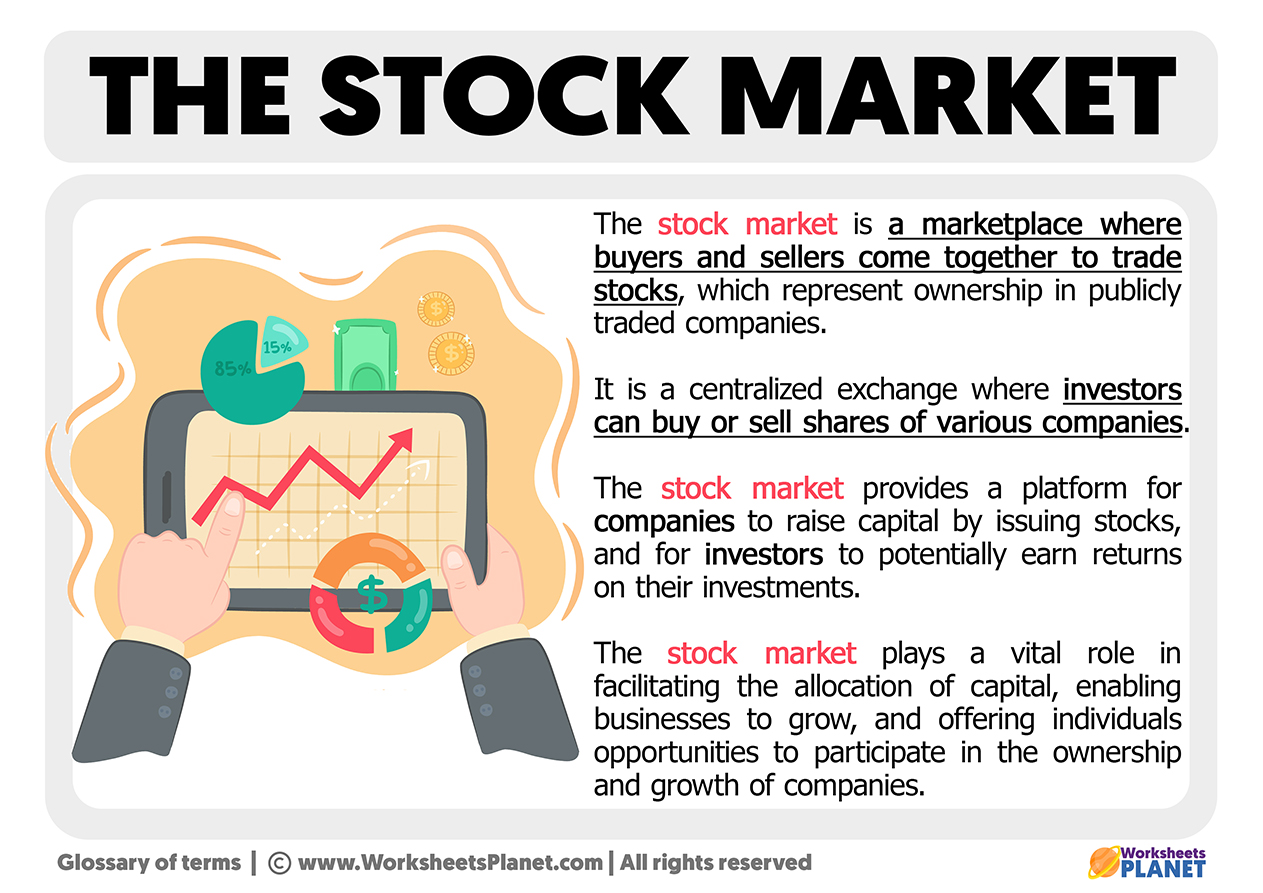
The stock market is perhaps the greatest wealth-generating machine in history. For the average individual, it offers a path to financial independence that is difficult to achieve through a traditional savings account alone.
The Miracle of Compounding
The primary reason to invest in the stock market is the power of compounding. Compounding occurs when your investment earnings are reinvested to generate their own earnings. Over decades, this creates an exponential growth curve. A modest monthly investment can grow into a significant nest egg over 30 years because you are earning interest on your interest.
Hedging Against Inflation
Inflation is the silent killer of purchasing power. If you leave your money in a cash savings account earning 0.5% while inflation is at 3%, you are effectively losing money every year. Historically, the stock market has provided an average annual return of roughly 7% to 10% (after adjusting for inflation). This makes equity investing one of the most effective ways to ensure your money retains and increases its value over time.
Ownership and Passive Income
Buying a stock means you are a partial owner of a business. As an owner, you are entitled to a share of the profits. Many companies distribute these profits to shareholders in the form of dividends. This creates a stream of passive income, which can be particularly valuable during retirement. Even if the stock price remains flat, the dividend payments provide a tangible return on investment.
Managing Risk: Navigating Volatility and Market Cycles
While the potential for reward is high, the stock market is not without risk. Understanding and managing this risk is the difference between a successful investor and one who loses their capital.
Volatility vs. Risk
It is crucial to distinguish between volatility and permanent loss of capital. Volatility refers to the price swings—the ups and downs—that happen daily. For a long-term investor, volatility is a feature of the market, not a bug. Risk, however, is the possibility that an investment will lose its value and never recover.
The Importance of Diversification
The most effective way to mitigate risk is through diversification. This is the financial equivalent of “not putting all your eggs in one basket.” By spreading your investments across different companies, sectors, and geographic regions, you reduce the impact of any single failure. If one company in your portfolio goes bankrupt, but you own 49 others, your overall wealth remains largely intact.
Market Cycles: Bulls and Bears
The market moves in cycles. A “Bull Market” is a period of rising prices and investor optimism. A “Bear Market” is a period where prices fall by 20% or more from recent highs, often accompanied by fear and economic downturns. History shows that bull markets last significantly longer than bear markets, and the market has recovered from every single downturn it has ever faced. The key for the investor is emotional discipline—resisting the urge to sell when prices are low.
Strategy for Success: How to Start Your Investment Journey
Starting in the stock market can feel overwhelming, but modern technology and financial tools have made it more accessible than ever before.
Choosing a Brokerage and Account Type
The first step is opening a brokerage account. Today, many platforms offer commission-free trading and user-friendly interfaces. Beyond the platform, you must choose the right account type. Tax-advantaged accounts like the 401(k) or Roth IRA offer significant tax benefits that can accelerate your wealth-building.
Active vs. Passive Investing
Investors must decide on their approach. Active investing involves picking individual stocks in an attempt to “beat the market.” This requires significant research and time. Passive investing involves buying index funds or Exchange-Traded Funds (ETFs) that track the performance of the entire market, such as the S&P 500. For most people, passive investing is the more effective strategy, as it provides instant diversification and has historically outperformed the majority of professional stock pickers.

The Long-Term Mindset
The final and most important component of a successful stock market strategy is a long-term perspective. The stock market is not a “get rich quick” scheme. It is a tool for long-term capital appreciation. Successful investors focus on “time in the market” rather than “timing the market.” By staying invested through the highs and lows, and consistently adding to your positions, you leverage the full power of the global economy to build lasting wealth.
In conclusion, the stock market is a complex but rewarding system that offers everyone the opportunity to own a piece of the world’s most successful companies. By understanding its mechanics, diversifying your holdings, and maintaining a disciplined, long-term approach, you can transform the stock market from a source of confusion into a powerful engine for your personal financial freedom.
aViewFromTheCave is a participant in the Amazon Services LLC Associates Program, an affiliate advertising program designed to provide a means for sites to earn advertising fees by advertising and linking to Amazon.com. Amazon, the Amazon logo, AmazonSupply, and the AmazonSupply logo are trademarks of Amazon.com, Inc. or its affiliates. As an Amazon Associate we earn affiliate commissions from qualifying purchases.