
In the world of investing, few things are as unsettling as logging into a brokerage account and seeing a sea of red. For many investors, the immediate question is “Why are stocks falling today?” While the stock market is often viewed as a singular entity, it is actually a complex ecosystem influenced by millions of variables, ranging from high-level geopolitical shifts to minute changes in corporate guidance.
Market volatility is an inherent part of the wealth-creation process, yet understanding the catalysts behind a downturn can provide the clarity needed to make rational decisions rather than emotional ones. When the market dips, it is rarely due to a single isolated event; rather, it is usually a confluence of macroeconomic pressures, shifts in monetary policy, and changes in investor sentiment.
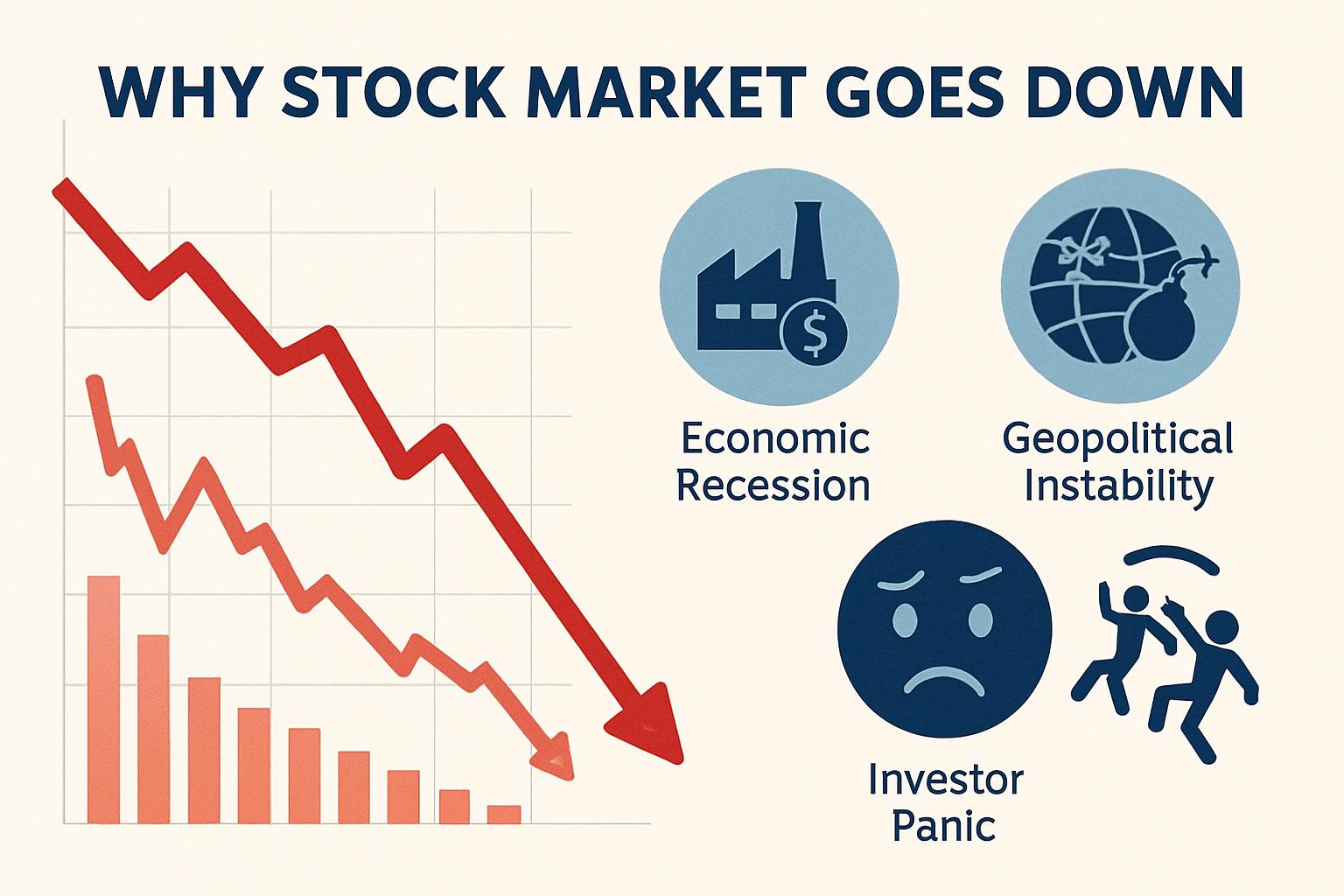
The Role of Macroeconomic Pressures and Monetary Policy
The most common drivers of widespread market sell-offs are macroeconomic indicators that signal a shift in the health of the broader economy. Because the stock market is a forward-looking mechanism, it attempts to price in future conditions months in advance. When those conditions look unfavorable, prices adjust downward almost instantly.
Inflation and the Consumer Price Index (CPI)
Inflation is perhaps the most significant “silent killer” of stock market gains. When the Consumer Price Index (CPI) reveals that prices for goods and services are rising faster than expected, investors get nervous. High inflation erodes the purchasing power of consumers, which can lead to lower sales for corporations. Furthermore, inflation increases the cost of raw materials and labor, squeezing corporate profit margins. If companies cannot pass these costs onto consumers, their earnings suffer, leading to a decline in stock prices.
Interest Rate Decisions by the Federal Reserve
In the United States, the Federal Reserve (the “Fed”) holds the most powerful levers for influencing the market. To combat inflation, the Fed raises the federal funds rate. Higher interest rates are essentially “gravity” for stock prices. When rates rise, it becomes more expensive for companies to borrow money to fund expansion. Additionally, higher rates make fixed-income assets, like Treasury bonds, more attractive relative to risky stocks. When an investor can get a guaranteed 5% return on a bond, they are less likely to gamble on a volatile stock, leading to a rotation out of equities and into safer havens.
The Impact of Rising Bond Yields
There is an inverse relationship between bond prices and yields. When bond yields rise—often in anticipation of Fed rate hikes—it creates a valuation problem for stocks, particularly in the technology and growth sectors. Most stock valuations are based on the “discounted cash flow” model, which calculates the present value of future earnings. When the “discount rate” (influenced by bond yields) goes up, the present value of those future earnings goes down. This is why “today’s” market often falls sharply even if a company is currently profitable.
Corporate Earnings and Sector-Specific Headwinds
While the “macro” environment sets the stage, “micro” factors—the performance of individual companies—provide the specifics. Earnings season, which occurs four times a year, is a period of heightened volatility where the fundamental health of Corporate America is put on display.
Disappointing Guidance and the “Earnings Miss”
Stock prices are built on expectations. If a company reports strong profits for the previous quarter but issues “weak guidance” (a forecast that future sales or profits will be lower than analysts expected), the stock will likely plummet. Investors buy stocks for what they will do tomorrow, not what they did yesterday. When bellwether companies in the S&P 500 or Nasdaq-100 warn of slowing growth, it can drag down the entire sector as investors fear a systemic slowdown.
Supply Chain Disruptions and Input Costs
Modern corporations rely on complex, globalized supply chains. Any disruption—be it a port strike, a shortage of semiconductors, or a spike in shipping costs—directly impacts the bottom line. If a major retailer or manufacturer reports that they are struggling to get products to market, it signals to investors that inventory levels will be low and sales will be lost. These logistical bottlenecks are frequently cited during market downturns as a reason for reduced profitability.
The Valuation Reset
Sometimes, stocks fall simply because they became too expensive. During “bull markets,” euphoria can drive stock prices far beyond their intrinsic value, leading to high Price-to-Earnings (P/E) ratios. Eventually, the market undergoes a “mean reversion” or a “valuation reset.” This is a healthy, albeit painful, process where prices fall back in line with historical norms and actual earnings potential.
Geopolitical Uncertainty and Global Market Sentiment

Markets hate uncertainty more than they hate bad news. When the geopolitical landscape becomes unstable, investors often adopt a “risk-off” mentality, selling equities and moving into “safe-haven” assets like gold or the U.S. Dollar.
Trade Wars and Regulatory Changes
International trade is the lifeblood of many large-cap stocks. When tensions rise between major economies—such as the U.S. and China—it often results in tariffs or trade restrictions. These policies increase costs for businesses and limit their total addressable market. Similarly, unexpected regulatory crackdowns on specific industries (like big tech or energy) can cause a localized sell-off that eventually spills over into the broader market as institutional investors rebalance their portfolios.
Energy Prices and Global Conflict
Energy is a primary input for almost every sector of the economy. When geopolitical conflicts arise in oil-producing regions, energy prices tend to spike. This creates a double-edged sword: it increases the cost of transportation and manufacturing (inflationary) and reduces the amount of discretionary income consumers have to spend on other goods. A sharp rise in crude oil prices is historically a precursor to market volatility and, in some cases, economic recession.
The “Contagion” Effect
In our interconnected global economy, a crisis in one region can quickly spread to others. If a major foreign bank fails or a sovereign nation defaults on its debt, it can trigger a “contagion” effect. Global investors, sensing systemic risk, may sell off assets across all regions to preserve liquidity, leading to a simultaneous drop in indices from New York to Tokyo.
Market Psychology and Technical Indicators
Not all market moves are based on fundamental data. Often, stocks fall because of the way investors—and the algorithms they use—react to price movement itself.
Panic Selling and the “Fear Index” (VIX)
The CBOE Volatility Index, or VIX, is often called the “Fear Gauge.” It measures the market’s expectation of 30-day volatility. When the VIX spikes, it indicates that investors are buying “put options” to protect themselves against further drops. This often creates a feedback loop: as prices fall, fear increases; as fear increases, more people sell; and as more people sell, prices fall further. Panic selling is a psychological phenomenon where the desire to “stop the bleeding” overrides long-term investment logic.
Algorithmic Trading and Stop-Loss Cascades
A significant portion of daily trading volume is now driven by high-frequency trading (HFT) and algorithms. These systems are often programmed to sell when certain technical levels are broken. For example, if the S&P 500 falls below a key “support level,” like its 200-day moving average, it can trigger a wave of automated sell orders. This can cause “flash crashes” or accelerated downturns that seem disconnected from any specific news event.
Margin Calls and Liquidity Crunches
When markets fall, investors who have borrowed money to buy stocks (trading on margin) may receive “margin calls” from their brokers. To meet these calls, they are forced to sell their holdings immediately. This forced selling adds downward pressure on prices. In extreme cases, this can lead to a liquidity crunch where everyone is selling and few are buying, causing prices to “gap down” rapidly.
Navigating the Dip: Strategies for Investors
While a falling market is stressful, it is also where the most significant long-term gains are often seeded. Understanding why the market is falling is the first step; deciding how to react is the second.
The Importance of a Long-Term Perspective
Historically, the stock market has a 100% recovery rate from every downturn, recession, and depression it has ever faced. For an investor with a time horizon of 10, 20, or 30 years, today’s “crash” is often just a blip on a long-term chart. Reviewing your original investment thesis is crucial. If the reasons you bought a stock or fund haven’t changed—if the company is still profitable and the management is still competent—then a price drop is a market fluctuation, not a permanent loss of capital.
Dollar-Cost Averaging (DCA)
One of the most effective ways to handle a falling market is through dollar-cost averaging. By investing a fixed amount of money at regular intervals, you naturally buy more shares when prices are low and fewer shares when prices are high. This removes the need to “time the bottom,” which is nearly impossible even for professional traders. In a down market, DCA allows you to lower your average cost basis, positioning you for greater gains when the market eventually recovers.
Rebalancing and Tax-Loss Harvesting
A market downturn is an excellent time to rebalance your portfolio to ensure your asset allocation aligns with your risk tolerance. Furthermore, it provides an opportunity for “tax-loss harvesting.” This involves selling losing positions to offset capital gains in other areas, thereby reducing your tax liability. This is a proactive way to find “silver linings” in a red market, turning a paper loss into a strategic financial advantage.
In conclusion, when you ask “why are stocks falling today,” remember that the answer is usually a blend of math and mood. While interest rates and earnings provide the math, investor fear and geopolitical uncertainty provide the mood. By staying informed and maintaining a disciplined strategy, you can navigate these periods of volatility without losing sight of your ultimate financial goals.
aViewFromTheCave is a participant in the Amazon Services LLC Associates Program, an affiliate advertising program designed to provide a means for sites to earn advertising fees by advertising and linking to Amazon.com. Amazon, the Amazon logo, AmazonSupply, and the AmazonSupply logo are trademarks of Amazon.com, Inc. or its affiliates. As an Amazon Associate we earn affiliate commissions from qualifying purchases.