
Navigating the complexities of the tax calendar is a fundamental pillar of sound personal finance and business management. For many, the mention of “tax season” evokes a sense of urgency, yet understanding the specific timelines involved is crucial to maintaining liquidity and avoiding unnecessary fiscal erosion through penalties. Whether you are an individual filer, a freelance entrepreneur, or a corporate entity, knowing exactly how long you have to pay your taxes—and what happens if you miss those windows—is essential for long-term financial health.

This guide explores the standard deadlines set by the Internal Revenue Service (IRS), the strategic use of extensions, and the various mechanisms available for those who find themselves unable to meet their obligations by the traditional filing date.
Understanding the Standard Federal Deadlines
The bedrock of the American tax system is the annual filing deadline, but this date is not as static as it might seem. While “April 15” is etched into the public consciousness, the actual timeline depends on the calendar year and your specific tax classification.
Individual Income Tax Deadlines
For the vast majority of individual taxpayers, the deadline to file Form 1040 and pay any remaining tax liability is April 15. However, if the 15th falls on a Saturday, Sunday, or a legal holiday (such as Emancipation Day in Washington, D.C.), the deadline is pushed to the next business day.
It is important to view this date not just as a paperwork deadline, but as a “payment maturity date.” Even if you are waiting for certain documents to arrive, the IRS expects the treasury to be made whole for the previous year’s earnings by this mid-April cutoff.
Quarterly Estimated Payments for Freelancers and Businesses
For those in the “Money” sector—investors, side-hustlers, and small business owners—the once-a-year mindset is a dangerous oversight. The U.S. tax system is a “pay-as-you-go” system. If you expect to owe more than $1,000 in taxes for the year, you are generally required to make quarterly estimated tax payments.
These payments are typically due on:
- April 15 (Quarter 1)
- June 15 (Quarter 2)
- September 15 (Quarter 3)
- January 15 of the following year (Quarter 4)
Failure to adhere to these mid-year deadlines can result in underpayment penalties, even if you pay the full balance by the following April. From a cash-flow management perspective, treating these dates as fixed overhead is vital for maintaining business solvency.
The Strategic Use of Tax Extensions
In the world of finance, an extension is often misunderstood as a “delay of payment.” In reality, a federal tax extension is merely a delay in the submission of paperwork. Understanding this distinction is the difference between a savvy financial move and a costly mistake.
How to Apply for an Extension (Form 4868)
By filing Form 4868 by the April deadline, individual taxpayers can receive an automatic six-month extension to file their returns, pushing the paperwork deadline to October 15. This is particularly useful for investors with complex portfolios, such as those involved in private equity or K-1 distributions, where third-party data may arrive late.
The application process is straightforward and does not require a reason or excuse; as long as the form is submitted on time, the extension is granted. However, the “Money” focus here is on the financial implications of that extra time.
The Critical Distinction: Extension to File vs. Extension to Pay
This is perhaps the most important caveat in tax planning: An extension of time to file is not an extension of time to pay.
When you submit Form 4868, you are expected to estimate your total tax liability and pay as much of it as possible by the original April deadline. If you file for an extension but do not send a payment for the estimated balance due, the IRS will begin charging interest and late-payment penalties starting from the original April date.
For high-net-worth individuals and business owners, the strategy should be to “over-estimate” and pay early to avoid these costs, then settle the exact figures during the extended filing window in October.
Consequences of Missing the Deadline: Penalties and Interest

The financial cost of procrastination is high. The IRS employs a multi-tiered penalty system designed to incentivize timely filing and payment. For anyone managing a budget or a business ledger, these costs represent “bad debt” that should be avoided at all costs.
Failure-to-File vs. Failure-to-Pay Penalties
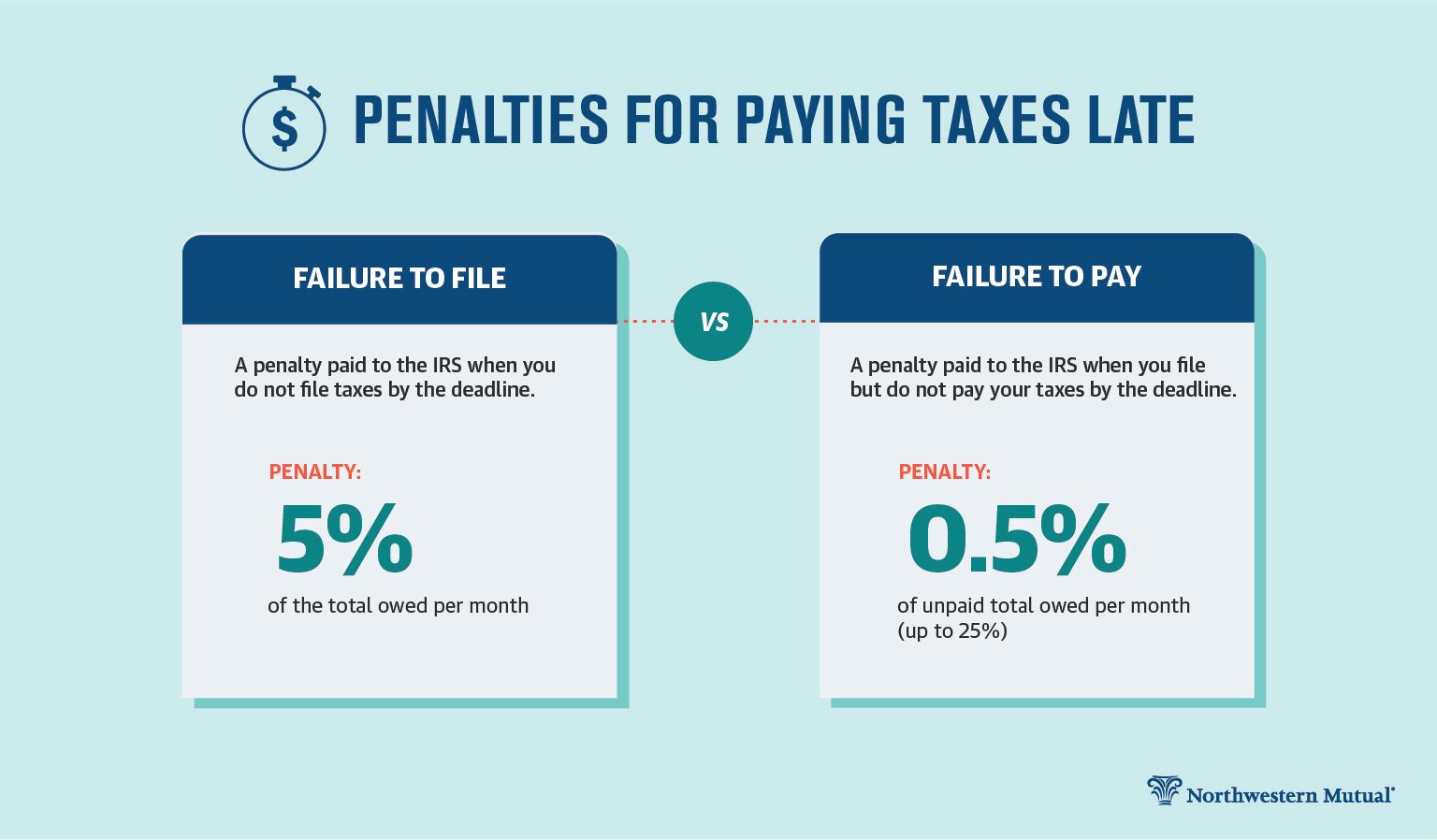
If you miss the deadline, you face two distinct types of penalties. The “Failure-to-File” penalty is generally much more severe than the “Failure-to-Pay” penalty.
- Failure-to-File: This penalty is usually 5% of the unpaid taxes for each month or part of a month that a tax return is late. This can climb to a maximum of 25% of your unpaid taxes.
- Failure-to-Pay: This penalty is 0.5% of the unpaid taxes for each month or part of a month the tax remains unpaid.
The lesson for the financially savvy is clear: Even if you cannot afford to pay your tax bill in full, you should still file your return on time. By filing the paperwork, you eliminate the 5% monthly penalty, leaving you only with the much smaller 0.5% monthly interest on the debt.
How Interest Accrues on Unpaid Balances
Beyond penalties, the IRS charges underpayment interest. This rate is adjusted quarterly and is typically the federal short-term rate plus 3%. Unlike some forms of consumer debt, IRS interest is compounded daily. In an environment of fluctuating interest rates, carrying a tax debt can become exponentially more expensive than securing a traditional bank loan or using a line of credit to settle the balance.
Solutions When You Can’t Pay on Time
Financial setbacks are a reality for many businesses and individuals. If you find yourself approaching the deadline without the necessary liquidity to settle your tax bill, the IRS offers several “Financial Tools” to manage the debt without triggering aggressive collection actions like wage garnishments or tax liens.
IRS Installment Agreements and Payment Plans
For those who owe a manageable amount (generally under $50,000 for individuals), the IRS offers Online Payment Agreements.
- Short-term Payment Plans: These give you up to 180 days to pay the liability in full, including interest and accrued penalties.
- Long-term Installment Agreements: These allow for monthly payments over a period of up to 72 months.
While interest still accrues during these plans, the failure-to-pay penalty is often halved while the plan is active. This is a vital tool for business finance management, allowing a company to preserve working capital while slowly chipping away at tax debt.
Offer in Compromise (OIC) and “Currently Not Collectible” Status
In cases of extreme financial hardship, the IRS may allow an “Offer in Compromise.” This is a negotiation where the taxpayer settles their tax debt for less than the full amount owed. The IRS considers the taxpayer’s ability to pay, income, expenses, and asset equity.
Additionally, if a taxpayer can prove that paying the tax would prevent them from meeting basic living expenses, the IRS may label the account “Currently Not Collectible.” While this stops collection activities, it does not erase the debt; interest continues to accrue, and the IRS will review the taxpayer’s income annually to see if their financial status has improved.
State-Level Obligations and Regional Variations
While federal taxes follow a centralized timeline, state taxes introduce another layer of complexity. For those managing multi-state business operations or remote work setups, keeping track of these variations is critical.
Aligning Federal and State Filing Dates
Most states align their income tax deadlines with the federal April 15 date to simplify the process for taxpayers. However, this is not a universal rule. For example, states like Delaware or Iowa have occasionally utilized different schedules.
Furthermore, some states offer different extension periods. While you might get six months from the IRS, your state might only offer four. If you live in a state with no income tax—such as Texas, Florida, or Washington—your focus remains solely on the federal timeline, which significantly simplifies your cash-flow forecasting.
Special Circumstances: Disaster Relief Extensions
One often-overlooked aspect of tax timing is the “Disaster Relief” provision. When the Federal Emergency Management Agency (FEMA) declares a disaster area (due to hurricanes, wildfires, or floods), the IRS frequently grants automatic extensions to residents and business owners in those regions. During these windows, taxpayers may have several additional months to both file and pay without incurring penalties. Staying informed through a financial advisor or the IRS “Tax Relief in Disaster Situations” portal can provide much-needed breathing room during a crisis.
Conclusion: Mastering the Tax Timeline
How long you have to pay your taxes is ultimately determined by your preparation and your proactive communication with tax authorities. While the April deadline is the primary milestone, the use of quarterly payments, filing extensions, and structured payment plans provides a degree of flexibility.
In the realm of personal and business finance, time is literally money. By respecting these deadlines, filing even when funds are low, and utilizing IRS payment tools when necessary, you can protect your assets from the eroding effects of penalties and interest. Precision in tax timing is not just about compliance; it is a hallmark of sophisticated financial management.
aViewFromTheCave is a participant in the Amazon Services LLC Associates Program, an affiliate advertising program designed to provide a means for sites to earn advertising fees by advertising and linking to Amazon.com. Amazon, the Amazon logo, AmazonSupply, and the AmazonSupply logo are trademarks of Amazon.com, Inc. or its affiliates. As an Amazon Associate we earn affiliate commissions from qualifying purchases.