
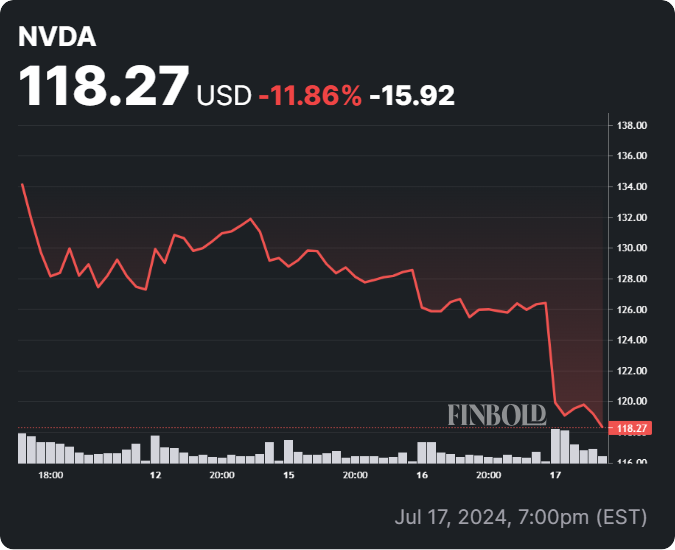
In the modern financial landscape, few tickers command as much attention as NVDA. As the poster child for the artificial intelligence revolution, NVIDIA Corporation has transitioned from a niche graphics card manufacturer to a trillion-dollar titan that dictates the rhythm of the S&P 500 and the Nasdaq-100. However, even the most meteoric ascents are met with periods of turbulence. When investors see NVIDIA’s price flashing red, the immediate reaction is often one of confusion: how can the leader of the AI era be down?
The answer is rarely found in a single news event. Instead, a decline in NVDA is usually the result of a complex interplay between macroeconomic shifts, valuation mechanics, and geopolitical tensions. To understand why NVDA is down, one must look beyond the company’s high-performance silicon and analyze the broader financial ecosystem in which it operates.
1. Macroeconomic Pressures and Interest Rate Sensitivity
NVIDIA is classified as a “growth stock,” a category of equities where the majority of the company’s value is derived from its projected future earnings rather than its current cash flow. In the world of finance, these future earnings are sensitive to the “discount rate,” which is heavily influenced by the Federal Reserve’s monetary policy.
The Role of the Federal Reserve and Yields
When the Federal Reserve maintains high interest rates or signals a “higher-for-longer” stance, it creates a headwind for growth stocks like NVIDIA. Higher rates increase the cost of borrowing for businesses and consumers, but more importantly, they make the present value of future profits less attractive. If an investor can get a guaranteed 5% return on a 10-year Treasury note, they are less likely to pay a premium for a high-risk tech stock. Consequently, when Treasury yields spike, NVDA often faces downward pressure as capital rotates into safer, fixed-income assets.
Inflationary Fears and Consumer Spending
While NVIDIA’s primary revenue driver is currently its Data Center segment, it still maintains a significant presence in the gaming and professional visualization markets. Persistent inflation can erode the discretionary income of consumers, leading to a slowdown in GPU upgrades. On a corporate level, if inflation forces NVIDIA’s enterprise clients to tighten their belts, the aggressive capital expenditure (CapEx) currently being funneled into AI infrastructure might be scrutinized, leading to fears of a slowdown in demand.
2. The “Priced for Perfection” Dilemma
One of the most common reasons for a dip in NVDA’s share price is the sheer weight of expectation. When a company experiences a rally of several hundred percent over a short period, the market begins to “price in” flawless execution for years to come. This creates a scenario where even objectively “good” news can lead to a stock sell-off.
Earnings Expectations vs. Reality
In recent quarters, NVIDIA has consistently beaten analyst estimates for both revenue and earnings per share (EPS). However, professional investors don’t just look at the past; they look at the “beat and raise.” If NVIDIA reports record-breaking profits but provides guidance for the next quarter that is only “in line” with expectations rather than significantly above them, the stock may drop. This is often referred to as a “whisper number” phenomenon, where the market expects more than what official analysts project.
Valuation and Profit-Taking
From a fundamental perspective, NVIDIA often trades at a high Price-to-Earnings (P/E) ratio. While this is justified by its triple-digit growth rates, it makes the stock vulnerable to mean reversion. When NVDA reaches an all-time high, institutional investors—such as hedge funds and pension funds—often engage in “profit-taking.” By selling a portion of their winners to lock in gains, they create a surplus of sell orders, which naturally drives the price down. This isn’t necessarily a reflection of the company’s health, but rather a routine part of portfolio rebalancing.
3. Geopolitical Headwinds and Regulatory Scrutiny
As a global leader in semiconductor technology, NVIDIA is frequently caught in the crosshairs of international trade disputes and regulatory oversight. Because NVIDIA’s chips are considered dual-use technology (valuable for both civilian AI and military applications), they are a focal point of national security policy.
Export Restrictions and the China Market
A significant portion of NVIDIA’s historical revenue has come from China. The U.S. Department of Commerce has implemented several rounds of export controls, preventing NVIDIA from selling its most advanced AI chips, such as the H100 and Blackwell architectures, to Chinese entities. While NVIDIA has attempted to create compliant, “slimmed-down” versions of these chips, the risk remains that further restrictions could permanently impair its access to one of the world’s largest tech markets. Investors react sharply to any news suggesting a tightening of these trade barriers.
Antitrust Concerns and Market Dominance
NVIDIA’s dominance in the AI chip market—estimated by some analysts to be over 80%—has drawn the attention of regulators in the U.S., the E.U., and the U.K. Reports of antitrust investigations into whether NVIDIA bundles its hardware with software (like the CUDA platform) to stifle competition can lead to investor jitters. Regulatory battles are expensive, time-consuming, and can lead to structural changes in how a company operates, making any hint of a “Department of Justice” probe a catalyst for a price decline.
4. Sector Rotation and the Cyclical Nature of Chips
The stock market often moves in cycles, with capital flowing between different sectors based on the economic outlook. Even if NVIDIA is performing exceptionally well, it may be sold off simply because it is no longer the “flavor of the month” for institutional money managers.
Rotation from Growth to Value
There are periods when investors rotate out of high-flying technology stocks and into “value” sectors like energy, utilities, or consumer staples. This usually happens when the market anticipates an economic slowdown or when tech valuations become too stretched relative to the rest of the market. During these rotations, NVDA can see significant outflows regardless of its individual corporate performance, as it is used as a “source of funds” for investors to buy into undervalued sectors.
The “AI Fatigue” Narrative
The market is prone to hype cycles. After years of relentless focus on Generative AI, some investors may begin to question the “Return on Investment” (ROI) for the companies buying NVIDIA’s chips. If software giants and cloud providers (like Microsoft, Google, and Meta) cannot demonstrate how AI is translating into their own bottom-line profits, the market may fear a “CapEx air pocket”—a period where these companies stop ordering new chips until they’ve utilized their current inventory. Any data point suggesting a cooling in AI spending can send NVDA shares lower.
5. Technical Indicators and Market Structure
Finally, it is essential to recognize that the stock market is not always a rational reflection of fundamental value; it is also a massive system of automated trades and technical patterns.
Breach of Key Support Levels
Traders often look at moving averages (such as the 50-day or 200-day moving averages) to determine the trend of a stock. If NVDA breaks below a key “support level”—a price point where buyers have historically stepped in—it can trigger a wave of automated selling. Stop-loss orders are executed, and momentum-following algorithms flip from “long” to “short,” accelerating the downward move.
Options Market Dynamics
NVIDIA is one of the most actively traded stocks in the options market. Large volumes of “call options” (bets that the stock will go up) can lead to a phenomenon called a “gamma squeeze” on the way up, but the reverse is also true. If the stock starts to slide, market makers who sold those options must sell the underlying shares to hedge their risk, creating a feedback loop of selling pressure.
Conclusion: Perspective for the Investor
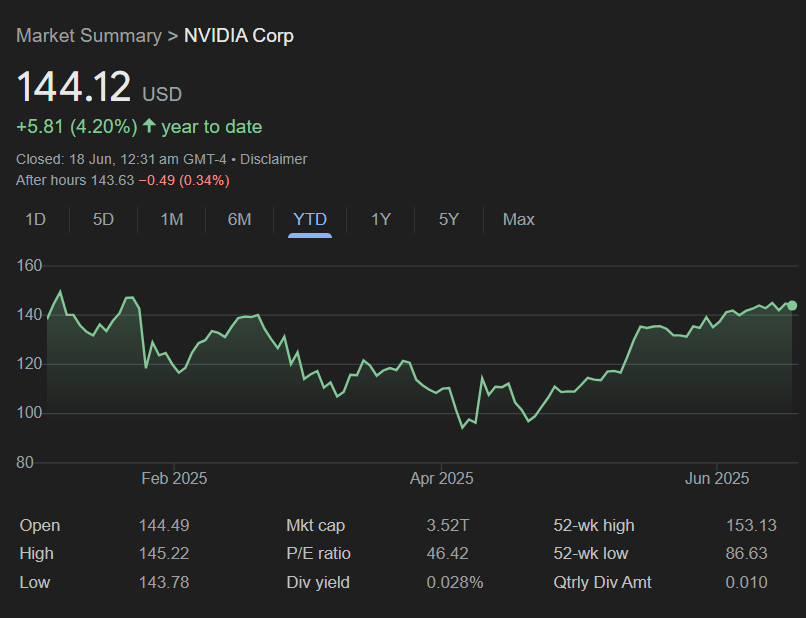
Seeing NVDA in the red can be unsettling, especially given its role as a cornerstone of the modern portfolio. However, for the disciplined investor, understanding why the stock is down is more important than the price drop itself. Most declines in NVIDIA are driven by external factors—macroeconomics, geopolitical posturing, or simple market mechanics—rather than a failure of the company’s core business model.
NVIDIA remains the primary architect of the hardware that powers the AI era. While volatility is the “price of admission” for owning high-growth semiconductor stocks, these periods of decline often serve as necessary cooling-off periods, resetting valuations and shaking out speculative “weak hands” before the next leg of the long-term cycle. For those focused on the “Money” aspect of investing, the key is to distinguish between a temporary market fluctuation and a permanent change in the company’s ability to generate cash. As of now, NVDA’s challenges are largely a byproduct of its own incredible success and the complex global environment in which it thrives.
aViewFromTheCave is a participant in the Amazon Services LLC Associates Program, an affiliate advertising program designed to provide a means for sites to earn advertising fees by advertising and linking to Amazon.com. Amazon, the Amazon logo, AmazonSupply, and the AmazonSupply logo are trademarks of Amazon.com, Inc. or its affiliates. As an Amazon Associate we earn affiliate commissions from qualifying purchases.