
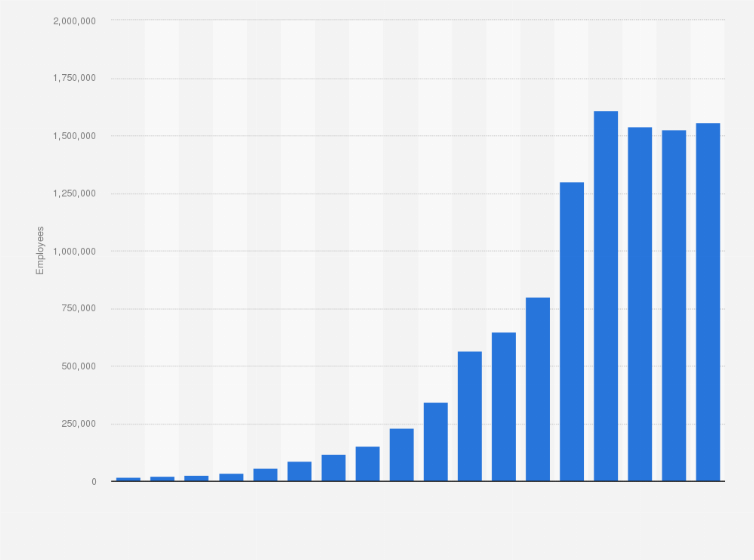
In the landscape of global commerce, few metrics are as staggering as the headcount of Amazon.com, Inc. As of recent filings, the company employs approximately 1.5 million people globally. To put this into perspective, if Amazon were a city, it would be the tenth-largest in the United States, sitting comfortably between San Jose and Austin. However, for investors, financial analysts, and business strategists, the question of how many people Amazon employs is not merely a trivia point—it is a critical indicator of the company’s operational efficiency, capital allocation strategy, and long-term fiscal health.

In the realm of business finance, labor represents both the greatest engine of growth and the most significant variable cost. For Amazon, managing a workforce of this magnitude is a balancing act between the “Day 1” philosophy of relentless expansion and the “Day 2” reality of margin compression and logistical friction.
Decoding the Numbers: The Global Scale of Amazon’s Human Capital
Amazon’s employment figures are not static. They represent a dynamic response to consumer demand, global supply chain health, and the aggressive expansion of the company’s physical footprint. Understanding the breakdown of these numbers is essential for grasping the sheer financial weight the company carries.
The Peak-Season Surge and Seasonal Fluctuations
One of the unique financial characteristics of Amazon’s workforce is its elasticity. During the “Peak” season—spanning from Prime Day through the December holidays—Amazon’s headcount often swells significantly. The company frequently hires hundreds of thousands of seasonal workers to manage the surge in logistics. From a financial perspective, this represents a massive temporary increase in operating expenses (OPEX). While these workers are essential for capturing top-line revenue during the busiest shopping periods, the cost of recruiting, training, and off-boarding this transient workforce is a recurring line item that analysts watch closely to determine the company’s seasonal profitability.
Geographical Distribution: Beyond the US Borders
While the United States remains the primary hub for Amazon’s operations, employing over one million people domestically, the international expansion into markets like India, the UK, and Germany has created a massive global payroll. Each of these regions presents unique financial challenges, from varying labor laws and minimum wage requirements to the fluctuating costs of employee benefits. In India, for example, Amazon has invested billions of dollars into its fulfillment network, creating hundreds of thousands of jobs as it attempts to capture the burgeoning e-commerce market in South Asia. This geographic diversification is a hedge against regional economic downturns but also introduces currency risk and complex tax implications to the company’s consolidated financial statements.
The Financial Weight of a 1.5 Million-Strong Workforce
In the world of corporate finance, labor is often viewed through the lens of efficiency. For a company like Amazon, which operates on relatively thin margins in its retail segment, the management of human capital is directly tied to its stock valuation and cash flow.
Labor Costs as a Percentage of Revenue
For most retail and logistics companies, labor is the single largest operating expense. Amazon is no exception. As the company has expanded its “Last Mile” delivery network—the process of bringing a package from a local hub to a customer’s door—it has moved away from third-party carriers like UPS and FedEx. While this gives Amazon more control over the customer experience, it shifts the financial burden of labor directly onto its own balance sheet. The multibillion-dollar quarterly payroll reflects a strategic decision to trade capital for control, a move that only a company with Amazon’s massive revenue streams can afford.
The Efficiency Ratio: Revenue per Employee
A key metric for evaluating the health of a tech-heavy business is the “Revenue per Employee” ratio. Historically, tech giants like Google or Meta boast incredibly high revenue-per-employee figures because their products (software and ads) require relatively little human intervention to scale. Amazon is a hybrid. While its Amazon Web Services (AWS) division mirrors the high-efficiency model of Big Tech, its retail and fulfillment divisions are labor-intensive. When Amazon’s headcount grows faster than its revenue—as seen during the post-pandemic adjustment period—the revenue-per-employee ratio drops, signaling to investors that the company may be over-leveraged in its human capital.

Automation vs. Human Capital: A Capital Expenditure Shift
The most significant financial narrative regarding Amazon’s workforce today is the tension between human labor and robotic automation. To maintain its competitive edge and protect its margins, Amazon is increasingly moving toward a future where capital expenditure (CAPEX) in technology replaces the variable cost of labor.
Investing in Robotics to Offset Labor Inflation
Wage inflation is a persistent reality in the global economy. As Amazon has pushed for a $15 minimum wage (and higher in many regions), it has simultaneously accelerated its investment in Amazon Robotics. By deploying hundreds of thousands of robotic units across its fulfillment centers, the company is attempting to “de-risk” its operations from the rising cost of human labor. From a business finance perspective, this is a shift from variable costs (wages) to fixed costs (robotics hardware and software). While the upfront investment is massive, the long-term ROI is found in increased throughput, 24/7 operational capability, and the elimination of human-centric costs like healthcare, insurance, and turnover.
The Financial Trade-off of the “Last Mile”
While robots can navigate a warehouse floor with ease, the “last mile” of delivery remains a human-dominated sector. Amazon’s “Delivery Service Partner” (DSP) program is a clever financial structure that allows the company to expand its workforce without technically adding every driver to its own official headcount. By incentivizing small business owners to run delivery fleets exclusively for Amazon, the company offloads some of the liability and administrative costs associated with thousands of drivers. This “gig-adjacent” model is a strategic financial tool designed to maintain the speed of a massive workforce while mitigating the direct financial overhead of a traditional employment model.
Economic Impact and the Macro-Finance of Amazon’s Growth
Amazon’s status as a “mega-employer” means that its internal financial decisions have external macroeconomic consequences. The company does not just respond to the market; it moves it.
Influencing Minimum Wage and Regional Labor Markets
When Amazon enters a new region by opening a fulfillment center, it often becomes the largest employer in that area almost overnight. By setting a high internal minimum wage, Amazon effectively forces other local businesses to raise their wages to compete for talent. This phenomenon, often called the “Amazon Effect” on labor, can lead to increased consumer spending power in those regions but also places financial pressure on small-to-medium enterprises (SMEs). For Amazon, this is a strategic move to secure the “lion’s share” of the available labor pool, ensuring their logistics machine never grinds to a halt due to staffing shortages.
Implications for Shareholders and Long-term Valuation
For shareholders, the headcount is a double-edged sword. On one hand, a growing workforce is a sign of an expanding business and increasing market share. On the other hand, a 1.5 million-person payroll is a massive liability in the event of an economic downturn. During the tech “right-sizing” of 2023, Amazon conducted its largest layoffs in history, cutting roughly 27,000 corporate roles. This move was viewed favorably by the market as a sign of fiscal discipline. It demonstrated that even a company as large as Amazon must prioritize “operating leverage”—the ability to grow revenue faster than expenses.
Conclusion: The Scale of Ambition
How many people Amazon employs is a number that tells the story of the modern global economy. It is a story of unprecedented scale, the complexities of human logistics, and the relentless pursuit of efficiency through technology.
From a money and business finance perspective, Amazon is more than just a store; it is a massive capital allocation experiment. By managing a workforce larger than the populations of many countries, Amazon is testing the limits of how much a single corporate entity can manage. Whether through the seasonal hiring of hundreds of thousands or the multi-billion dollar pivot toward robotics, Amazon’s employment strategy remains the primary driver of its financial destiny. As the company continues to evolve, its ability to balance the cost of its human capital against the efficiency of its technological investments will ultimately determine its position in the hierarchy of the world’s most valuable companies.
aViewFromTheCave is a participant in the Amazon Services LLC Associates Program, an affiliate advertising program designed to provide a means for sites to earn advertising fees by advertising and linking to Amazon.com. Amazon, the Amazon logo, AmazonSupply, and the AmazonSupply logo are trademarks of Amazon.com, Inc. or its affiliates. As an Amazon Associate we earn affiliate commissions from qualifying purchases.