
Navigating the world of personal finance often feels like deciphering a complex puzzle, where the most critical piece is understanding your monthly obligations. Whether you are eyeing a new home, considering a sleek vehicle, or planning to consolidate debt with a personal loan, the ability to accurately calculate a monthly payment is an essential financial literacy skill. It moves you from a position of uncertainty to a position of power, allowing you to budget with precision and avoid the pitfalls of over-leveraging your income.
In this comprehensive guide, we will explore the mechanics of debt repayment, the mathematical formulas that govern your loans, and the strategic considerations that help you integrate these payments into a healthy financial lifestyle.
Understanding the Fundamentals of Loan Structures
Before diving into the mathematics, it is vital to understand the components that dictate the size of a monthly payment. Every loan is a combination of three primary variables, and changing any one of them will have a ripple effect on your monthly cash flow.
The Principal Amount
The principal is the raw amount of money you borrow from a lender. If you buy a car for $30,000 and provide a $5,000 down payment, your principal loan amount is $25,000. The principal is the foundation of your monthly payment; the higher it is, the more you will owe each month, regardless of other factors. Reducing the principal through a larger down payment is often the most effective way to lower a monthly obligation before the loan even begins.
Interest Rates: Fixed vs. Variable
The interest rate is essentially the cost of “renting” the lender’s money. Expressed as an Annual Percentage Rate (APR), it determines how much extra you pay for the privilege of borrowing.
- Fixed Rates: These remain constant throughout the life of the loan, providing predictability. Your first payment and your last payment will be identical.
- Variable Rates: Also known as adjustable rates, these can fluctuate based on market benchmarks (like the Federal Prime Rate). While they may start lower than fixed rates, they introduce an element of risk, as your monthly payment could rise significantly over time.
Loan Term and Its Impact on Total Cost
The term is the duration you have to pay back the loan, usually expressed in months or years. While it may be tempting to opt for a longer term (like a 72-month car loan or a 30-year mortgage) to achieve a lower monthly payment, this decision comes at a price. A longer term means you will be paying interest for a longer period, significantly increasing the total cost of the asset. Conversely, a shorter term increases your monthly payment but drastically reduces the total interest paid.
The Mathematics of Repayment: Breaking Down the Formula
While online calculators are ubiquitous, understanding the underlying formula provides clarity on how your money is being distributed between interest and principal reduction.
The Standard Amortization Formula
Most installment loans (mortgages, car loans, personal loans) use an amortization schedule. The formula to calculate the monthly payment ($M$) is:
$M = P [ i(1 + i)^n ] / [ (1 + i)^n – 1 ]$
Where:
- $P$ = Principal loan amount
- $i$ = Monthly interest rate (Annual rate divided by 12)
- $n$ = Number of months (Loan term)
By looking at this formula, you can see that the interest is compounded monthly. In the early stages of a loan, a larger portion of your monthly payment goes toward interest. As the principal balance decreases, the interest portion of the payment shrinks, and more of your money goes toward paying off the actual debt.
Calculating Simple Interest vs. Compound Interest
It is important to distinguish between simple interest and compound interest. Simple interest is calculated only on the principal amount, whereas compound interest—which most modern loans use—is calculated on the principal plus any accumulated interest. This is why credit card debt can spiral out of control; if you do not pay the balance in full, you begin paying interest on your interest. Understanding this distinction helps you prioritize which debts to pay off first.
Practical Example: Calculating a Car Loan
Let’s apply the formula to a real-world scenario. Imagine you take out a $20,000 car loan at a 6% annual interest rate for 60 months (5 years).
- $P$ = $20,000
- $i$ = 0.06 / 12 = 0.005
- $n$ = 60

Plugging these into the formula results in a monthly payment of approximately $386.66. Over the life of this loan, you would pay a total of $23,199.60, meaning the “cost” of the loan was $3,199.60 in interest.
Managing Different Types of Debt Payments
Not all monthly payments are created equal. Depending on the type of debt, there may be additional costs hidden within that single monthly check.
Mortgage Payments: Taxes and Insurance (PITI)
When calculating a mortgage payment, the “Principal and Interest” are only half the story. Most homeowners must account for PITI: Principal, Interest, Taxes, and Insurance.
- Taxes: Property taxes are often collected by the lender and held in an escrow account.
- Insurance: Homeowners insurance and, if your down payment was less than 20%, Private Mortgage Insurance (PMI) are also added to the monthly total.
When using a monthly payment calculator for a home, always ensure you include these “extras,” as they can easily add several hundred dollars to your monthly commitment.
Credit Card Minimums and Revolving Debt
Unlike installment loans with a fixed end date, credit cards are “revolving debt.” The monthly payment is usually a small percentage of the total balance (often 1% to 3%) or a flat minimum fee. Calculating this payment is dangerous because if you only pay the minimum, the interest will continue to accrue on the remaining balance. To truly manage revolving debt, your “monthly payment” should be calculated based on your goal to reach a zero balance within a specific timeframe, rather than the minimum the bank requests.
Personal and Student Loans
Personal loans often have fixed terms and higher interest rates than secured loans (like car or home loans) because there is no collateral. Student loans, meanwhile, often offer various repayment plans—such as income-driven repayment—where the monthly payment is calculated based on your discretionary income rather than the loan balance. It is vital to understand which calculation method your lender is using to avoid surprises.
Utilizing Tools and Strategies for Faster Debt Repayment
Once you know how to calculate your payment, the next step is learning how to manipulate those numbers in your favor.
Digital Calculators and Spreadsheet Templates
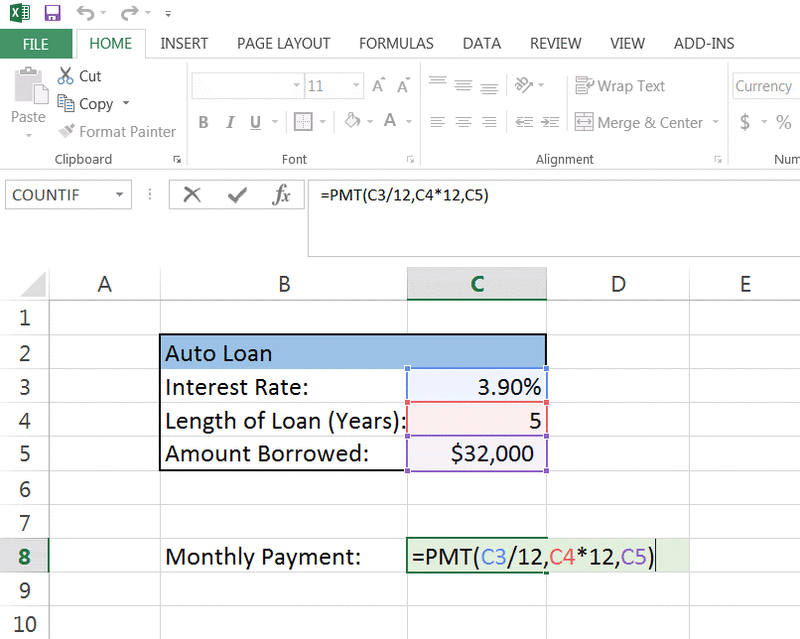
While the manual formula is great for understanding the “why,” digital tools are best for the “how.” Software like Microsoft Excel or Google Sheets offers built-in functions like =PMT(rate, nper, pv) that allow you to run “what-if” scenarios. You can quickly see how an extra $50 a month affects your loan’s lifespan or how a 1% difference in interest rate changes your long-term wealth.
The Power of Extra Principal Payments
One of the most effective ways to change your financial trajectory is to pay more than the calculated monthly payment. By designating extra funds toward the principal, you bypass the interest calculation for that portion of the debt. On a 30-year mortgage, making just one extra payment per year can shave years off the loan and save tens of thousands of dollars in interest.
Refinancing as a Monthly Payment Solution
If market interest rates drop or your credit score improves significantly, you might recalculate your monthly payment through refinancing. This involves taking out a new loan to pay off the old one, ideally at a lower interest rate. However, you must factor in “closing costs” or “origination fees” to ensure that the monthly savings actually outweigh the cost of getting the new loan.
Integrating Monthly Payments into Your Long-Term Financial Strategy
Calculating a payment is a mathematical exercise; affording it is a strategic one. Your monthly payments should exist within the context of a broader financial plan.
The Debt-to-Income (DTI) Ratio
Lenders use the DTI ratio to determine your creditworthiness, but you should use it to determine your comfort level. To calculate your DTI, divide your total monthly debt payments by your gross monthly income.
- 36% or less: Generally considered a healthy debt load.
- 43%: Often the maximum DTI allowed for a qualified mortgage.
- 50% or more: A danger zone where a small financial emergency could lead to insolvency.
When calculating a new monthly payment, always check how it will shift your DTI.

Budgeting Frameworks for Debt Management
A popular method for managing monthly payments is the 50/30/20 rule:
- 50% of income goes to Needs (housing, utilities, minimum debt payments).
- 30% of income goes to Wants.
- 20% of income goes to Savings and extra debt repayment.
By calculating your monthly payments accurately, you can see if your “Needs” category is becoming bloated. If your calculated payments for a car and a home exceed 50% of your take-home pay, you are “house poor” or “car poor,” meaning you have the asset but lack the financial flexibility to enjoy life or save for the future.
In conclusion, knowing how to calculate a monthly payment is about more than just numbers on a screen. It is about understanding the cost of time, the price of borrowing, and the limits of your own income. By mastering these calculations and applying them with discipline, you can ensure that every dollar you spend on debt is a calculated step toward eventual financial freedom.
aViewFromTheCave is a participant in the Amazon Services LLC Associates Program, an affiliate advertising program designed to provide a means for sites to earn advertising fees by advertising and linking to Amazon.com. Amazon, the Amazon logo, AmazonSupply, and the AmazonSupply logo are trademarks of Amazon.com, Inc. or its affiliates. As an Amazon Associate we earn affiliate commissions from qualifying purchases.