
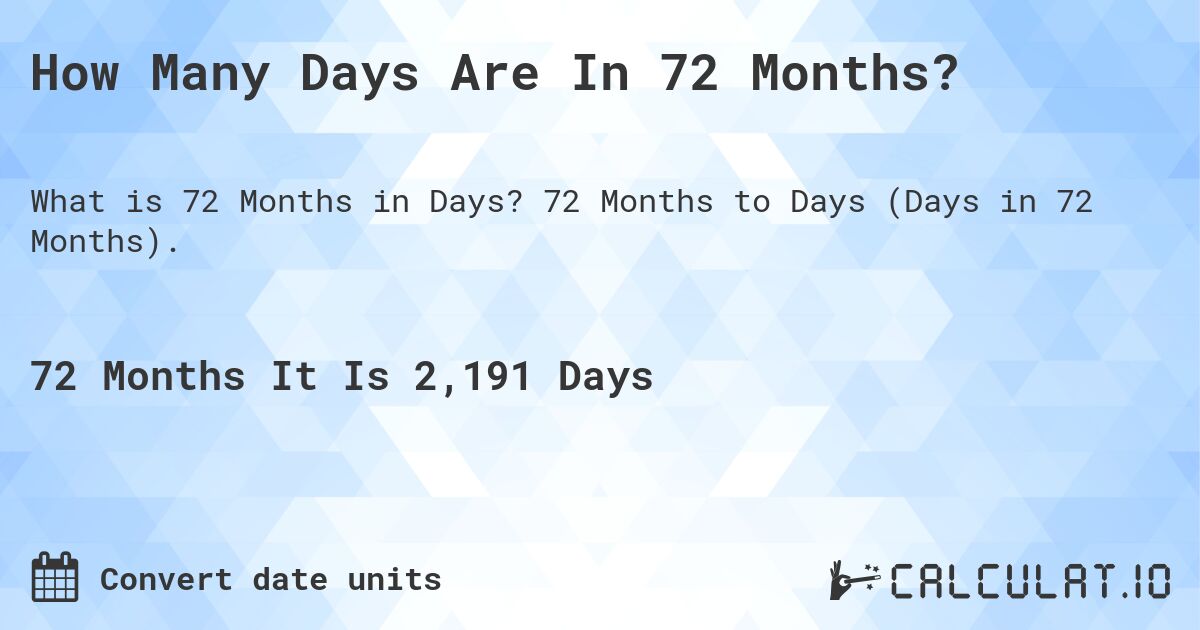
In the world of personal finance, the number 72 is appearing with increasing frequency. When a consumer asks, “How much is 72 months?” they are rarely asking for a calendar conversion. Instead, they are usually inquiring about the financial weight of a six-year commitment—most commonly in the context of an auto loan.
As vehicle prices and the cost of living have surged, the 72-month loan has shifted from an outlier to an industry standard. While a longer term makes a high-priced asset feel more affordable on a month-to-month basis, the true cost of 72 months is measured in thousands of dollars of interest, the risks of depreciation, and the long-term impact on your overall financial health.
Understanding the 72-Month Term in Modern Finance
The expansion of loan terms is a direct response to the widening gap between stagnant wages and the rising cost of consumer goods. To bridge this gap, financial institutions have extended the repayment window. Understanding the mechanics of these terms is essential for anyone looking to maintain a healthy balance sheet.
Why 72 Months Has Become the New Standard
Two decades ago, a 36-month or 48-month loan was the gold standard for vehicle financing. However, as the average price of a new car has climbed toward the $50,000 mark, the math of shorter loans has become difficult for the average household budget to absorb.
By stretching the repayment period to 72 months (six full years), lenders can offer a monthly payment that fits within a borrower’s cash flow. This shift is driven by a consumer focus on “monthly affordability” rather than “total cost of ownership.” Lenders are happy to oblige, as longer terms equate to more interest collected over the life of the loan.
The Psychology of the Monthly Payment
The “monthly payment trap” is a psychological phenomenon where borrowers prioritize their immediate bank balance over their long-term net worth. When a dealership or lender presents a 72-month option, they are selling a lifestyle today at the expense of your future financial flexibility.
By focusing on whether one can afford $500 a month, the borrower often overlooks the fact that they will be paying that $500 long after the “new car smell” has faded and the vehicle’s warranty has expired. This psychological framing is a key reason why 72-month and even 84-month loans have become the primary tools for modern consumer debt.
The Math Behind the 72-Month Loan: Principal vs. Interest
To truly answer “how much” 72 months is, we must look at the mathematical divergence between principal and interest. The longer a loan lasts, the more the amortization schedule is weighted toward interest in the early years.
The Impact of Compounding Interest Over Six Years
Interest is the price you pay for the privilege of using someone else’s money. In a 72-month loan, the interest has more time to accrue on the outstanding principal. Even if the interest rate (APR) remains the same, a 72-month loan will always be significantly more expensive than a 48-month loan.
For example, on a $35,000 loan at a 6% interest rate:
- A 48-month loan results in approximately $4,400 in total interest paid.
- A 72-month loan results in approximately $6,700 in total interest paid.
In this scenario, the extra two years of “affordability” costs the borrower an additional $2,300. This is capital that could have been invested in a Roth IRA or used to pay down higher-interest credit card debt.
Total Cost of Ownership: A Case Study
When evaluating “how much” 72 months is, one must calculate the Total Cost of Ownership (TCO). This includes the purchase price, interest, insurance, and maintenance. On a 72-month timeline, the maintenance costs often spike just as the loan is entering its final third.
By year five and six, vehicles typically require more significant repairs—new tires, brake rotors, or timing belts. Borrowers on a 72-month plan find themselves in a precarious position where they are paying high monthly loan installments while simultaneously facing the increased maintenance costs of an aging asset. This “double-dipping” into the consumer’s pocket often leads to further debt as they struggle to cover both the loan and the upkeep.
The Hidden Risks of Long-Term Debt Cycles
Beyond the simple interest calculation, 72-month loans introduce structural risks to a person’s financial portfolio. The most dangerous of these is the disconnect between the loan balance and the asset’s market value.
Depreciation: The Silent Wealth Killer
Assets like vehicles depreciate the moment they are driven off the lot. On average, a new car loses about 20% of its value in the first year and roughly 60% of its value by the end of year five.
Because a 72-month loan pays down the principal very slowly in the beginning, the car’s value often drops faster than the loan balance decreases. This creates a state of “negative equity,” commonly referred to as being “underwater” on a loan.
The “Underwater” Trap: What is Negative Equity?
Being underwater means you owe the bank more than the car is worth. If you decide to sell the car in year three or four, or if the car is totaled in an accident, you will have to pay the lender the difference out of your own pocket.
This becomes a systemic issue when consumers try to trade in an underwater vehicle for a new one. Lenders often “roll over” the negative equity from the old loan into a new 72-month loan. This starts a vicious cycle where the borrower is perpetually paying for “dead debt”—money owed on a car they no longer even own. This is the ultimate “cost” of 72 months: it can tether a consumer to debt cycles that last decades.
Strategic Alternatives to the 72-Month Commitment
If the math of 72 months is so punitive, how should a savvy investor or consumer approach large purchases? The goal is to minimize interest and maximize equity as quickly as possible.
The 20/4/10 Rule for Vehicle Financing
Financial experts often recommend the 20/4/10 rule as a benchmark for responsible financing:
- 20% Down Payment: This ensures you have immediate equity in the asset and protects you against initial depreciation.
- 4-Year Term (48 Months): This limits the amount of interest you pay and ensures the loan is paid off while the vehicle still holds significant value.
- 10% of Income: Your total transportation costs (loan, insurance, fuel) should not exceed 10% of your gross monthly income.
Following this rule prevents the “72-month creep” and ensures that your car serves as a tool for your life rather than a burden on your wealth-building potential.
Choosing Shorter Terms for Faster Equity Building
Opting for a 36 or 48-month term may require a higher monthly payment, but it forces a discipline that pays dividends. When you pay off a car in four years, you enjoy two or more years of “payment-free” driving before the vehicle typically needs major repairs. During those two years, you can redirect that monthly payment into a high-yield savings account or a brokerage account, effectively using your previous debt payment to build future wealth.
Is 72 Months Ever the Right Move?
While generally discouraged for those seeking to maximize their net worth, there are specific, niche scenarios where a 72-month term might be a calculated financial move.
Low-Interest Opportunities and Opportunity Cost
In rare economic climates where manufacturers offer 0% or 0.9% APR for 72 months, the math changes. If you can borrow money at 0% and keep your cash in a high-yield savings account or the stock market earning 5-7%, you are effectively using “arbitrage” to make a profit on the lender’s money.
In this specific case, 72 months is “cheap” because inflation will likely erode the value of the dollars you use to pay back the loan in years five and six. However, this strategy requires immense discipline; the cash you “saved” by taking the longer loan must actually be invested, not spent on lifestyle inflation.
Leveraging Inflation in Long-Term Fixed Debt
In a high-inflation environment, long-term fixed-rate debt can theoretically benefit the borrower. If your wages increase with inflation but your car payment remains fixed for 72 months, the “real” cost of that payment decreases over time.
However, this is a risky gamble. It assumes your income will outpace inflation and that you won’t encounter financial hardship over the six-year span. For most, the security of owning an asset outright is far more valuable than the marginal gains of an inflationary hedge.

Final Thoughts on the 72-Month Horizon
“How much is 72 months?” It is six years of your financial life. It is the difference between building equity and chasing depreciation. While it offers the lure of a lower monthly payment, the long-term cost is a reduction in financial freedom. By understanding the math of interest and the reality of depreciation, you can make an informed decision that prioritizes your long-term wealth over short-term convenience. In the journey toward financial independence, the shortest path is rarely the one that takes 72 months to complete.
aViewFromTheCave is a participant in the Amazon Services LLC Associates Program, an affiliate advertising program designed to provide a means for sites to earn advertising fees by advertising and linking to Amazon.com. Amazon, the Amazon logo, AmazonSupply, and the AmazonSupply logo are trademarks of Amazon.com, Inc. or its affiliates. As an Amazon Associate we earn affiliate commissions from qualifying purchases.