
In the complex ecosystem of digital assets, understanding the supply dynamics of a cryptocurrency is fundamental to evaluating its value proposition. Unlike Bitcoin, which is minted through a process of proof-of-work mining, or Ethereum, which transitioned to proof-of-stake, XRP operates on a fundamentally different financial model. For investors and financial enthusiasts, the question of “how many XRP are there” is not just about a raw number; it is about understanding the distribution, the escrow mechanisms, and the deflationary pressures that govern its market presence.
As of its inception, the total supply of XRP was hard-capped at 100 billion tokens. However, the number of tokens currently available for trade—known as the circulating supply—is significantly lower. This discrepancy is a result of strategic financial management by Ripple, the company most closely associated with the ledger. To navigate the investment landscape of XRP, one must delve into the specifics of its tokenomics.
Understanding XRP’s Fixed Supply and Tokenomics
The architecture of XRP is unique in the world of high-cap cryptocurrencies. While most digital assets are “mined” into existence over decades, XRP was “pre-mined,” meaning the entire supply was created at the launch of the XRP Ledger (XRPL) in 2012.
The 100 Billion Hard Cap
The creators of the XRP Ledger—Arthur Britto, Jed McCaleb, and David Schwartz—minted exactly 100,000,000,000 XRP. This number is programmed into the ledger’s protocol and cannot be increased. From a financial perspective, this creates a predictable supply ceiling, eliminating the risk of “inflationary debasement” that often plagues fiat currencies. In a world where central banks can print unlimited money, the fixed nature of XRP’s supply is a key pillar of its utility as a store of value and a medium of exchange.
The Initial Distribution
At the genesis of the ledger, 80 billion XRP were gifted to the company then known as OpenCoin (now Ripple Labs) to develop the ecosystem and provide liquidity for cross-border payments. The remaining 20 billion were retained by the founders. Over the years, this massive concentration of supply in the hands of a single corporate entity has been a point of intense discussion among institutional investors. To address concerns regarding market flooding and price manipulation, Ripple implemented a transparent and rigorous supply management system.
Circulating Supply vs. Total Supply: The Escrow Mechanism
When checking financial aggregators like CoinMarketCap or CoinGecko, you will notice two distinct figures: the Total Supply (roughly 100 billion) and the Circulating Supply (currently around 54–56 billion). The gap between these two numbers is held in a sophisticated cryptographic escrow system.
How Ripple Manages the Escrow
In 2017, Ripple took a decisive step to provide predictability to the XRP market by placing 55 billion XRP into a series of escrows. These escrows are governed by the ledger itself; they are smart contracts that release a specific amount of XRP at set intervals. This ensures that the company cannot “dump” its entire holdings onto the market at once, which would theoretically crash the price and erode investor confidence.
Monthly Releases and Market Impact
Every month, the escrow releases 1 billion XRP to Ripple. The company uses a portion of these funds to support its operations, invest in ecosystem startups, and provide liquidity to institutional partners (such as banks using Ripple Payments). However, it is rare for the full 1 billion to be sold. Typically, a significant portion—often 600 million to 800 million XRP—is returned to a new escrow, extending the timeline of the full supply’s release. For the savvy investor, monitoring these monthly movements is crucial for understanding short-term liquidity shifts in the market.
The Deflationary Nature of XRP
While the 100 billion cap provides a ceiling, the “Total Supply” is actually slowly decreasing over time. This makes XRP a deflationary asset, a characteristic that differentiates it from most traditional financial instruments.
Transaction Fees and the “Burning” Mechanism
Every transaction on the XRP Ledger requires a small fee to prevent spam and DDoS attacks. Unlike other blockchains where fees are paid to miners or validators, XRP transaction fees are permanently destroyed, or “burned.” The minimum transaction cost is currently 0.00001 XRP. While this amount is infinitesimally small, the cumulative effect over millions of transactions per day results in a steady reduction of the total supply.
Long-term Implications for Investors
As of today, approximately 12 million XRP have been burned since the ledger’s inception. While this represents a tiny fraction of the 100 billion total, the rate of burning is tied to network utility. If institutional adoption of the XRP Ledger increases—particularly for high-volume use cases like global remittances or Central Bank Digital Currencies (CBDCs)—the burn rate will accelerate. For long-term holders, this deflationary pressure serves as a potential tailwind for price appreciation, as the asset becomes scarcer even as demand grows.
Why Supply Matters for Potential Investors
In the world of personal finance and investing, price is only half of the equation. To truly value an asset, one must look at its market capitalization (Price x Circulating Supply). Understanding “how many XRP there are” allows an investor to perform realistic valuations.
Market Cap Calculations and Realistic Expectations
A common mistake among retail investors is comparing the price of one unit of XRP to the price of one unit of Bitcoin. Because Bitcoin has a supply of only 21 million compared to XRP’s 100 billion, their unit prices will never be comparable. However, by looking at the circulating supply, an investor can calculate what the price would be if XRP reached a certain market cap. For example, if XRP were to reach a market cap of $500 billion (comparable to major tech stocks or top-tier cryptocurrencies), the price per token would be approximately $9.00 to $10.00 based on current circulation.
Comparing XRP to Bitcoin and Ethereum
When evaluating XRP within a diversified portfolio, its supply model offers a middle ground between Bitcoin and Ethereum. Bitcoin is purely scarce but faces issues with mining energy and slow transaction speeds. Ethereum has an uncapped supply but uses a “burn” mechanism (EIP-1559) to offset new issuance. XRP offers the certainty of a fixed hard cap combined with a built-in deflationary burn, making it an attractive “Money” category asset for those looking for institutional-grade utility and predictable tokenomics.
The Role of Liquidity and Institutional Holdings
Beyond the raw numbers of supply, the availability of XRP is a major factor in its financial health. “Liquidity” refers to how easily the asset can be bought or sold without affecting its price.
XRP as a Bridge Currency
The primary financial use case for XRP is as a “bridge currency” in On-Demand Liquidity (ODL). When a bank in the US wants to send money to Mexico, they can convert USD to XRP, send the XRP instantly, and convert it to MXN on the other end. This requires a high circulating supply and deep liquidity. If there were only a few million XRP in existence, the price would be too volatile for these multi-million dollar transfers. Therefore, the “large” supply of 100 billion is actually a strategic advantage for global finance, ensuring there is enough “grease” for the wheels of international commerce.
Locked vs. Unlocked Assets
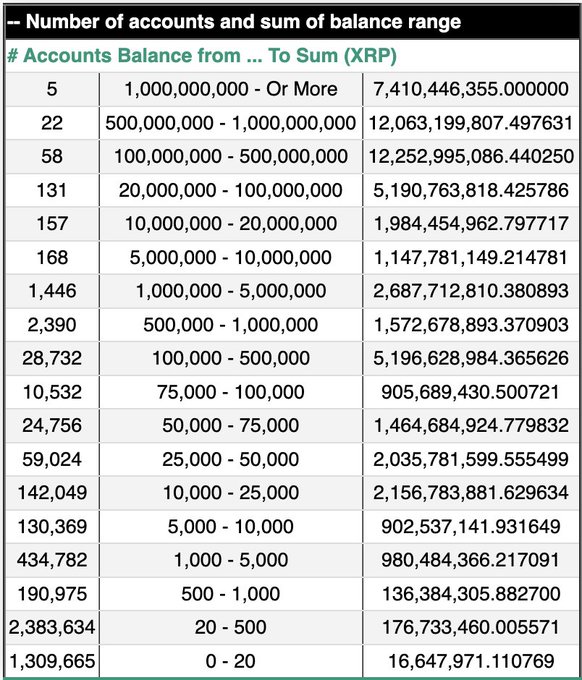
For an investor, it is essential to distinguish between XRP held in private wallets and XRP held by exchanges or Ripple. A large portion of the circulating supply is held by long-term “whales” or institutional holders. This “illiquid supply” can lead to price spikes during periods of high demand, as the number of tokens actually available for sale on exchanges is much smaller than the total circulating supply figure suggests.

Conclusion: Navigating the XRP Supply Landscape
To answer the question “how many XRP are there,” one must look at the asset through three lenses: the 100 billion created at the start, the ~55 billion currently in the hands of the public, and the slowly decreasing total due to transaction burns.
From a financial standpoint, XRP’s supply management is one of the most transparent in the cryptocurrency industry. The escrow system provides a predictable roadmap for future supply, while the deflationary burn ensures that the asset becomes scarcer over time. For the modern investor, XRP represents a unique intersection of corporate strategy and decentralized technology. By understanding these supply mechanics, one can move past the noise of price fluctuations and make informed, data-driven decisions about the role of XRP in a digital-age financial portfolio.
aViewFromTheCave is a participant in the Amazon Services LLC Associates Program, an affiliate advertising program designed to provide a means for sites to earn advertising fees by advertising and linking to Amazon.com. Amazon, the Amazon logo, AmazonSupply, and the AmazonSupply logo are trademarks of Amazon.com, Inc. or its affiliates. As an Amazon Associate we earn affiliate commissions from qualifying purchases.