
For the modern investor, the question “When does the market close today?” is often the starting point for a complex daily ritual. While the short answer for major U.S. exchanges is 4:00 PM Eastern Standard Time (EST), the nuances of market hours—including extended sessions, holiday schedules, and the strategic importance of the closing bell—carry significant weight for anyone managing a portfolio. Understanding the rhythm of the financial markets is not just about knowing when to stop trading; it is about understanding liquidity, volatility, and the global flow of capital.
Understanding Standard Market Hours in the United States
The backbone of the American financial system is built upon the operating hours of the two largest exchanges: the New York Stock Exchange (NYSE) and the NASDAQ. For the vast majority of retail investors, the “trading day” refers to the core session where the highest volume of activity occurs.
The NYSE and NASDAQ Core Sessions
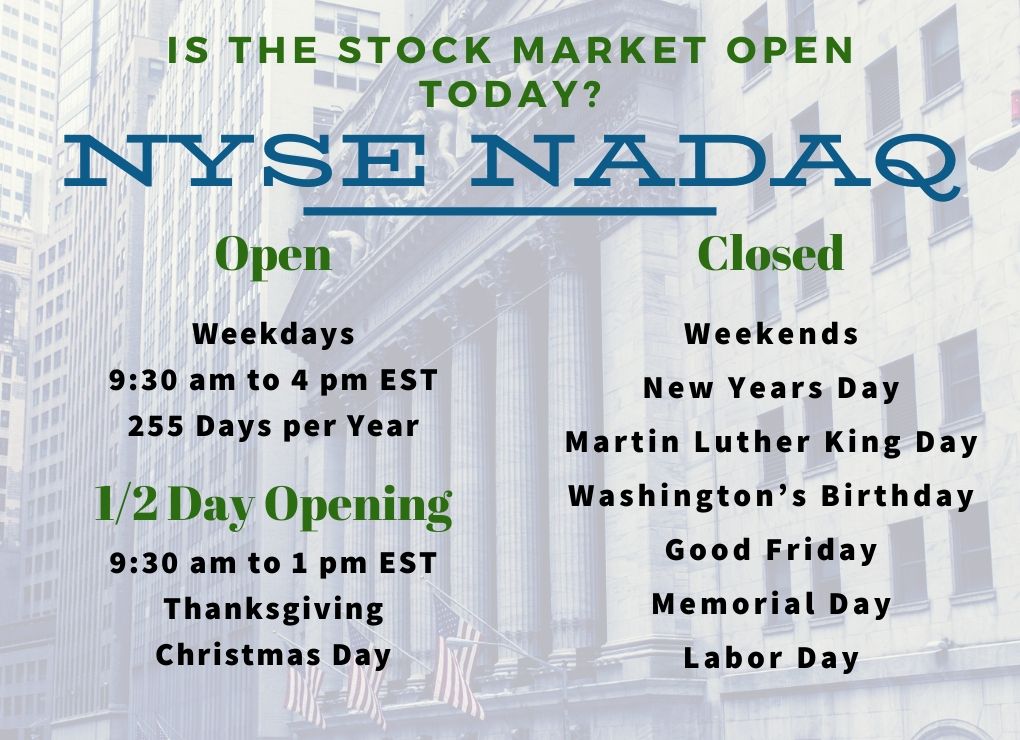
Standard trading hours for the NYSE and NASDAQ are Monday through Friday, from 9:30 AM to 4:00 PM EST. Unlike some international markets that observe a lunch break, U.S. markets remain open throughout the day, providing a continuous seven-and-a-half-hour window for price discovery. This period is characterized by the highest level of liquidity, meaning that the spread between the “bid” (what a buyer is willing to pay) and the “ask” (what a seller wants) is typically at its narrowest. For most long-term investors, executing trades within this window is the most cost-effective way to build or liquidate positions.
Pre-Market and After-Hours Trading Sessions
The market does not truly “turn off” at 4:00 PM. Through Electronic Communication Networks (ECNs), investors can participate in extended-hours trading. Pre-market trading typically begins as early as 4:00 AM EST and runs until the opening bell at 9:30 AM. After-hours trading begins immediately at 4:00 PM and can extend until 8:00 PM EST.
While these sessions offer flexibility, they come with unique risks. Volume is significantly lower than during the core session, which leads to increased volatility and wider bid-ask spreads. Prices can move dramatically on news released after the bell—such as corporate earnings reports or economic data—but the lack of participants means an investor might not get a favorable execution price.
Exceptions to the Rule: Holidays and Early Closures
One of the most critical reasons an investor might ask when the market closes today is to check for federal holidays or scheduled early closures. The U.S. stock market does not follow a 365-day schedule; it observes specific holidays where trading is either completely halted or shortened.
The Annual Stock Market Holiday Calendar
The NYSE and NASDAQ generally observe nine major holidays. These include New Year’s Day, Martin Luther King Jr. Day, Presidents’ Day, Good Friday, Memorial Day, Juneteenth National Independence Day, Independence Day, Labor Day, Thanksgiving Day, and Christmas Day. If a holiday falls on a Saturday, the market is typically closed on the preceding Friday; if it falls on a Sunday, the market closes on the following Monday. Being aware of these dates is essential for managing options expirations and ensuring that margin requirements are met before a long weekend.
What Happens During Early Close Days?
On specific occasions, the market observes an “early close,” typically at 1:00 PM EST. The most common examples are the Friday following Thanksgiving (often referred to as Black Friday) and Christmas Eve (if it falls on a weekday). These shortened sessions often see “thin” trading, where the absence of institutional traders leads to low volume. For the retail investor, these days are often better spent observing the market rather than making aggressive moves, as the lack of liquidity can cause erratic price movements.
Global Market Perspectives: Trading Across Time Zones
In an era of globalized finance, the closing of the New York market is simply a hand-off to the next region. For those involved in international investing or currency trading (Forex), the concept of a “close” is relative.
Major International Exchanges
As the sun sets on Wall Street, attention often shifts to the Asia-Pacific region. The Tokyo Stock Exchange (JPX) and the Hong Kong Stock Exchange (HKEX) represent the next major wave of liquidity. Following them, the London Stock Exchange (LSE) and the Euronext markets dominate the European morning.
- London (LSE): 3:00 AM – 11:30 AM EST
- Tokyo (TSE): 7:00 PM – 1:00 AM EST (with a lunch break)
- Hong Kong (HKEX): 8:30 PM – 3:00 AM EST (with a lunch break)
Understanding these times is vital for investors holding ADRs (American Depositary Receipts) or international ETFs, as news in these time zones will inevitably dictate the “gap” at which the U.S. market opens the following morning.
The Impact of Overlapping Trading Sessions
The most volatile and liquid times in the global market often occur when two major regions are open simultaneously. The most prominent overlap is the “U.S./Europe Overlap,” which occurs between 9:30 AM and 11:30 AM EST. During these two hours, both New York and London are active. This is often when the heaviest trading volume of the day occurs, making it a critical window for institutional rebalancing and large-scale currency conversions.
Why Market Timing Matters for Your Investment Strategy
The specific time you choose to trade within the open hours can have a measurable impact on your investment returns. Professional traders often divide the day into segments based on behavior and risk profiles.
Liquidity and Volatility at the Open and Close
The first and last 30 minutes of the trading day are often referred to as “amateur hour” by some and “the battleground” by others. The market open (9:30 AM) is characterized by a rush of orders reacting to overnight news, leading to high volatility and price swings. Conversely, the market close (4:00 PM) sees a surge in volume as mutual funds and ETFs “rebalance” to match their underlying indices. For the passive, long-term investor, trading in the middle of the day—when prices have stabilized—is often the safest strategy to avoid “slippage” (the difference between expected and executed price).
The “Closing Auction” and Institutional Rebalancing
At precisely 4:00 PM, the NYSE and NASDAQ conduct a closing auction. This is a sophisticated process designed to determine the official closing price for every security. Institutional investors use “Market on Close” (MOC) orders to ensure they receive this final price. This auction is vital because many financial instruments, including derivatives and mutual fund Net Asset Values (NAVs), are calculated based strictly on the 4:00 PM print. Understanding that this surge of institutional activity is happening can help retail investors understand why their stocks might see a sudden price jump or drop in the final seconds of the day.
Tools and Strategies for Navigating Market Hours
To stay ahead of the curve, investors should utilize digital tools that go beyond a simple clock. Effective financial management requires proactive awareness of market status.
Digital Financial Calendars and Real-Time Alerts
Most modern brokerage platforms provide built-in calendars that highlight upcoming holidays and early closures. However, third-party financial news apps are equally valuable for setting alerts. For example, setting an alert for the “London Close” (11:30 AM EST) can warn a trader that liquidity might dry up in certain sectors, while an alert for the “U.S. Core Open” helps one prepare for the morning’s price discovery.

Managing Risk Outside of Standard Trading Hours
If you must trade in the pre-market or after-hours sessions, risk management is paramount. Most professionals recommend using Limit Orders exclusively during these times. A “Market Order” (an instruction to buy or sell at whatever the current price is) can be dangerous in low-volume sessions, as you might end up buying a stock for significantly more than its “fair” value. By setting a limit, you ensure that you only execute the trade at a price you are comfortable with, protecting your capital from the erratic swings that occur when the majority of the market is offline.
In conclusion, knowing when the market closes today is the first step in a broader understanding of financial mechanics. Whether you are a day trader looking to capitalize on the 3:30 PM “Power Hour” or a long-term investor looking to avoid the noise of the opening bell, the clock is a fundamental tool in your investment arsenal. By respecting the hours of the exchange and the global nature of capital flow, you can make more informed, disciplined decisions that safeguard your financial future.
aViewFromTheCave is a participant in the Amazon Services LLC Associates Program, an affiliate advertising program designed to provide a means for sites to earn advertising fees by advertising and linking to Amazon.com. Amazon, the Amazon logo, AmazonSupply, and the AmazonSupply logo are trademarks of Amazon.com, Inc. or its affiliates. As an Amazon Associate we earn affiliate commissions from qualifying purchases.