
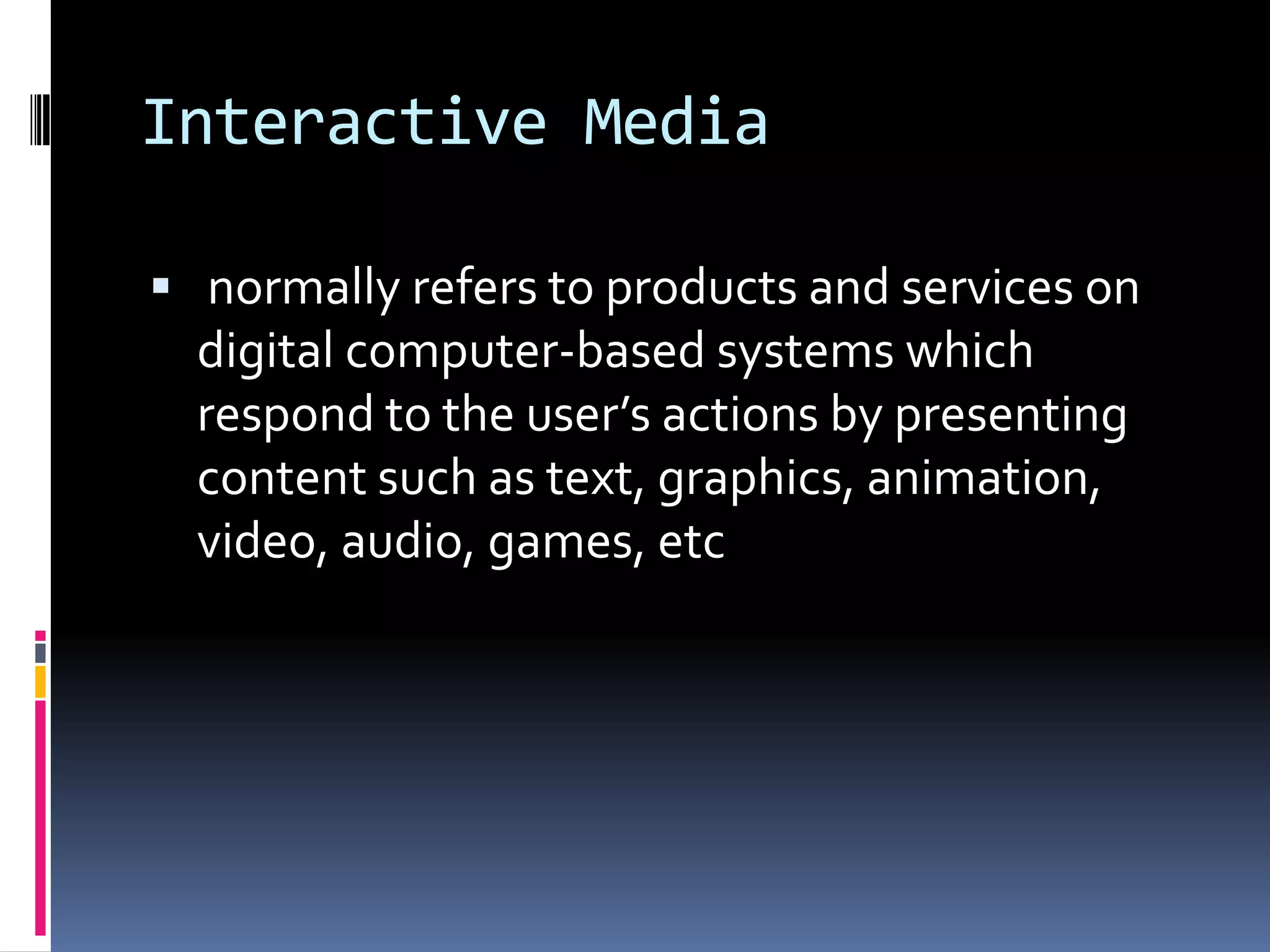
In the rapidly evolving landscape of the twenty-first century, the way we consume information has undergone a fundamental transformation. We have moved from an era of passive consumption—where audiences simply watched, read, or listened—to an era of active participation. This shift is defined by “interactive media.” At its core, interactive media refers to products and services on digital computer-based systems which respond to the user’s actions by presenting content such as text, moving image, animation, video, audio, and video games. Unlike traditional media, which operates on a one-way street, interactive media creates a bidirectional dialogue between the user and the machine.

From the smartphone in your pocket to the sophisticated virtual reality headsets used in surgical training, interactive media is the technological heartbeat of the modern digital experience. To understand its full scope, we must delve into the underlying technologies, the architectural frameworks, and the hardware innovations that allow digital systems to “talk back” to us.
The Core Components and Technologies of Interactive Media
To classify a medium as “interactive,” it must possess specific technical attributes that facilitate a feedback loop. This loop involves a user input, a processing phase, and a resulting output that alters the state of the digital environment. This process is governed by several critical technological pillars.
User Interface (UI) and User Experience (UX) Design
The bridge between human intent and machine execution is the User Interface. In the tech niche, UI is not merely about aesthetics; it is about the functional architecture of interaction. This includes Graphical User Interfaces (GUIs) that utilize icons, menus, and visual indicators. Modern interactive media has advanced to include Voice User Interfaces (VUIs) like Alexa and Siri, and Natural User Interfaces (NUIs) that respond to touch and gesture. UX design, on the other hand, focuses on the logic and flow of these interactions, ensuring that the software anticipates user needs and minimizes “friction”—the technical term for obstacles that prevent a smooth interactive flow.
Real-Time Data Processing and Feedback Loops
For media to be truly interactive, the response must be near-instantaneous. This requires high-performance computing and efficient algorithms. When a user clicks a button in a high-fidelity video game or drags a 3D model in a CAD (Computer-Aided Design) program, the system must process that input and render a new visual state in milliseconds. This relies on powerful Graphics Processing Units (GPUs) and sophisticated software engines—such as Unreal Engine or Unity—that handle physics, lighting, and logic in real-time.
The Role of Artificial Intelligence and Machine Learning
The most recent evolution in interactive media is the integration of Artificial Intelligence (AI). AI tools have transformed interactive media from static branching paths (if user does X, then show Y) to dynamic, generative experiences. Large Language Models (LLMs) allow for interactive text interfaces that can hold nuanced conversations, while machine learning algorithms analyze user behavior to customize interfaces in real-time. This level of technical sophistication ensures that no two users experience the medium in exactly the same way.
The Evolution from Passive Consumption to Active Participation
The history of interactive media is a history of technological breakthroughs. To understand where we are today, we must look at the software and hardware milestones that moved us away from the “broadcast” model of the 20th century.
From Web 1.0 to the Interactive Web
The early internet was largely a “read-only” environment. Websites were static brochures composed of simple HTML. The transition to Web 2.0 and eventually Web 3.0 was driven by technologies like JavaScript, CSS3, and HTML5, which allowed developers to create interactive elements directly within the browser. Today, web applications utilize APIs (Application Programming Interfaces) to fetch data dynamically without refreshing the page, enabling the seamless, interactive experiences we see on platforms like Google Maps or real-time collaborative tools like Figma.
Video Games: The Pioneer of Interactive Systems
Video games are the purest form of interactive media and have served as the R&D lab for the entire tech industry. The transition from 2D sprites to 3D polygons required massive leaps in hardware capability. Games introduced the concept of “agency”—the technical ability of a user to influence a digital narrative. Innovations originally designed for gaming, such as ray tracing (a rendering technique for realistic lighting) and low-latency networking, have since migrated into other fields, including architectural visualization and remote robotic surgery.
Social Media and Peer-to-Peer Interaction
While often viewed through a social lens, social media is a complex technological feat of interactive media. It relies on massive databases and real-time notification systems. The interactivity here is not just between the user and the software, but between multiple users mediated by the software. Features like live streaming, real-time polling, and collaborative filtering are all manifestations of interactive media technology that require robust backend infrastructure to manage millions of concurrent interactions.
Modern Modalities: VR, AR, and Beyond
As hardware becomes more powerful and sensors more miniaturized, interactive media is moving beyond the screen. We are entering the era of “spatial computing,” where the digital and physical worlds converge.
Virtual Reality (VR) and Immersive Environments
VR technology represents the pinnacle of digital immersion. By using Head-Mounted Displays (HMDs) like the Meta Quest or Valve Index, users are placed inside a computer-generated 360-degree environment. The technical challenge of VR is immense; to prevent motion sickness, the system must maintain high frame rates (90Hz or higher) and ultra-low latency. This requires advanced “inside-out” tracking sensors that monitor the user’s position in 3D space with sub-millimeter precision, making the digital world feel tangible and responsive.
Augmented Reality (AR) and Mixed Reality (MR)
Unlike VR, which replaces the real world, AR overlays digital information onto the physical environment. This is achieved through sophisticated computer vision algorithms that “map” a room and understand surfaces. Devices like the Microsoft HoloLens or the Apple Vision Pro use LiDAR (Light Detection and Ranging) to create a “digital twin” of the environment, allowing interactive digital objects to interact with physical furniture. For example, a digital ball can bounce off a real-world table, a feat that requires complex real-time spatial mapping and physics calculation.
Wearable Tech and Haptic Feedback
Interactivity is also becoming more tactile. Haptic technology uses vibrations, forces, or motions to simulate the sense of touch. In the tech space, this is seen in specialized gloves or vests that allow users to “feel” digital objects. Even consumer devices, like the Apple Watch or PlayStation DualSense controllers, use sophisticated actuators to provide haptic feedback, adding a physical dimension to the interactive experience. This sensory feedback is crucial for making digital interactions feel “real” to the human brain.
Technical Challenges and Future Trends in Interactive Systems
Despite the progress made, the field of interactive media faces several technological hurdles that define the current research and development landscape.
Latency and Bandwidth Requirements
The “enemy” of interactivity is latency—the delay between an action and a response. As interactive media becomes more complex (such as cloud gaming or 8K VR streaming), the demand for high-speed data transmission becomes critical. The rollout of 5G and 6G networks, along with edge computing (processing data closer to the user rather than in a distant data center), is essential for the next generation of interactive media. Without these infrastructure improvements, the “seamlessness” of interaction breaks down.
Interoperability and the Metaverse Concept
A major trend in the tech industry is the move toward a “Metaverse”—a persistent, shared interactive space. The primary technical challenge here is interoperability: the ability for digital assets and identities to move seamlessly between different software environments. This requires the development of universal standards (like USD – Universal Scene Description) and decentralized technologies like blockchain to ensure that interactive experiences are not siloed within a single platform or company.

The Shift Toward Voice and Gesture-Based Interfaces
The mouse and keyboard are gradually being supplemented, or even replaced, by more natural forms of interaction. Computer vision is now capable of tracking individual finger movements without the need for controllers. Similarly, Natural Language Processing (NLP) has advanced to the point where voice interaction is becoming the primary way we engage with interactive media in smart homes and vehicles. The future of interactive media lies in “ambient computing,” where the technology is invisible, responding to our natural movements and speech patterns.
In conclusion, interactive media is more than just a buzzword; it is a complex intersection of software engineering, hardware innovation, and human-centric design. It represents the transition of technology from a tool we use to an environment we inhabit. As AI continues to evolve and spatial computing becomes mainstream, the boundaries of what is “interactive” will continue to expand, creating digital experiences that are increasingly immersive, responsive, and indistinguishable from reality. For tech professionals and enthusiasts alike, understanding the mechanics of these systems is essential to navigating the digital future.
aViewFromTheCave is a participant in the Amazon Services LLC Associates Program, an affiliate advertising program designed to provide a means for sites to earn advertising fees by advertising and linking to Amazon.com. Amazon, the Amazon logo, AmazonSupply, and the AmazonSupply logo are trademarks of Amazon.com, Inc. or its affiliates. As an Amazon Associate we earn affiliate commissions from qualifying purchases.