
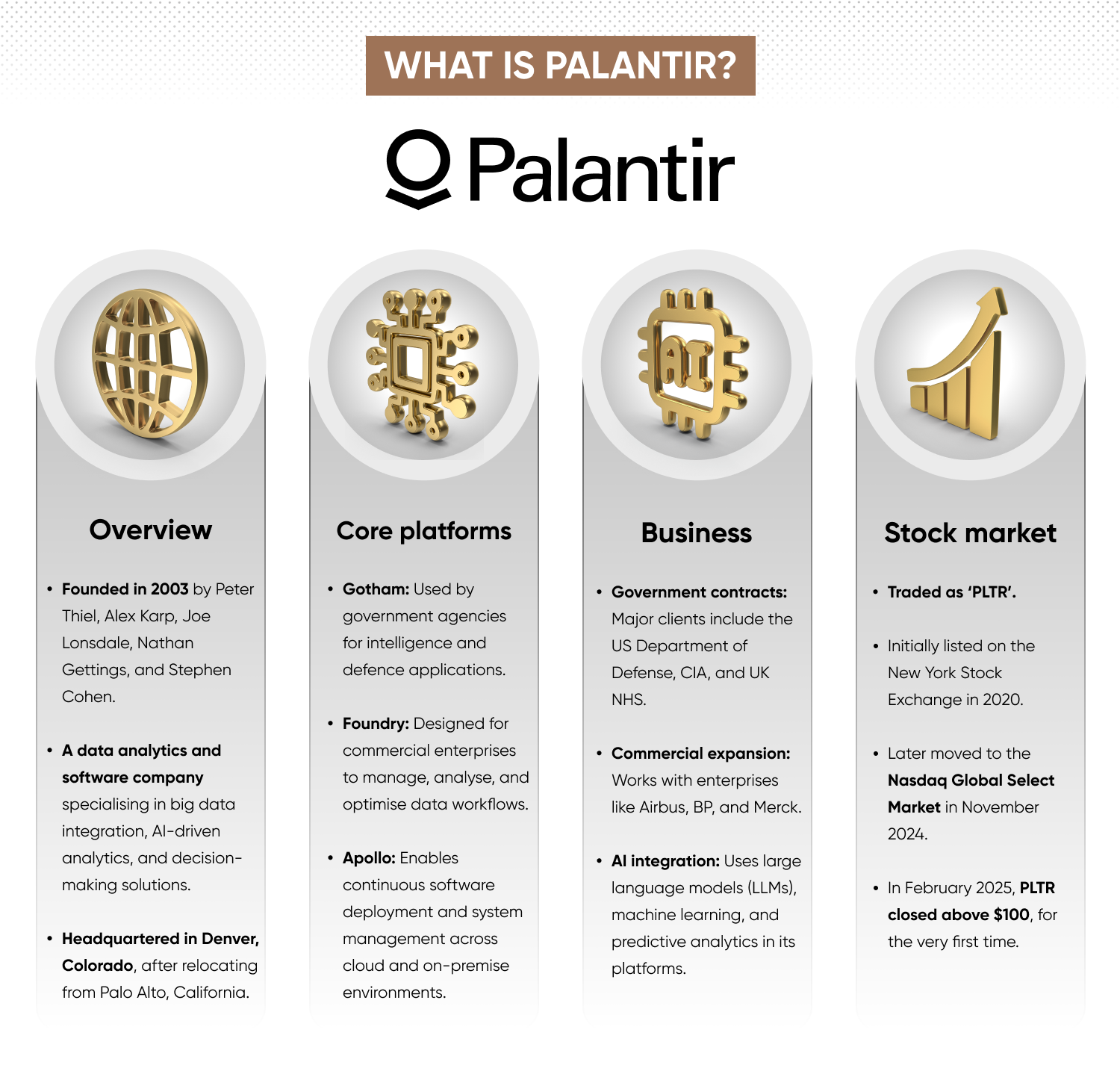
In the modern landscape of enterprise software, few names evoke as much intrigue and complexity as Palantir Technologies. Founded in 2003 by a group of PayPal alumni—including Peter Thiel and Alex Karp—Palantir was born out of a necessity to solve a specific problem: the inability of the intelligence community to connect disparate dots of information to prevent global threats. Today, Palantir has evolved far beyond its counter-terrorism roots, positioning itself as the foundational “operating system” for the modern enterprise.
To understand Palantir is to understand the shift from simple data storage to active data intelligence. While most software companies focus on collecting data, Palantir focuses on the synthesis of that data into actionable decisions. This article explores the technological architecture, the core platforms, and the cutting-edge Artificial Intelligence (AI) advancements that define Palantir Technologies.
The Foundations of Palantir: A New Paradigm in Data Processing
At its core, Palantir is not a traditional data analytics company. It does not sell data, nor does it provide a simple dashboard. Instead, it provides a sophisticated software environment that allows organizations to integrate their most fragmented data sources into a single, cohesive “Ontology.”
Breaking Down Data Silos
Most large organizations—whether a Fortune 500 company or a national government—suffer from data fragmentation. Information is stored in “silos”: legacy databases, cloud spreadsheets, real-time sensor feeds, and internal communication logs that do not talk to one another. Palantir’s technology acts as a universal translator. It connects to these disparate sources without requiring the user to move or rewrite their data, creating a unified layer where information becomes accessible and interpretable.
The Philosophy of Human-Centric AI
A defining characteristic of Palantir’s technological philosophy is the concept of “Human-in-the-Loop.” Unlike many Silicon Valley firms that aim to replace human judgment with autonomous algorithms, Palantir builds tools that augment human intelligence. The software handles the heavy lifting of data processing, pattern recognition, and correlation, but it leaves the final, critical decision-making to the human operator. This synergy is particularly vital in high-stakes environments like battlefield management or global supply chain logistics, where the cost of a “black box” algorithmic error is too high.
The Core Product Ecosystem: Gotham, Foundry, and Apollo
Palantir’s technological dominance is built upon three primary software platforms, each designed for specific operational environments. While they share a common DNA of data integration, their applications differ significantly.
Palantir Gotham: Intelligence and Defense
Palantir Gotham was the company’s first flagship product, designed primarily for the defense and intelligence sectors. Gotham is engineered to find “needles in haystacks.” By ingesting massive amounts of unstructured data—such as satellite imagery, intercepted communications, and financial records—Gotham allows analysts to map out networks.
Whether it is tracking the movement of a terrorist cell or predicting the location of an insurgent ambush, Gotham provides a visual interface where entities (people, places, events) are linked by relationships. Its power lies in its ability to handle “noisy” data and present it in a way that allows a human investigator to see the story the data is trying to tell.
Palantir Foundry: Operational Excellence for Enterprise
As Palantir expanded into the commercial sector, it developed Palantir Foundry. If Gotham is for the investigator, Foundry is for the operator. Foundry is designed to manage the complexity of massive industrial and corporate operations.
For a global manufacturer like Airbus, Foundry serves as the digital twin of the entire production process. It integrates data from thousands of suppliers, factory floor sensors, and flight test logs. By creating this digital replica, Foundry allows executives to run simulations: “What happens to our delivery schedule if a specific part is delayed in Singapore?” Foundry provides the answer in seconds, transforming raw data into a competitive advantage.
Palantir Apollo: The Continuous Delivery Engine
One of the greatest challenges in modern software is deployment. How do you update software on a submarine in the middle of the Pacific, or a remote oil rig with limited connectivity? Palantir Apollo is the answer. It is a continuous delivery and infrastructure management platform that allows Palantir to deploy its software across heterogeneous environments—on-premises, in the cloud, or at the “edge.” Apollo ensures that the software remains secure, updated, and functional regardless of the hardware it sits on, acting as the invisible backbone of the Palantir ecosystem.
The AI Revolution: Introducing Palantir AIP
In recent years, the conversation around Palantir has shifted toward its newest innovation: the Artificial Intelligence Platform (AIP). As Large Language Models (LLMs) like GPT-4 began to revolutionize the tech world, Palantir recognized a critical gap: enterprises wanted to use AI, but they lacked the security and governance to do so safely with their proprietary data.
Large Language Models in Secure Environments
AIP is designed to bring the power of LLMs into the secure, governed environment of the Palantir Ontology. Standard AI models often suffer from “hallucinations” or data leakage, which are unacceptable in a corporate or military context. AIP solves this by anchoring the AI to the organization’s real-world data. The AI doesn’t just “guess” an answer; it queries the integrated data within the Palantir system to provide factual, context-aware insights.
Moving from Pilot to Production
The brilliance of AIP lies in its ability to automate workflows. In a logistics setting, a user can ask the AIP, “Identify all shipments delayed by the hurricane and re-route them to the nearest available hub.” The AI generates the logic, but the user must approve the action. This bridge—moving from a chat interface to an actual operational action—is what distinguishes Palantir from generic AI tools. It is the transition from “AI as a toy” to “AI as a tool of production.”
Real-World Applications and Technological Impact
To truly understand what Palantir is, one must look at where it is being used. Its technology has been deployed in some of the most critical challenges of the 21st century.
Global Logistics and Supply Chain Resilience
During the height of the COVID-19 pandemic, the U.S. government used Palantir’s technology (specifically a system called Tiberius) to track and manage the distribution of vaccines. This required integrating data from thousands of hospitals, state health departments, and logistics providers like FedEx and UPS. Palantir provided the “common operating picture” that allowed officials to see where vaccines were needed and where they were in danger of expiring.
Counter-Terrorism and National Security
While many of its applications are now commercial, Palantir remains a titan in national security. Its technology is used by the Department of Defense and various intelligence agencies to combat human trafficking, detect financial fraud, and provide situational awareness to soldiers in active conflict zones. The ability to process data at the “edge”—directly on drones or handheld devices—has redefined modern electronic warfare.
The Future of Digital Sovereignty and Data Security
As we look toward the future, Palantir is positioning itself at the center of a new technological movement: Digital Sovereignty. In an era where data is the most valuable resource, nations and corporations are increasingly concerned about who controls their software and where their data resides.
Forward-Deployed Engineering
A unique aspect of Palantir’s technical approach is its use of “Forward-Deployed Engineers.” Unlike traditional software sales teams, these are highly skilled coders who work side-by-side with the client. This ensures that the software is not just “installed,” but deeply integrated into the specific technical fabric of the organization. This hands-on approach allows Palantir to solve “impossible” engineering problems that off-the-shelf software cannot touch.

Ethical Considerations in Modern Computation
Palantir often finds itself at the center of ethical debates regarding privacy and surveillance. From a technical standpoint, however, Palantir argues that its software actually enhances privacy. Because the platform creates a rigorous audit trail of every piece of data accessed, it prevents the unauthorized “fishing expeditions” common in legacy systems. Every time a user interacts with data in Palantir, there is a record of why, when, and how, providing a level of governance that is technologically superior to older, less secure databases.
In conclusion, Palantir Technologies is far more than a “data mining” firm. It is a sophisticated engineering company that has built the plumbing, the engine, and the brain for the world’s most complex organizations. By combining deep data integration (Foundry), elite intelligence tools (Gotham), seamless deployment (Apollo), and governed AI (AIP), Palantir has secured its place as a cornerstone of the 21st-century technological infrastructure. As data continues to grow in volume and complexity, the need for a platform that can make sense of the chaos will only become more vital.
aViewFromTheCave is a participant in the Amazon Services LLC Associates Program, an affiliate advertising program designed to provide a means for sites to earn advertising fees by advertising and linking to Amazon.com. Amazon, the Amazon logo, AmazonSupply, and the AmazonSupply logo are trademarks of Amazon.com, Inc. or its affiliates. As an Amazon Associate we earn affiliate commissions from qualifying purchases.