
In the realm of music theory, counterpoint is often viewed as the pinnacle of formal composition. Historically associated with the likes of Johann Sebastian Bach, it describes the relationship between two or more melodic lines that are linear and independent in rhythm and contour, yet harmonious when sounded together. However, as we transition deeper into the digital age, the definition and application of counterpoint have migrated from the parchment of the 18th century into the sophisticated code of modern music technology.
To understand what counterpoint is in the context of the current tech landscape is to understand the intersection of mathematical logic, algorithmic generation, and digital signal processing. Today, counterpoint is not merely a stylistic choice for a composer; it is a structural framework for Artificial Intelligence (AI) and a benchmark for the capabilities of modern Digital Audio Workstations (DAWs).

From Bach to Binary: The Mathematical Foundation of Counterpoint
Counterpoint is fundamentally a system of rules. In traditional “species counterpoint,” composers follow strict guidelines regarding how independent voices can move—avoiding parallel fifths, managing dissonances, and ensuring that each voice maintains its individual integrity. From a technological perspective, these rules are essentially a proto-algorithm.
The Rules-Based System of Voice Leading
In computer science, a rule-based system is one of the earliest forms of AI. Classical counterpoint functions similarly. Each “voice” in a contrapuntal texture can be viewed as a data stream. The challenge for both the human composer and the software programmer is to ensure these streams interact without violating the structural integrity of the piece. When we translate “voice leading” into digital terms, we are looking at the optimization of vertical (harmonic) and horizontal (melodic) constraints simultaneously.
Transposing Classical Logic into Digital Algorithms
Modern music software utilizes the logical framework of counterpoint to assist composers in real-time. Whether it is through “smart” MIDI editors or notation software like Sibelius and Dorico, the logic of counterpoint is embedded in the software’s DNA. These tools use constraint satisfaction engines to alert composers when a melodic line violates the “code” of traditional harmony. This digital transition has turned the abstract art of counterpoint into a measurable, programmable science, allowing for the automation of complex musical textures that once took weeks to hand-write.
Artificial Intelligence and the Evolution of Polyphonic Generation
Perhaps the most exciting frontier for counterpoint is in the field of Artificial Intelligence and Machine Learning (ML). Unlike homophonic music—where a single melody is supported by chords—counterpoint requires an AI to manage multiple independent “agents” (melodies) at once. This is a significantly more complex computational task.
Neural Networks and the Challenge of Independent Melodies
Generating counterpoint is a high-level test for neural networks. Models must be trained on vast datasets of polyphonic music to understand the nuances of how independent lines interact. Traditional Generative Adversarial Networks (GANs) or Transformers must learn to maintain “long-term dependency,” ensuring that a melody introduced in the first measure remains logically consistent even as three other melodies are layered on top of it. This requires the tech to process music not just as a series of sounds, but as a multi-layered architectural blueprint.
Case Study: Google Magenta and Coconet
A prime example of counterpoint in the tech world is Google Magenta’s “Coconet” model. This ML model was specifically designed to tackle the “Bach Doodle” challenge, where it took a simple user-provided melody and harmonized it into a four-part contrapuntal chorale in the style of J.S. Bach. Coconet treats the musical score as a two-dimensional grid, using convolutional neural networks to fill in missing notes based on the surrounding contrapuntal context. This is a landmark in music tech, proving that the rigid logic of counterpoint is the perfect training ground for refining generative AI.
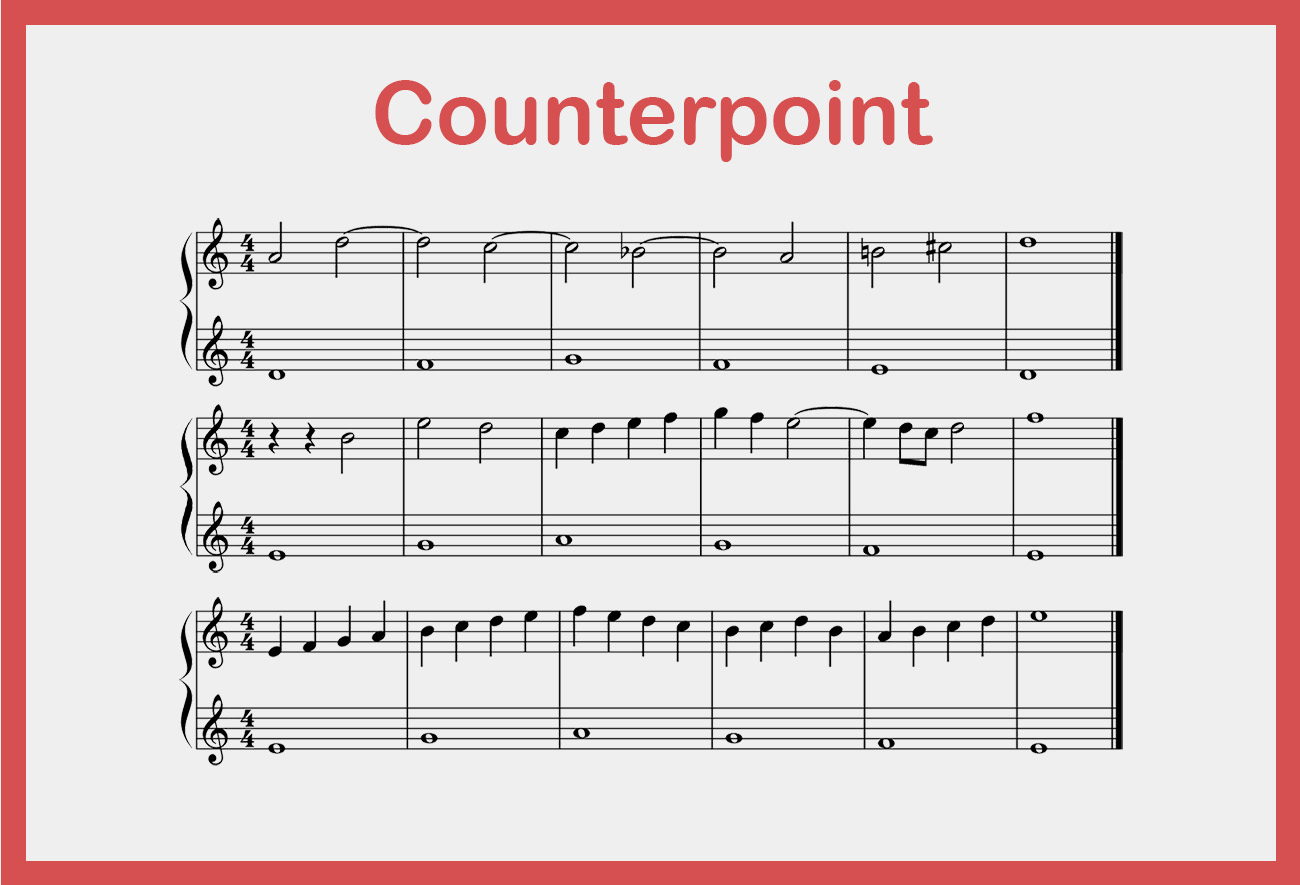
Software Solutions for Modern Composers: Tools for Counterpoint
For the contemporary producer or film scorer, counterpoint is managed through a suite of advanced software tools. The evolution of the Digital Audio Workstation (DAW) has moved beyond simple multi-track recording into an era of intelligent polyphonic manipulation.
Advanced MIDI Orchestration and Polyphony
In a modern tech-driven studio, counterpoint is often visualized through MIDI piano rolls. Advanced software instruments, such as those produced by Vienna Symphonic Library or Orchestral Tools, utilize “Polyphonic Legato” scripts. These scripts use complex logic to track individual voices within a MIDI chord, ensuring that each transition between notes sounds like a real human player. This is “counterpoint as a service,” where the software handles the micro-adjustments of independent lines so the composer can focus on the macro-level structure.
Plugin Architecture for Real-Time Harmony
There is a growing market for plugins that use counterpoint logic to generate harmonies in real-time. Tools like Eventide’s Quadravox or Antares Harmony Engine allow a single vocal input to be transformed into a four-part contrapuntal arrangement. These plugins analyze the incoming pitch and, based on pre-set mathematical intervals and voice-leading rules, generate independent secondary melodies. This democratizes the use of complex music theory, allowing creators without formal training to utilize the power of counterpoint through sophisticated digital signal processing.
Counterpoint in Interactive Media and Procedural Audio
As we move toward more immersive digital experiences, counterpoint is finding a new home in procedural audio—music that is generated in real-time based on user input. This is particularly prevalent in the video game industry and Virtual Reality (VR).
Dynamic Music Systems in Video Game Engines
In modern gaming, music needs to be as reactive as the gameplay. Traditional linear music often falls short here. Instead, developers use middleware like Wwise or FMOD to implement “vertical re-orchestration.” This is a form of digital counterpoint where different melodic layers are added or subtracted based on the player’s actions. If a player enters a combat zone, an independent, high-tempo “counter-melody” might fade in, perfectly synced to the existing exploration theme. The software must ensure that these layers function contrapuntally, maintaining harmonic cohesion regardless of when the player triggers the transition.
The Role of Algorithmic Counterpoint in VR/AR Environments
In VR and Augmented Reality (AR), the audio environment is spatial. Counterpoint becomes an essential tool for “spatialized soundscapes.” As a user moves through a digital space, different musical elements (voices) can be tied to different physical objects. For example, a “melody” might be attached to a waterfall on the left, while a “counter-melody” is attached to a distant bird on the right. As the user moves, the software must dynamically adjust the volume and phase of these independent lines, ensuring they still form a coherent contrapuntal whole. This represents the ultimate evolution of counterpoint: from a static piece of paper to a dynamic, 360-degree digital experience.

The Future: Toward Autonomous Musical Systems
The journey of counterpoint from the 1700s to today reveals a fascinating trend: the more complex the musical theory, the more it relies on sophisticated technology to execute in the modern era. We are moving toward a future where “autonomous counterpoint” will be a standard feature in creative software.
In this future, AI will not just assist in writing melodies but will act as a collaborative partner, suggesting complex voice-leading movements that a human might never conceive. The “interplay of independent voices” will extend beyond musical notes to the interplay between human creativity and machine intelligence.
Ultimately, counterpoint in the tech world is a testament to the enduring power of structure. Whether it is a fugue by Bach or a generative soundscape in a high-end VR simulation, the principles remain the same: independence, relationship, and harmony. As we continue to refine the algorithms that govern our digital world, the ancient art of counterpoint provides the perfect map for navigating the complexities of multi-layered, data-driven art. Music technology hasn’t just preserved counterpoint; it has given it a new, infinite canvas upon which to evolve.
aViewFromTheCave is a participant in the Amazon Services LLC Associates Program, an affiliate advertising program designed to provide a means for sites to earn advertising fees by advertising and linking to Amazon.com. Amazon, the Amazon logo, AmazonSupply, and the AmazonSupply logo are trademarks of Amazon.com, Inc. or its affiliates. As an Amazon Associate we earn affiliate commissions from qualifying purchases.