
In the realm of computer science and software engineering, the terms we use to describe data are not merely semantic; they dictate how memory is allocated, how algorithms execute, and how digital security is maintained. Among these fundamental terms, the “nonnegative integer” stands as a cornerstone of discrete mathematics and computational logic. While a casual observer might see a simple number, a developer sees a critical constraint that ensures system stability and efficiency.
Understanding what a nonnegative integer is—and why it is categorized specifically in technical environments—requires a transition from basic arithmetic to the sophisticated world of data types, bit-depth, and memory management.

Understanding the Mathematical Foundation in Computing
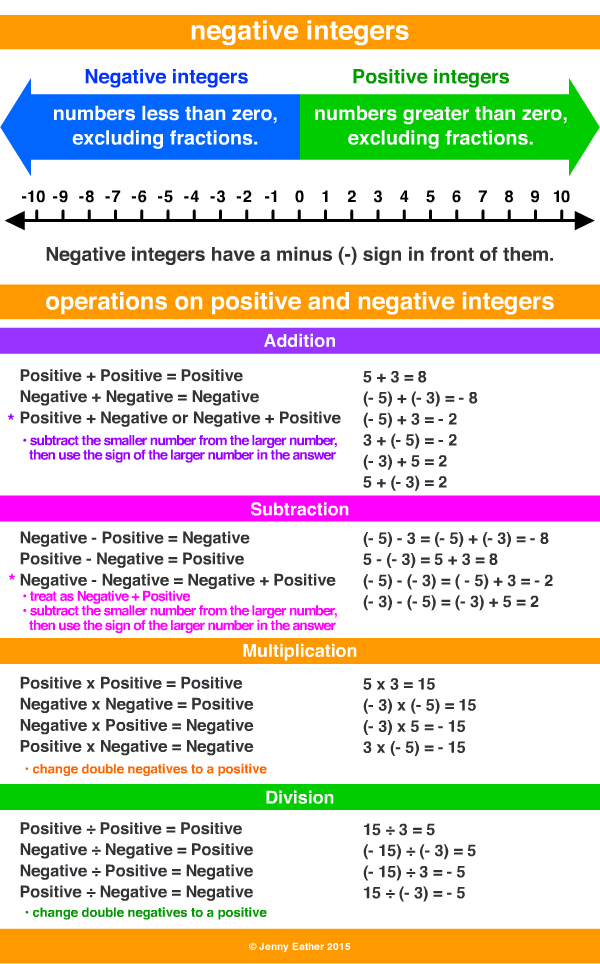
Before exploring its technical applications, we must define the mathematical parameters of a nonnegative integer. In the broadest sense, an integer is any whole number that can be written without a fractional component. This includes negative numbers (-1, -2, -3…), zero, and positive numbers (1, 2, 3…).
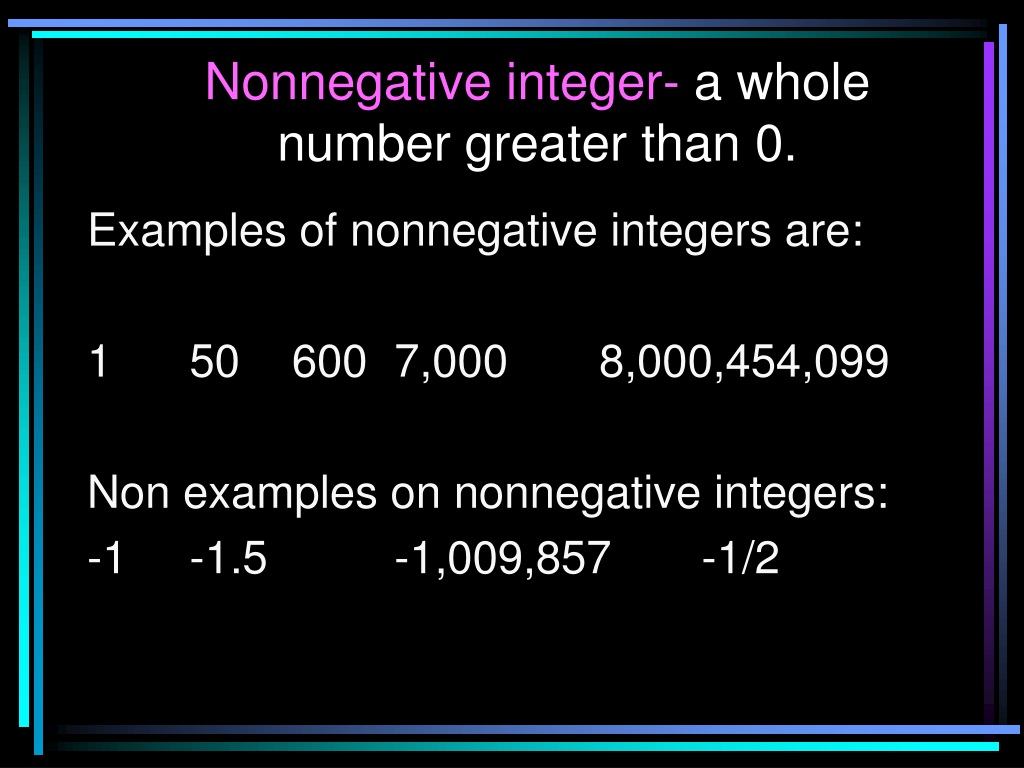
A nonnegative integer is exactly what the name implies: any integer that is not less than zero. This set begins at 0 and extends to positive infinity ({0, 1, 2, 3, …}). In mathematical notation, this is often represented as $mathbb{Z}_{ge 0}$.
Defining Nonnegative Integers: Natural Numbers vs. Whole Numbers
In mathematics, there is often a debate regarding whether “natural numbers” ($mathbb{N}$) include zero. However, in the tech industry—specifically in programming language documentation and database schema design—the term “nonnegative integer” is preferred because it explicitly includes zero. This distinction is vital. If a software engineer is told to use a positive integer, they may exclude zero, which could lead to logic errors in systems where a “null” or “empty” state is represented by the value 0.
The Logical Role of Zero in Digital Systems
In computing, zero is not just “nothing.” It is a specific state. In a binary system, zero represents the “off” state or the base level of a signal. When we categorize a value as a nonnegative integer, we are providing the computer with a floor. We are establishing that the value cannot “underflow” into a negative range. This logical floor is the basis for everything from system timers to memory address offsets.
Data Types and Memory Management: The Unsigned Integer
When translating the concept of a nonnegative integer into software, developers use a specific data type known as the “unsigned integer.” In languages like C, C++, Rust, and Go, understanding the difference between “signed” and “unsigned” is a fundamental skill.
Signed vs. Unsigned Integers in Software Development
A “signed” integer uses one of its bits (usually the most significant bit) as a “sign bit” to indicate whether the number is positive or negative. This effectively splits the range of numbers the variable can hold in half.
An “unsigned integer” (the technical implementation of a nonnegative integer) ignores the sign bit. Because it does not need to store negative values, it can use that extra bit to represent larger positive values. For example, in an 8-bit system:
- A signed integer can store values from -128 to 127.
- An unsigned integer (nonnegative) can store values from 0 to 255.
By strictly using nonnegative integers for values that will never be negative—such as the number of pixels on a screen or the number of users in a database—developers double the efficiency of their memory usage for that specific variable.
How Bit Depth Influences Nonnegative Integer Ranges
The capacity of a nonnegative integer is determined by the system’s bit depth. In modern 64-bit computing, an unsigned 64-bit integer (uint64) can hold a value as high as 18,446,744,073,709,551,615. This massive range is essential for high-level technical tasks, such as tracking unique identifiers in global cloud infrastructures or calculating complex cryptographic hashes. Understanding the limits of these integers prevents “overflow” errors, where a number exceeds its maximum capacity and wraps back around to zero.
Practical Applications in Software Engineering
Nonnegative integers are the workhorses of the tech world. They are used in almost every layer of the “stack,” from the low-level firmware in your keyboard to the high-level API calls of a mobile app.
Array Indexing and Memory Offsets
One of the most common uses of nonnegative integers is in array indexing. In almost all modern programming languages (Python, JavaScript, C#, Java), arrays are “zero-indexed.” This means the first element of a list is accessed at position 0, the second at position 1, and so on.
Because you cannot have a negative position in a memory block, the index is strictly a nonnegative integer. Attempting to access a negative index usually results in a “segmentation fault” or an “out of bounds” error, which are among the most common bugs in software development.
Counter Variables and Loop Iterations
Whenever a program performs a repetitive task—such as processing a list of emails or rendering frames in a video game—it uses a loop. These loops rely on “counters,” which are nonnegative integers. The counter starts at zero and increments with each iteration. Using a nonnegative integer ensures that the loop has a predictable progression and prevents the program from entering an infinite state due to unexpected negative transitions.
Database Identifiers and Primary Keys
In database architecture, “Primary Keys” are used to uniquely identify each record. In the vast majority of SQL and NoSQL databases, these IDs are configured as “Auto-Incrementing Unsigned Integers.” Since you cannot have a “negative” user or a “negative” transaction record, the nonnegative integer provides a clean, logical sequence (1, 2, 3…) that is easy for the database engine to index and search.
Digital Security and Error Handling with Nonnegative Values
From a cybersecurity perspective, the way a system handles nonnegative integers can be the difference between a secure platform and one vulnerable to exploitation.
Preventing Integer Overflow and Underflow
One of the most famous exploits in tech history is the “integer overflow.” This occurs when a nonnegative integer reaches its maximum value and, upon adding 1, resets to 0. Conversely, an “underflow” occurs when you try to subtract 1 from a nonnegative zero, potentially causing the value to wrap around to the maximum possible number.
Hackers often use these vulnerabilities to bypass security checks. For instance, if a digital wallet checks if you have “more than 0” dollars before a withdrawal, but a subtraction error causes your balance to underflow to a massive positive integer, a thief could withdraw funds that don’t exist. Robust software architecture requires strict validation to ensure that nonnegative integers remain within their logical bounds.
Input Validation and Logic Guarding
In UI/UX design and backend development, nonnegative integers are used as “guards.” When a user enters data—such as the number of items to purchase—the system must validate that the input is a nonnegative integer. Allowing a negative input in a “quantity” field could lead to a logic error where the system “pays” the user for taking items, or subtracts from an inventory in a way that crashes the database. Professional tech development involves implementing strict “type checking” to ensure these inputs never violate the nonnegative constraint.
The Future of Discrete Mathematics in AI and Machine Learning
As we move deeper into the era of Artificial Intelligence (AI) and Machine Learning (ML), the importance of nonnegative integers has shifted from simple counting to complex data modeling.
Nonnegative Matrix Factorization (NMF)
In machine learning, Nonnegative Matrix Factorization (NMF) is a group of algorithms used in multivariate analysis and linear algebra. Unlike standard factorization, NMF enforces the constraint that all values in the matrices must be nonnegative. This is particularly useful in computer vision and natural language processing. For example, when an AI is identifying parts of a face or recurring themes in a text, those attributes cannot be “negative.” By restricting the integers to nonnegative values, the AI produces results that are more interpretable and physically meaningful.
Neural Network Layers and Discrete Counting
While neural networks often rely on floating-point decimals (fractions) for weights, the architecture itself—the number of layers, the number of neurons, and the batch size—is defined strictly by nonnegative integers. As AI models become more complex, the efficient management of these discrete values becomes paramount. Future hardware, such as neuromorphic chips that mimic the human brain, relies heavily on discrete “spikes” or counts, further solidifying the role of nonnegative integers in the next generation of computing.
Conclusion
The question “what is a nonnegative integer” might seem like a simple mathematical query, but in the context of technology, it is an essential architectural rule. These numbers are the foundation of memory management, the logic behind our loops, the security of our financial systems, and the structure of our most advanced AI models. By understanding the constraints and capabilities of the nonnegative integer, technologists can build faster, safer, and more efficient digital worlds. Whether you are coding a simple script or managing a global server network, the humble nonnegative integer remains one of the most powerful tools in your technical arsenal.
aViewFromTheCave is a participant in the Amazon Services LLC Associates Program, an affiliate advertising program designed to provide a means for sites to earn advertising fees by advertising and linking to Amazon.com. Amazon, the Amazon logo, AmazonSupply, and the AmazonSupply logo are trademarks of Amazon.com, Inc. or its affiliates. As an Amazon Associate we earn affiliate commissions from qualifying purchases.