
In the world of finance, we are often conditioned to seek out exponential growth. We look for the “hockey stick” graph in a startup’s revenue, the compounding interest of a retirement fund, or the rapid appreciation of a burgeoning real estate market. However, there is a mirror image to this phenomenon that is equally powerful and arguably more dangerous to the uninformed investor: exponential decay.
Exponential decay is a mathematical process where a quantity decreases at a rate proportional to its current value. While it sounds like a concept relegated to physics textbooks or radioactive isotopes, it is a foundational pillar of economic reality. From the moment you drive a new luxury vehicle off the lot to the steady erosion of your cash’s purchasing power due to inflation, exponential decay is the silent force dictating the lifecycle of value. Understanding this concept is not just an academic exercise; it is a critical requirement for anyone looking to preserve wealth and optimize business capital.
The Mechanics of Financial Decay: Why Value Doesn’t Last Forever
To master your finances, you must first understand the “why” behind the decline. In a linear world, an asset might lose a fixed amount of value every year—say, $1,000 annually. But the financial world is rarely linear. It is governed by percentages and ratios, which leads us directly into the territory of exponentiality.
Defining Exponential Decay in a Monetary Context
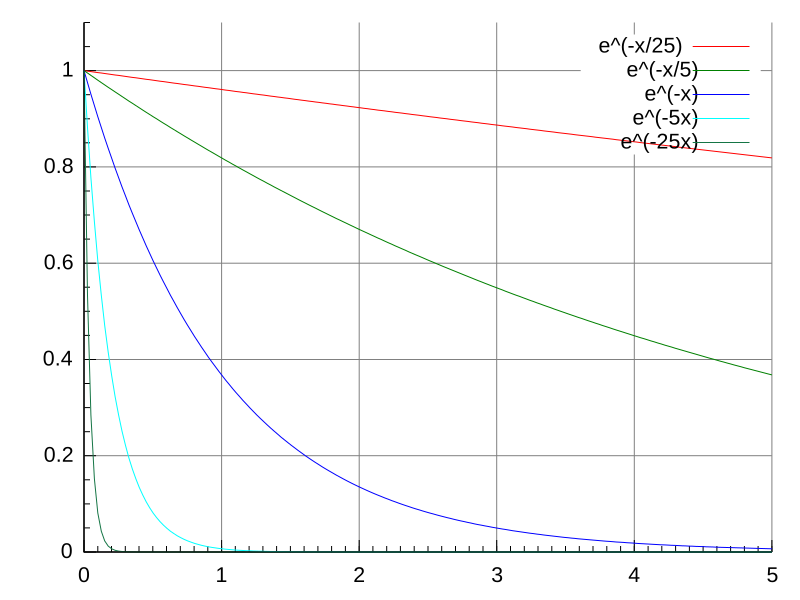
In finance, exponential decay occurs when an asset loses value by a consistent percentage over a specific period, rather than a fixed dollar amount. This means the absolute loss is greatest at the beginning and slows down as the total value approaches zero.
If you own a piece of specialized manufacturing equipment that depreciates by 20% every year, you aren’t losing the same amount of money each year. In the first year, the 20% hit is massive. By the fifth year, the 20% reduction is taken from a much smaller remaining balance. This curve creates a distinct “L” shape on a graph, representing a rapid initial descent that gradually flattens out but theoretically never hits absolute zero.
The Mathematical Reality of Compounding in Reverse
Most investors understand compounding interest as “interest earning interest.” Exponential decay is simply “loss compounding on loss.” In the context of an investment portfolio, this is often seen during prolonged market drawdowns or when holding “melting” assets like leveraged ETFs or certain types of options contracts that suffer from “theta decay.”
When an asset is in a state of exponential decay, the “half-life”—a term borrowed from physics—becomes a vital metric. In money terms, the half-life is the amount of time it takes for your investment or the value of your currency to lose 50% of its initial purchasing power.
Asset Depreciation: The Silent Killer of Net Worth
For the average individual and the small business owner, the most tangible manifestation of exponential decay is asset depreciation. While we often think of spending as a one-time event, the “cost” of an asset continues long after the transaction through the steady decline of its resale value.
Consumer Goods and the “Instant Drop” Effect
High-end consumer goods, particularly vehicles and electronics, are the poster children for exponential decay. A new car typically loses about 10% to 15% of its value the moment it is registered and driven away. From there, it follows a decay curve.
For a professional looking to maximize their net worth, understanding this curve is the difference between a savvy purchase and a financial sinkhole. By purchasing an asset that has already moved through the steepest part of its decay curve—such as a three-year-old vehicle—you allow the previous owner to absorb the most aggressive exponential loss, leaving you with an asset that depreciates at a much slower, more linear rate.
Managing Business Assets and Tax Implications
In business finance, exponential decay is formalized through “accelerated depreciation” methods, such as the Double Declining Balance (DDB). This accounting method recognizes that many assets are most productive when they are new and lose their utility (and market value) rapidly in the first few years.
By utilizing the logic of exponential decay in accounting, businesses can claim larger tax deductions in the early years of an asset’s life. This improves short-term cash flow, which can then be reinvested into growth-oriented, appreciating assets. This is a classic example of using a mathematical “loss” to create a strategic “win” in business capital management.

Inflation and the Half-Life of Your Cash Savings
Perhaps the most insidious form of exponential decay is the impact of inflation on stagnant cash. While your bank balance might show the same numerical figure year after year, the value of that money is in a state of constant, exponential retreat.
How Purchasing Power Erodes Over Decades
Central banks typically aim for a target inflation rate (often around 2%). While 2% sounds negligible, it is an exponential rate. Using the “Rule of 70” (a variation of the Rule of 72 used for decay), we can calculate the half-life of your money. At a consistent 2% inflation rate, the purchasing power of your cash will be cut in half in approximately 35 years.
If inflation spikes to 7% or 8%, as seen in recent economic cycles, the half-life of your savings drops to just 10 years. This means that a “safe” pile of cash is actually an asset in a state of rapid exponential decay. This is why “holding cash” is often described by billionaire investors as a guaranteed way to lose wealth over the long term.
The Importance of Outpacing Decay with ROI
To build true wealth, your rate of return (ROI) must be higher than the combined rate of exponential decay from inflation and taxes. If your savings account yields 1% but inflation is 3%, you are experiencing a net exponential decay of 2% per year in real terms.
Professional wealth management is essentially the art of outrunning decay. This is why diversification into equities, real estate, and commodities is essential; these assets have the potential for exponential growth, which acts as the necessary antidote to the natural decay of fiat currency.
Debt Amortization and the Decay of Liability
Not all exponential decay is bad. When you are the debtor, you want your liabilities to decay as quickly as possible. The structure of a modern mortgage or a business loan is designed around the mechanics of a decaying balance, though the path to getting there is often weighted against the borrower.
Paying Down the Principal: A Positive Decay
In the early years of a 30-year mortgage, the majority of your payment goes toward interest, and the principal balance decays very slowly. However, as the balance decreases, the amount of interest charged each month also decreases. This creates a “snowball effect” where the principal begins to decay at an accelerating rate toward the end of the loan term.
For a business owner or a homeowner, understanding this curve allows for strategic “pre-payments.” By applying extra capital to the principal early in the loan’s life, you are effectively “hacking” the decay curve, significantly reducing the total interest paid and shortening the life of the debt.
Strategies to Accelerate Debt Reduction
Understanding the mathematics of decay leads to smarter debt management. High-interest debt, such as credit card balances, represents a “reverse compounding” disaster. However, if treated as a target for exponential reduction, a borrower can use the “Debt Avalanche” method—targeting the highest interest rates first—to ensure that the most “expensive” debt decays the fastest. This is the most mathematically efficient way to clear a balance sheet.
Strategic Takeaways: Turning Decay into a Financial Tool
The goal of financial literacy is not to fear exponential decay, but to position yourself so that you are on the right side of the curve. Decay is an inevitability in a physical world where things break down, but in the financial world, it can be managed.
Choosing Appreciating vs. Depreciating Assets
The simplest rule of wealth is to own assets that grow exponentially (stocks, businesses, real estate) and lease or minimize ownership of assets that decay exponentially (cars, technology, trend-based commodities). When you do purchase a decaying asset, do so with the full awareness of its “half-life.” Ask yourself: “How much of this value will be gone in three years, and is the utility I gain worth that cost?”

The Role of Scarcity in Resisting Decay
Finally, it is worth noting that some assets resist exponential decay through scarcity. While a mass-produced sedan follows a predictable decay curve, a limited-edition vintage Ferrari may actually transition from a decaying asset into an appreciating one. Similarly, in the digital age, assets like Bitcoin are designed with “halving” events—a form of controlled decay in supply—to create an environment where the value has the potential to grow as the new supply decays.
By identifying the exponential decay at work in your own financial life, you can stop the leaks in your portfolio. Whether it’s moving cash out of a low-interest account to combat inflation or timing the sale of a business asset before it hits the steepest part of its depreciation curve, mastering decay is the secret to long-term financial survival and success. Value doesn’t last forever, but with the right strategy, you can ensure that your wealth stays ahead of the curve.
aViewFromTheCave is a participant in the Amazon Services LLC Associates Program, an affiliate advertising program designed to provide a means for sites to earn advertising fees by advertising and linking to Amazon.com. Amazon, the Amazon logo, AmazonSupply, and the AmazonSupply logo are trademarks of Amazon.com, Inc. or its affiliates. As an Amazon Associate we earn affiliate commissions from qualifying purchases.