
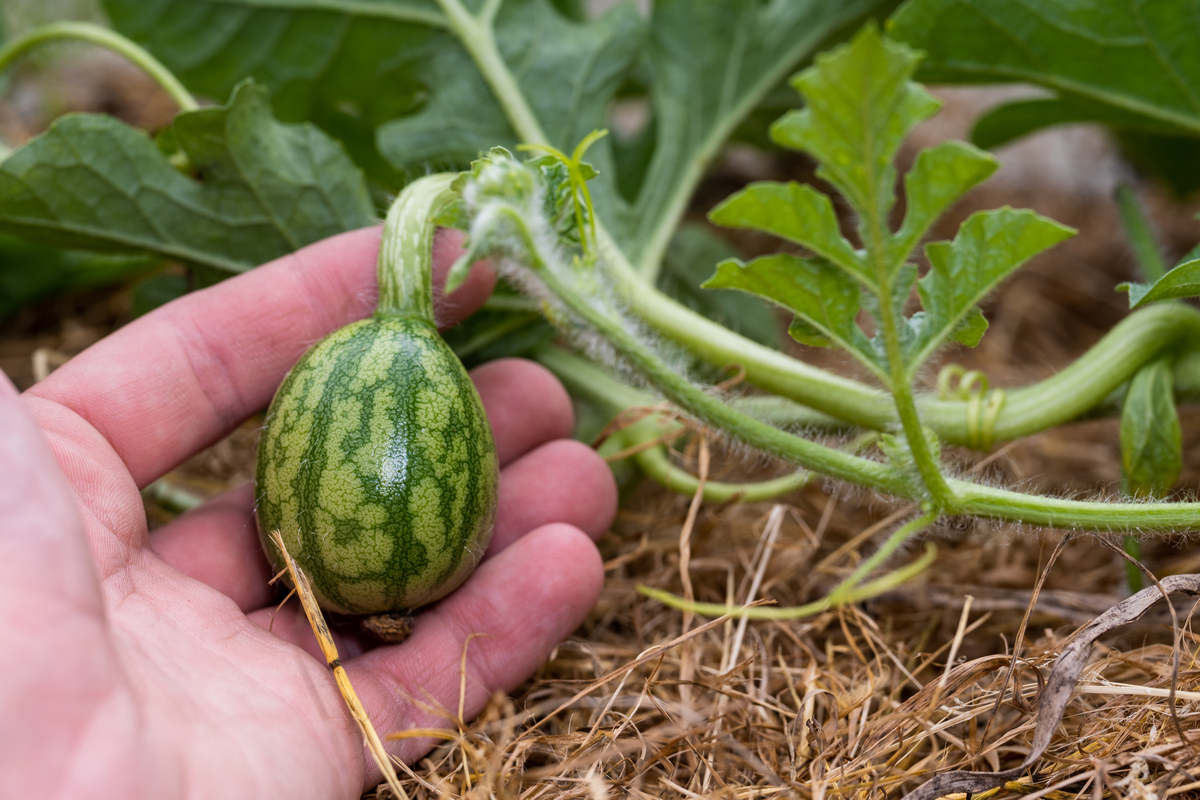
The question “what does a watermelon plant look like?” was once the exclusive domain of botanists and seasoned farmers. However, in the burgeoning era of AgTech (Agricultural Technology), this question has transitioned into a complex challenge for data scientists, software engineers, and roboticists. Identifying the visual characteristics of Citrullus lanatus is no longer just about recognizing a lobed leaf or a trailing vine; it is about teaching machine learning algorithms to distinguish high-yield crops from weeds, detecting nutrient deficiencies through multispectral imaging, and automating harvests using computer vision.

As we move toward a world that requires a 70% increase in food production by 2050, the “look” of a watermelon plant has become a critical data point in the digital transformation of the field.
The Digital Anatomy: Training AI to Recognize Watermelon Phenotypes
At the heart of modern precision agriculture lies the ability of a machine to “see.” To an AI model, a watermelon plant is not a biological entity but a collection of pixels, patterns, and spectral signatures. Identifying what a watermelon plant looks like involves a rigorous process of digital phenotyping.
Leaf Morphometry and Deep Learning
The most distinctive feature of a watermelon plant is its leaf—deeply lobed and roughly symmetrical. In the realm of software development, Convolutional Neural Networks (CNNs) are the primary tools used to map these shapes. By feeding thousands of annotated images into a model, developers train the AI to recognize the specific curvature and vein patterns of the watermelon leaf.
Unlike a simple image search, professional-grade AgTech tools must account for “intra-class variation.” This means the software must understand that a seedling looks different from a mature vine, and that a “Crimson Sweet” variety looks different from a “Sugar Baby.” The technical challenge lies in semantic segmentation—the ability of the software to outline every individual leaf in a crowded, overlapping field environment.
Distinguishing Cultivars via Spectral Imaging
Beyond human-visible light, technology allows us to look at what a watermelon plant “looks like” in the infrared spectrum. Using hyperspectral cameras, tech platforms can identify the unique “spectral fingerprint” of different watermelon cultivars. This is essential for large-scale operations where multiple varieties might be grown in proximity. By analyzing the light reflectance of the waxy cuticle of the leaf, AI can distinguish between varieties that look identical to the naked eye, allowing for precise application of variety-specific fertilizers or growth regulators.
IoT and Sensor Integration: Visualizing Plant Health Through Data
The visual identity of a watermelon plant is a rolling indicator of its health. In the tech sector, we refer to this as “real-time diagnostic visualization.” High-tech farming operations use a combination of Internet of Things (IoT) sensors and aerial imaging to monitor the “look” of the crop from a bird’s-eye view.
Multispectral Drones and the “Look” of Nutrient Deficiency
When a watermelon plant lacks nitrogen or magnesium, its visual appearance changes—a process called chlorosis. For a human scout, finding these patches in a 100-acre field is an arduous task. For a drone equipped with multispectral sensors, it is a matter of minutes.
The technology utilizes the Normalized Difference Vegetation Index (NDVI). By calculating the ratio between visible red light and near-infrared light, software generates a heat map of the field. In this digital context, a healthy watermelon plant “looks” like a bright green pixel, while a stressed plant appears yellow or red. This tech allows for “Variable Rate Application” (VRA), where software-controlled tractors deliver nutrients only to the specific coordinates where the plant’s visual signature indicates a need.
Real-time Growth Tracking with Edge Computing
Modern AgTech utilizes edge computing—processing data directly on the device rather than in the cloud—to monitor plant growth. Cameras mounted on autonomous ground vehicles (AGVs) take continuous photos of the watermelon vines.
On-device algorithms measure the “canopy cover.” By calculating the percentage of soil covered by green leaves, the software can predict harvest dates with startling accuracy. If the plant looks “smaller” than the growth model predicts for its age, the system automatically triggers an alert to the farm management software (FMS), identifying potential irrigation leaks or soil compaction issues before they become visible to the human eye.
Solving the “Look-Alike” Problem: Machine Learning vs. Weeds and Mimics
One of the greatest hurdles in agricultural software is the “mimicry” problem. To an untrained algorithm, many weeds (such as certain types of wild squash or morning glories) look remarkably similar to watermelon plants. Solving this requires sophisticated spatial analysis and pattern recognition.
Semantic Segmentation in Complex Fields
In a “noisy” environment—one where the ground is covered in debris, plastic mulch, and competing weeds—the software must perform semantic segmentation. This is a deep learning technique where every pixel in an image is classified.
Engineers use datasets like ImageNet or custom-curated agricultural sets to teach the AI the “spatial context” of a watermelon plant. For instance, watermelon plants are typically vine-based and follow a specific growth trajectory along the ground. By teaching the software to look for the vine’s “path” rather than just isolated leaves, the accuracy of plant identification increases from roughly 70% to over 95%.
Autonomous Weeding and Visual Precision
The practical application of “knowing what a watermelon plant looks like” is most evident in autonomous weeding robots. These gadgets use high-speed cameras to scan the ground as they move. When the computer vision system identifies a shape that does not match the stored profile of a watermelon plant, it triggers a mechanical hoe or a precision laser to eliminate the weed.
This tech represents a massive shift in digital security for food systems. By reducing reliance on broad-spectrum herbicides, technology creates a more resilient and precise agricultural framework. The “visual” recognition happens in milliseconds, involving a hardware-software handshake that represents the cutting edge of modern robotics.
The Future of Agri-Tech: From Visual Identification to Predictive Analytics
The evolution of “what a watermelon plant looks like” is moving toward the “Digital Twin” concept. In this scenario, every physical plant in a field has a corresponding digital model in a server.
Climate Resilience Modeling
As climate change shifts weather patterns, the visual cues of plant stress are changing. Tech companies are now using Generative Adversarial Networks (GANs) to simulate what watermelon plants might look like under extreme drought or high-salinity conditions.
By creating these “synthetic” images of stressed plants, developers can “pre-train” AI models. This means that if a new type of blight or environmental stress occurs, the software will recognize the visual symptoms immediately, even if that specific farmer has never seen them before. This is the ultimate form of proactive tech support for the natural world.
Scaling Smart Farms with AI-Driven Visual Diagnostics
Finally, the democratization of this technology via mobile apps is changing the landscape for smaller stakeholders. A farmer can now take a smartphone photo of a leaf, and a cloud-based AI will analyze the “look” of the plant against a global database of pests and diseases.
This “Pocket Agronomist” software uses the same visual recognition logic as high-end drones. It looks for the specific “halo” of a fungal infection or the “stippling” caused by spider mites. By translating the visual appearance of the watermelon plant into actionable data, these apps are bridging the gap between traditional labor and the digital economy.

Conclusion
What does a watermelon plant look like? In the context of 21st-century technology, it looks like a complex data set. It is a series of spectral signatures, a collection of geometric patterns for a CNN to decode, and a vital node in an IoT-enabled field.
The intersection of software engineering and botany has transformed the simple act of looking at a plant into a sophisticated diagnostic process. As computer vision becomes more acute and machine learning models become more accessible, our ability to interpret the “visual language” of crops will be the defining factor in the efficiency, sustainability, and profitability of global agriculture. The vine is no longer just a source of fruit; it is a source of information.
aViewFromTheCave is a participant in the Amazon Services LLC Associates Program, an affiliate advertising program designed to provide a means for sites to earn advertising fees by advertising and linking to Amazon.com. Amazon, the Amazon logo, AmazonSupply, and the AmazonSupply logo are trademarks of Amazon.com, Inc. or its affiliates. As an Amazon Associate we earn affiliate commissions from qualifying purchases.