
The question “What celebrity do I look like?” has evolved from a casual conversation starter into a complex computational challenge. What was once a subjective opinion shared between friends is now a sophisticated demonstration of computer vision, deep learning, and biometric data processing. Behind the viral social media filters and mobile applications lies a world of advanced artificial intelligence that maps the human face with a level of precision that was previously the stuff of science fiction.
As we delve into the technology driving these “Celebrity Look-Alike” AI tools, we find a convergence of mathematics, software engineering, and digital security. This article explores the technical architecture of facial recognition, the evolution of neural networks, and the ethical implications of using AI to analyze our most personal identifier: our face.
The Evolution of Computer Vision and Facial Recognition
The ability of a machine to “see” and interpret a human face is the cornerstone of celebrity matching apps. This field, known as Computer Vision, has undergone a radical transformation over the last decade. Early iterations of facial recognition relied on rigid geometric models, but today’s AI uses fluid, adaptive systems that learn from vast datasets.
From Basic Geometrics to Deep Learning
In the early days of digital image processing, software attempted to recognize faces by measuring the distances between key points—the distance between the eyes, the width of the nose, and the length of the jawline. These “geometric” methods were easily fooled by changes in lighting, facial expressions, or camera angles.
Modern AI celebrity look-alike tools have moved beyond these limitations through “Deep Learning.” By training on millions of labeled images, deep learning models can recognize patterns that are invisible to the human eye. They don’t just see a nose; they see a complex arrangement of pixels that represent the unique contours and textures of a celebrity’s features.
The Role of Convolutional Neural Networks (CNNs)
The specific technology that makes celebrity matching possible is the Convolutional Neural Network (CNN). A CNN is a type of artificial neural network specifically designed to process pixel data. When you upload a photo to an AI look-alike app, the CNN passes the image through various layers.
The initial layers identify simple edges and lines. The middle layers begin to recognize shapes like circles or triangles. Finally, the deep layers assemble these shapes into recognizable facial features. This hierarchical approach allows the AI to maintain accuracy even if the user’s photo is grainy or poorly lit, as the network focuses on the structural “essence” of the face rather than just the surface-level pixels.
How AI Matches Your Face to Famous Figures
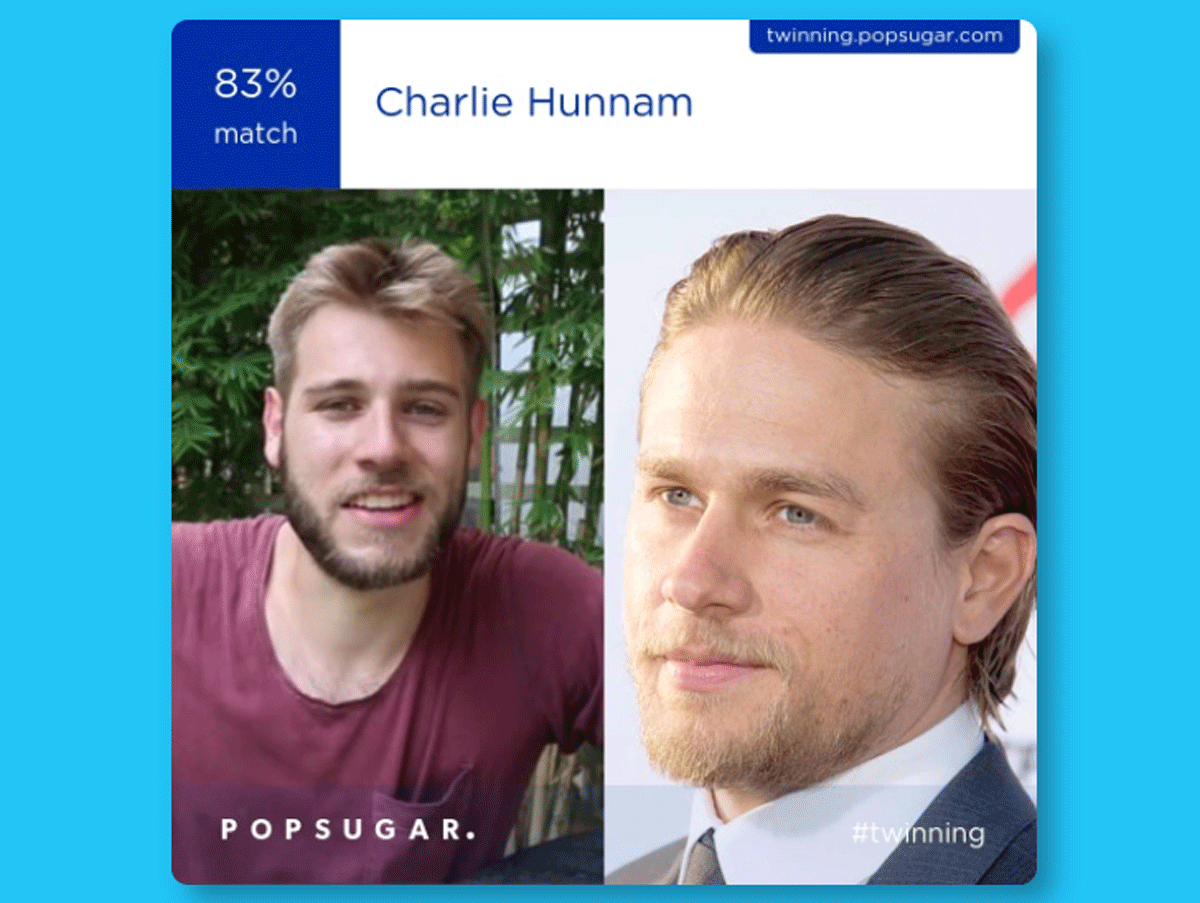
Once an AI tool has successfully identified a face within an image, the real technical work begins. Matching a user to a celebrity isn’t about finding a “twin”; it’s about calculating the statistical similarity between two sets of digital data.
Feature Extraction: Vectorizing the Human Face
The process of turning a physical face into something a computer can understand is called “vectorization.” The AI identifies “facial landmarks”—specific points on the face such as the corners of the mouth, the tip of the nose, and the arch of the eyebrows.
These landmarks are converted into a mathematical representation known as a “face embedding” or a “feature vector.” This vector is essentially a long string of numbers that acts as a digital fingerprint. Because these numbers represent the proportions and relationships between facial features, they remain relatively consistent regardless of the person’s expression or the photo’s filter.
Comparing Global Databases and High-Dimensional Spaces
Once the AI has your feature vector, it must compare it against a massive database of celebrity vectors. This database is pre-compiled by scanning thousands of images of actors, musicians, and public figures.
To find a match, the AI plots your vector in a “high-dimensional space.” Imagine a graph with hundreds of axes instead of just X and Y. The AI calculates the “Euclidean distance” between your vector and the celebrity vectors in the database. The celebrity whose vector is “closest” to yours in this mathematical space is declared your look-alike. This calculation happens in milliseconds, allowing for the near-instantaneous results we see in modern apps.
Popular AI Architectures and Implementation Tools
The accessibility of celebrity look-alike technology is largely due to the availability of powerful AI frameworks and pre-trained models. Developers no longer need to build these systems from scratch; instead, they leverage industry-standard tools to create consumer-facing applications.
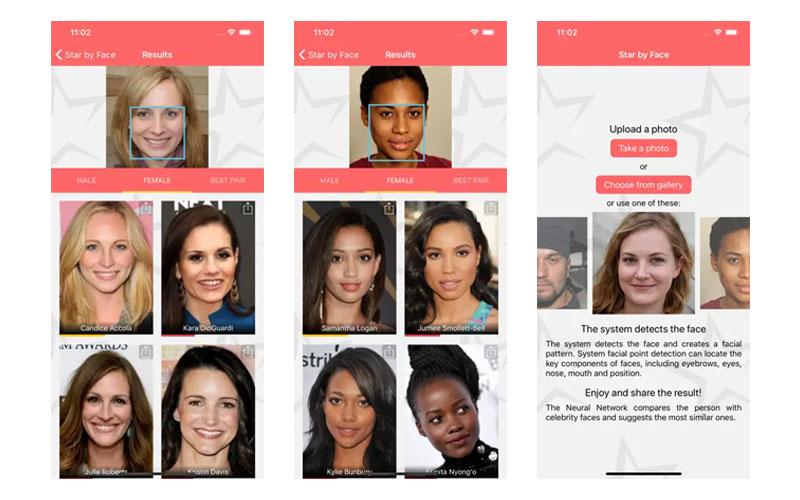
Mobile-First Applications: Gradient and StarByFace
Apps like Gradient and StarByFace have become industry leaders by optimizing AI models to run on mobile hardware. These applications often use “TensorFlow Lite” or “CoreML,” which are versions of machine learning frameworks designed to run on a smartphone’s processor rather than a massive server.
The technical challenge for these apps is balancing accuracy with speed. A model that is too large will drain the battery and lag, while a model that is too small will provide inaccurate matches. Successful apps use a technique called “model quantization,” which reduces the precision of the numbers in the neural network to make the file size smaller without significantly impacting the quality of the celebrity match.
Web-Based Interfaces and API Integrations
Many celebrity look-alike tools exist as web-based platforms that utilize powerful cloud APIs. Platforms like Microsoft Azure Face API, Amazon Rekognition, and Google Cloud Vision provide developers with “off-the-shelf” facial analysis capabilities.
When a user uploads a photo to a website using these services, the image is sent to a remote server. The server processes the image using its massive computational power and returns the results via an API call. This allows even simple websites to offer sophisticated AI matching services without the need for the developer to maintain their own neural network infrastructure.
Digital Security: The Technical Ethics of Facial Data
While celebrity look-alike AI is often presented as a harmless diversion, the underlying technology raises significant questions regarding digital security and data privacy. Every time a user uploads a high-resolution photo of their face to an AI tool, they are interacting with biometric data.
Data Storage and User Consent
The primary tech security concern involves how images are stored and processed. Many AI applications process the image “in the cloud,” meaning the user’s face is sent to a server. Technical audits of some viral apps have revealed that while the matching happens quickly, the images may be stored on servers for training future AI models or for other data-mining purposes.
Security-conscious developers are moving toward “on-device processing.” In this model, the AI model is downloaded to the user’s phone, and the facial analysis never leaves the device. From a technical standpoint, this is the gold standard for privacy, as it eliminates the risk of data interception or server-side breaches.
The Risks of Biometric Harvesting
There is a growing concern in the tech community about “biometric harvesting.” Because facial data is increasingly used for security purposes—such as unlocking smartphones or verifying bank identities—large databases of facial embeddings are highly valuable.
If an AI look-alike tool is not properly secured, it could become a target for hackers looking to steal facial vectors. While a vector cannot be “seen” as a face by a human, it can potentially be used to spoof other facial recognition systems. Consequently, robust encryption and strict data-handling protocols are essential components of any professionally developed AI facial tool.
The Future of AI Facial Analysis Beyond Entertainment
The technology used to tell you that you look like a Hollywood star is the same foundation being used for groundbreaking advancements in other tech sectors. The “look-alike” algorithm is just the beginning of a larger shift in how machines interact with human identity.
Hyper-Personalization in Virtual Reality and Metaverses
As we move toward more immersive digital environments, such as the Metaverse, AI facial analysis will play a critical role in avatar creation. Instead of manually choosing features, users will use “look-alike” technology to generate a 3D digital twin that mirrors their real-world proportions with uncanny accuracy. This involves moving from 2D pixel matching to 3D mesh generation, utilizing depth-sensing technology like LiDAR found in modern high-end smartphones.
Advancements in Generative AI and Synthetic Media
We are also seeing the convergence of facial recognition and Generative AI. Beyond just finding a match, new AI models can “morph” a user’s face into a celebrity’s face in real-time. This is achieved through Generative Adversarial Networks (GANs), where two neural networks work against each other—one creating the image and the other critiquing it—until the result is indistinguishable from reality.
While this technology powers fun filters, it also necessitates the development of “Deepfake Detection” tools. The same AI that matches your face to a celebrity is now being trained to identify the subtle digital artifacts that prove an image was manipulated by AI.
Conclusion
The “What celebrity do I look like?” AI is a testament to the incredible progress in the field of artificial intelligence. It represents a perfect marriage of complex mathematics and user-friendly software design. By leveraging Convolutional Neural Networks, feature vectorization, and high-speed cloud computing, these tools provide a glimpse into the power of computer vision.
However, as users, we must remain cognizant of the technical trade-offs. The convenience of these AI tools must be weighed against the security of our biometric data. As the technology continues to evolve from simple 2D matching to generative 3D modeling, the line between entertainment and identity becomes increasingly thin. Understanding the “how” behind the AI is the first step in using these powerful tools responsibly in an increasingly digital world.
aViewFromTheCave is a participant in the Amazon Services LLC Associates Program, an affiliate advertising program designed to provide a means for sites to earn advertising fees by advertising and linking to Amazon.com. Amazon, the Amazon logo, AmazonSupply, and the AmazonSupply logo are trademarks of Amazon.com, Inc. or its affiliates. As an Amazon Associate we earn affiliate commissions from qualifying purchases.