
In the realm of software engineering, a project without a specification is like a skyscraper being built without an architectural blueprint. While a developer might be able to write code based on a vague idea, the resulting product will almost inevitably fail to meet user expectations, exceed its budget, or suffer from critical performance bottlenecks. Software specifications serve as the definitive source of truth, aligning stakeholders, designers, and engineers under a single unified vision.
At its core, a software specification is a detailed document—or set of documents—that describes what the software must do, how it should behave, and the constraints under which it must operate. In this guide, we will explore the nuances of software specifications, their critical role in the development lifecycle, and the best practices for crafting them in a modern tech environment.
The Fundamental Components of Software Specifications
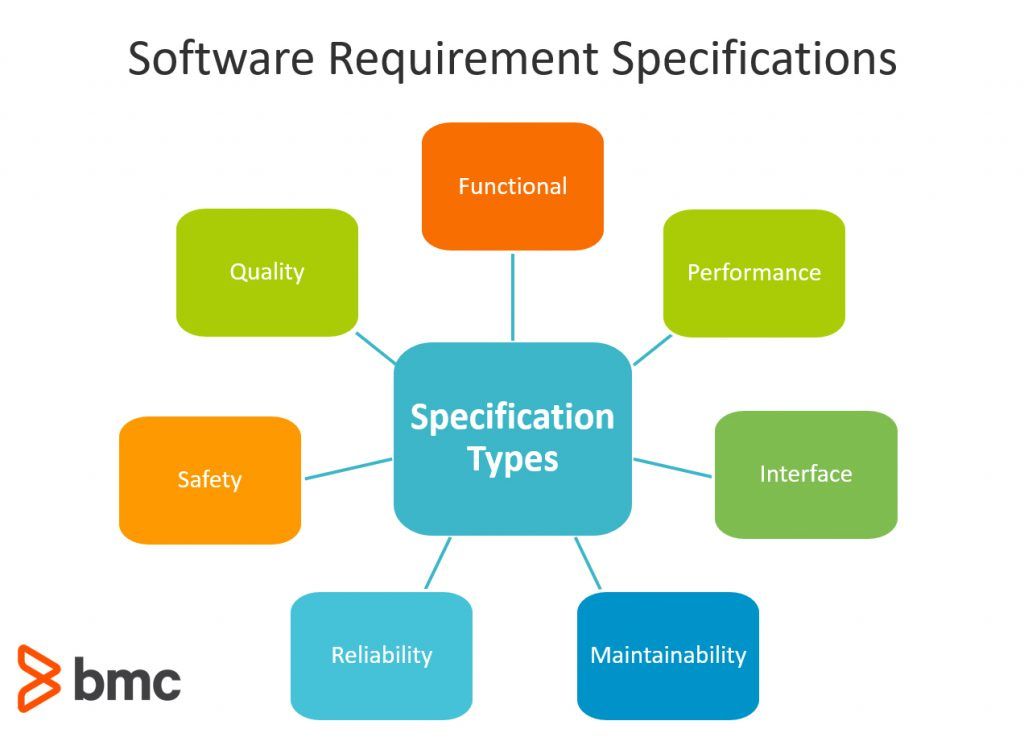
Software specifications are not monolithic; they are categorized based on the specific “needs” they address. Generally, these are divided into functional and non-functional requirements, alongside interface guidelines.
Functional Specifications: Defining the “What”
Functional specifications are the heart of the document. They describe the specific behaviors, tasks, and functions the system must perform. If a user clicks a button, what happens? If a database query fails, what error message is shown?
Key elements of functional specifications include:
- Business Logic: The rules that govern how data can be created, displayed, stored, and changed.
- User Capabilities: Detailed descriptions of what different user roles (e.g., Admin, Editor, Guest) can perform within the system.
- Data Processing: How the software handles input data and converts it into the desired output.
Non-Functional Specifications: Defining the “How”
While functional specs define the features, non-functional specifications define the quality attributes and constraints of the system. These are often called “Quality of Service” (QoS) requirements. Even if a software has all the right features, it is considered a failure if it is too slow or unsecure.
Non-functional requirements typically cover:
- Performance: How fast the system responds under specific loads.
- Scalability: The system’s ability to handle an increasing number of users or data points.
- Security: Encryption standards, authentication protocols, and data privacy measures.
- Usability: The learning curve and ease of use for the end-user.
UI/UX and Interface Requirements
Modern software specifications also include detailed information regarding the user interface (UI) and user experience (UX). This section bridges the gap between design and code. It includes wireframes, color palettes, and typography, but more importantly, it defines the technical interactions—such as API integrations between the front-end and back-end—that allow the interface to function correctly.
The Role of Software Specifications in the Development Lifecycle
In any professional software environment, specifications are not just a “pre-work” phase; they are an integrated part of the Software Development Life Cycle (SDLC). Their presence significantly influences the speed and quality of delivery.
Bridging the Gap Between Stakeholders and Developers
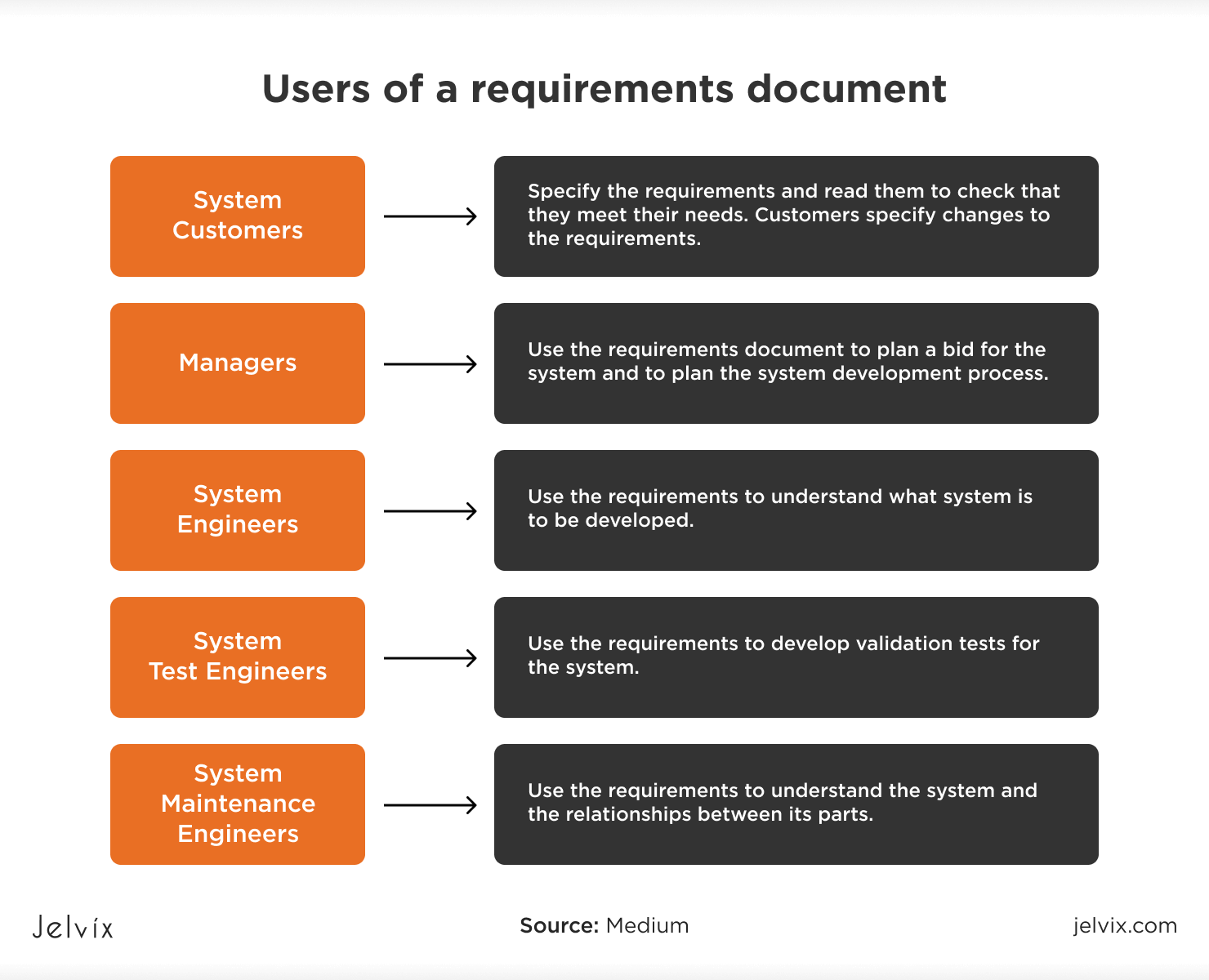
One of the greatest challenges in technology is communication. Stakeholders often speak the language of business goals, while developers speak the language of logic and syntax. Software specifications act as a translation layer. By formalizing requirements into a technical document, all parties can sign off on a shared understanding, ensuring that the final product actually solves the problem it was intended to address.
Reducing Scope Creep and Development Costs
Scope creep—the tendency for a project’s requirements to increase over time—is the leading cause of project failure in the tech industry. Without a clear specification, “small additions” can lead to massive architectural changes midway through development. A well-defined spec sets boundaries. When a new feature is proposed, the team can refer to the specification to determine if it fits within the current scope or requires a formal change request and additional budget.
Serving as a Baseline for Quality Assurance (QA)
Testing is only effective if the testers know what they are testing against. The software specification provides the “expected results” for every test case. QA engineers use these documents to write automated test scripts and conduct manual testing. If the software deviates from the specification, it is flagged as a bug. Without this baseline, QA becomes subjective, leading to inconsistent software quality.
Common Formats and Documentation Types
Depending on the methodology—whether it’s traditional Waterfall or modern Agile—the format of software specifications will vary.
Software Requirements Specification (SRS)
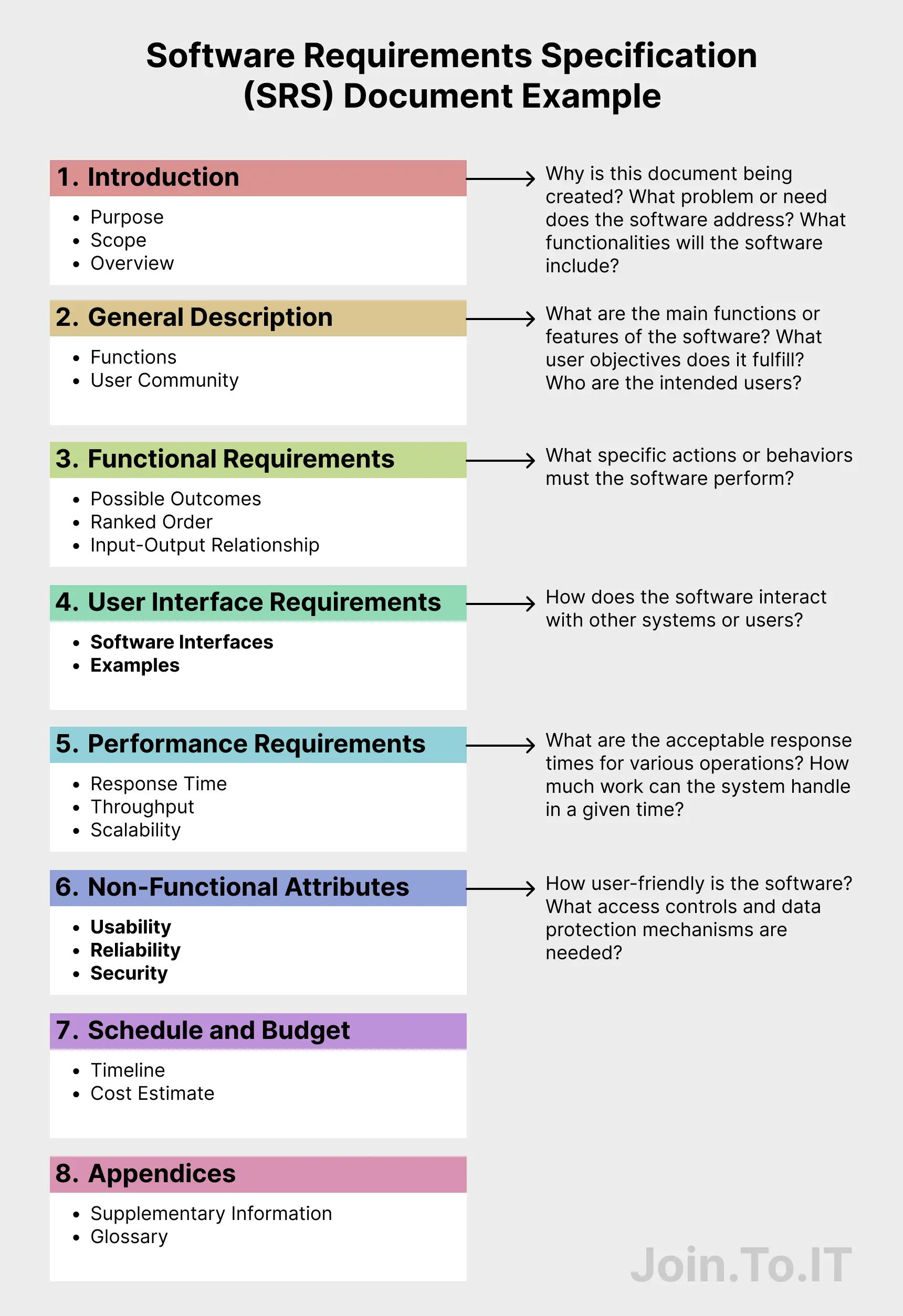
The SRS is the most traditional and comprehensive form of software documentation. It is a formal document that provides a complete description of the software’s purpose and functionality. An SRS is typically used in complex enterprise projects or highly regulated industries (like aerospace or healthcare) where every detail must be documented and audited before a single line of code is written.
User Stories and Acceptance Criteria in Agile
In Agile development, specifications are often more fluid. Instead of a 200-page SRS, teams use “User Stories.” These are short, simple descriptions of a feature told from the perspective of the person who desires the new capability.
A typical user story follows the format: “As a [user], I want to [action], so that [benefit].”
Accompanying these stories are “Acceptance Criteria,” which are a set of conditions that the software must satisfy to be accepted by a user or a product owner. This approach allows for rapid iteration while maintaining a clear standard of what “done” looks like.
Product Requirement Documents (PRD)
A PRD is often used by Product Managers to communicate the “why” behind a product. While it contains technical specifications, it focuses heavily on the market context, user personas, and the problems the software is solving. It serves as a precursor to more technical documentation, ensuring the engineering team understands the broader objectives of the build.
Best Practices for Writing Effective Software Specifications
Creating a specification is a skill that requires a balance of technical knowledge and clear communication. Poorly written specs can be just as dangerous as having no specs at all.
Clarity, Conciseness, and Testability
A good specification must be unambiguous. Avoid vague terms like “fast,” “user-friendly,” or “optimal.” Instead, use quantifiable metrics. Rather than saying “the page should load quickly,” specify that “the page must have a Time to Interactive (TTI) of less than 2.0 seconds under a load of 500 concurrent users.”
Every requirement should also be testable. If you cannot write a test case to prove a requirement has been met, the requirement is likely too vague and needs to be redefined.
Collaborative Drafting and Version Control
Specifications should not be written in a vacuum. They require input from developers (to assess technical feasibility), designers (to ensure usability), and stakeholders (to ensure business alignment). Using collaborative tools like Confluence, GitHub, or Notion allows for real-time feedback and versioning. Because software projects evolve, the specification must be a “living document.” Maintaining version control ensures that everyone is working from the latest requirements.
Utilizing Modern AI Tools for Documentation
The rise of AI has transformed how technical documentation is produced. Tools like GitHub Copilot or specialized LLMs can help draft initial requirements, identify edge cases that a human might miss, and even generate boilerplate documentation from existing codebases. While AI cannot replace the strategic thinking of a system architect, it can significantly accelerate the drafting process and ensure that common technical standards are upheld.
Conclusion: The Foundation of Technical Excellence
In an era where software complexity is increasing exponentially, the importance of clear software specifications cannot be overstated. They are the essential link between a conceptual idea and a functional, scalable digital product. By investing the necessary time into defining functional and non-functional requirements, choosing the right documentation format, and adhering to rigorous standards of clarity, organizations can drastically improve their development efficiency.
Ultimately, software specifications do more than just guide developers—they mitigate risk, ensure quality, and provide a roadmap for innovation. Whether you are working in a fast-paced startup using Agile user stories or a large-scale enterprise utilizing a formal SRS, the principle remains the same: clarity in thought leads to excellence in execution. Without a specification, you are merely writing code; with one, you are engineering a solution.
aViewFromTheCave is a participant in the Amazon Services LLC Associates Program, an affiliate advertising program designed to provide a means for sites to earn advertising fees by advertising and linking to Amazon.com. Amazon, the Amazon logo, AmazonSupply, and the AmazonSupply logo are trademarks of Amazon.com, Inc. or its affiliates. As an Amazon Associate we earn affiliate commissions from qualifying purchases.