
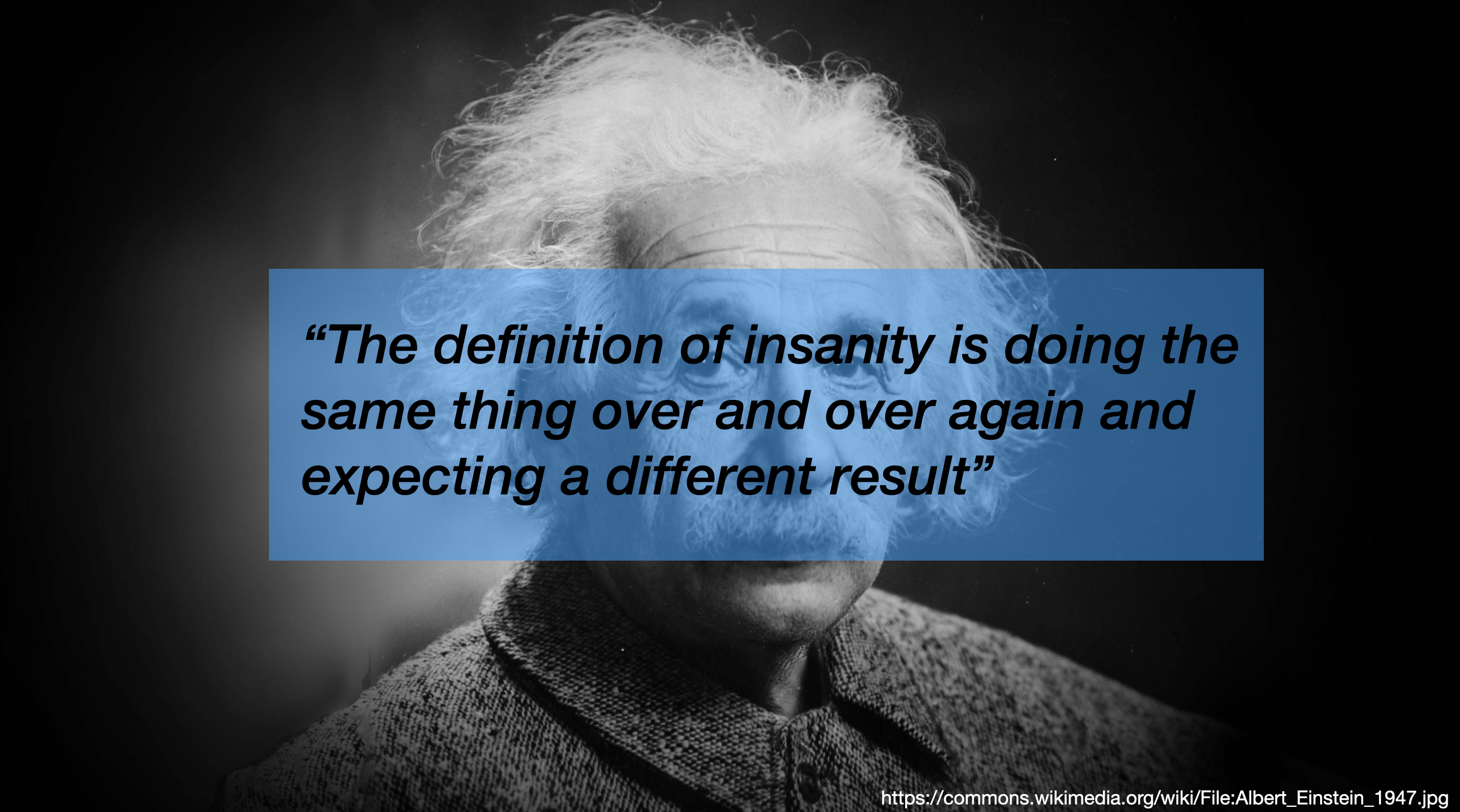
The adage commonly attributed to Albert Einstein—that insanity is “doing the same thing over and over again and expecting different results”—has become a staple of corporate motivational speaking. However, in the high-velocity world of technology, this definition is undergoing a radical transformation. In a landscape defined by rapid iteration, Moore’s Law, and the current generative AI gold rush, the line between visionary genius and systemic insanity has never been thinner.
In tech, “insanity” is not merely a psychological state; it is a structural byproduct of how we build, scale, and secure our digital world. It manifests in the persistent reliance on legacy code, the frantic pursuit of unsustainable growth, and the paradoxical ways we interact with artificial intelligence. To understand what defines insanity in the modern tech ecosystem, we must look at the repetitive cycles that govern software development, venture capital, and digital security.
The Loop of Technical Debt: Doing the Same Thing and Expecting Better Performance
At the core of software engineering lies a fundamental form of insanity: the belief that we can continue to stack new features onto a decaying foundation without the entire structure collapsing. This is known as technical debt, and it is perhaps the most pervasive example of repetitive, irrational behavior in the industry.
The Cost of “Quick Fixes” and MVP Culture
The tech industry is obsessed with the Minimum Viable Product (MVP). While the MVP approach is designed to test market viability, it often leads to “insane” long-term engineering choices. Development teams are frequently pressured to ship code that they know is suboptimal to meet a marketing deadline. The “insanity” here lies in the management’s expectation that a series of “quick fixes” will somehow result in a stable, scalable enterprise platform.
When developers use “duct-tape” solutions—patches upon patches—they are essentially repeating the same mistake: prioritizing the immediate over the sustainable. Over time, this creates a system so complex that no single human understands it, leading to bugs that appear, disappear, and reappear with haunting regularity.
Legacy Systems as a Psychological Trap
Large-scale organizations, particularly in the financial and governmental sectors, often operate on systems built in the 1970s and 80s. The refusal to modernize these systems—while simultaneously expecting them to integrate with modern cloud-based APIs—is a form of institutional insanity.
Decision-makers often fear the “big bang” migration, choosing instead to invest millions into maintaining COBOL-based architectures. They expect these ancient systems to support the security requirements of the 2020s, a logical fallacy that results in catastrophic outages and data breaches. In this context, insanity is defined by the preservation of the obsolete at the expense of the future.
The Silicon Valley Growth Paradox: Scaling Without Sustainability
Moving from the server room to the boardroom, insanity in tech is often defined by the economic models that drive innovation. For the past decade, the tech sector has been gripped by “Blitzscaling”—the pursuit of massive growth at the expense of profit or logic.
The Burn Rate Obsession
In the venture capital ecosystem, the definition of insanity shifted to mean “failing to grow at 300% year-over-year, regardless of the cost.” This led to a cycle where startups were encouraged to “burn” through hundreds of millions of dollars to capture market share. The irrationality lies in the assumption that once a monopoly is achieved, the unit economics will magically resolve themselves.
We have seen this cycle repeat from the dot-com bubble to the recent “unicorn” corrections. Investors continue to pour capital into companies with no clear path to profitability, expecting that this time, the network effect will outweigh the fundamental laws of economics. This repetitive behavior, fueled by “Fear Of Missing Out” (FOMO), perfectly aligns with the classical definition of insanity.
Why We Replicate Failed Business Models
The tech industry is notoriously prone to “copycat” behavior. When a platform like Uber or TikTok succeeds, hundreds of variants emerge. The insanity here is the belief that a market can support an infinite number of identical services. We see this in the current “AI-wrapper” craze, where thousands of startups are essentially just a thin UI layer over OpenAI’s GPT-4. Expecting to build a “moat” or a sustainable brand by doing exactly what every other developer is doing is a hallmark of the current tech hype cycle.
AI and the Illusion of Intelligence: Where Logic Meets Hallucination
The most modern definition of insanity in tech is currently being written by Large Language Models (LLMs). As we move toward Artificial General Intelligence (AGI), the line between a functioning tool and an “insane” one becomes blurred by the phenomenon of AI hallucinations.
Stochastic Parrots and Predictive Loops
LLMs function by predicting the next most likely token in a sequence. They don’t “know” facts; they understand probability. The insanity of AI occurs when the model enters a feedback loop, generating confidently incorrect information (hallucinations). If you ask an AI a question and it gives you a wrong answer, and you ask it again using the same parameters, it may continue to repeat that error with increasing confidence.
What makes this truly insane is the human response. We are increasingly delegating critical decision-making—in legal, medical, and technical fields—to these probabilistic engines, expecting them to behave with deterministic accuracy. We are treating a “stochastic parrot” as an oracle, a disconnect between reality and expectation that borders on the delusional.
The Ethical Insanity of Unchecked Automation
There is a growing trend of “automation for the sake of automation.” Tech companies are integrating AI into every corner of the user experience, often making the product more difficult to use. When a user wants a simple search result but is instead given a 500-word AI summary that is 20% incorrect, the technology has failed its primary purpose. The industry’s insistence on forcing AI into every workflow, regardless of its utility, represents a collective departure from user-centric design logic.
Cybersecurity and the Constant State of Paranoia
In the realm of digital security, insanity is defined by the “Human Element.” Despite decades of advancement in encryption, biometrics, and multi-factor authentication, the majority of breaches still occur because of the same simple human errors.
The Human Element: The Definition of Repeatable Error
Social engineering, phishing, and “password123” remain the primary vectors for cyberattacks. The tech industry’s insanity is evidenced by the belief that we can solve a psychological problem (trust and deception) with a purely technical solution. We keep building higher digital walls, yet we leave the front door key under the mat.
The repetition of the same security oversights—such as leaving S3 buckets publicly accessible or failing to patch known vulnerabilities—suggests that the industry has not learned from the history of breaches. Every year, we see a “record-breaking” data leak, and every year, the post-mortem reveals the same root causes.
Zero Trust as a Rational Response to Digital Chaos
If insanity is expecting reliability from an unreliable system, then “Zero Trust” architecture is the industry’s attempt at sanity. The Zero Trust model operates on the principle of “never trust, always verify.” It assumes that the network is already compromised and that every user and device is a potential threat.
While this may sound like digital paranoia, in the context of modern tech, it is the only rational stance. By acknowledging the “insanity” of the perimeter-based security model, tech leaders are finally moving toward a framework that accounts for human fallibility and the inevitability of failure.

Conclusion: Finding Sanity in a Disruptive Era
What defines insanity in tech? It is the refusal to learn from the cycles of the past. It is the belief that more data, more speed, and more capital can solve problems that are fundamentally rooted in logic and human behavior.
In software development, sanity is found in refactoring and addressing technical debt rather than chasing the next shiny feature. In business, it is found in sustainable unit economics rather than growth at any cost. In AI, it is found in understanding the limitations of the models we create rather than anthropomorphizing them.
The tech industry thrives on “crazy ideas”—the ones that change the world. But there is a vital difference between the “good crazy” of innovation and the “bad crazy” of repeating failed patterns. As we stand on the precipice of an AI-driven revolution, our ability to distinguish between the two will define the next decade of digital progress. To stay sane in tech, one must be willing to break the loop, question the hype, and occasionally, stop doing the same thing.
aViewFromTheCave is a participant in the Amazon Services LLC Associates Program, an affiliate advertising program designed to provide a means for sites to earn advertising fees by advertising and linking to Amazon.com. Amazon, the Amazon logo, AmazonSupply, and the AmazonSupply logo are trademarks of Amazon.com, Inc. or its affiliates. As an Amazon Associate we earn affiliate commissions from qualifying purchases.