
In an era increasingly defined by data, algorithms, and digital precision, understanding the foundational principles of numerical representation is more critical than ever. While often relegated to introductory science courses, the rules of significant figures (sig figs) are not merely academic exercises. They are the bedrock of reliable data analysis, robust software development, accurate scientific computing, and trustworthy engineering. For tech professionals, from data scientists and software engineers to IoT developers and AI practitioners, a firm grasp of significant figures is essential to prevent misinterpretation, ensure data integrity, and build systems that reflect real-world precision and uncertainty.

This guide delves into the core principles of significant figures, reframing them within the context of technology. We’ll explore why these rules matter in a digital age and how their thoughtful application can elevate the quality and credibility of your work.
The Core Principles of Significant Figures in a Digital Age
Significant figures are a convention for expressing numerical values to indicate the precision with which they are known. They communicate the certainty of a measurement or calculation, distinguishing between digits that contribute to its accuracy and those that are merely placeholders. In the digital realm, where numbers are constantly being generated, stored, processed, and displayed, understanding this distinction is paramount.
Defining Precision: What Significant Figures Represent
At its heart, a significant figure is any digit in a number that is considered reliable or necessary to indicate the precision of the measurement. When we measure something with a physical instrument – be it a thermometer, a sensor, or a ruler – there’s always an inherent limit to its precision. Significant figures allow us to communicate that limit. For instance, if a sensor reports a temperature as 25.4°C, it implies that the temperature is known to the nearest tenth of a degree. Reporting it as 25.400°C would suggest a precision down to the thousandths, which the sensor might not actually be capable of providing, leading to “false precision.”
In software, this translates to how we handle sensor data, the output of scientific simulations, or even the display of calculated metrics in a user interface. Misrepresenting precision can lead to erroneous conclusions, flawed algorithms, or even critical system failures.
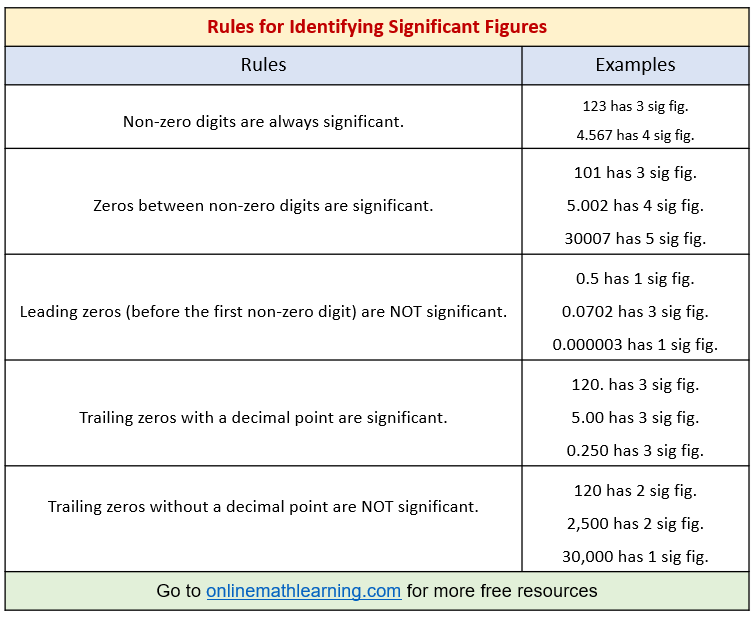
Rule 1: Non-Zero Digits are Always Significant
This is the simplest rule: any digit from 1 to 9 is always considered significant. These digits directly contribute to the magnitude and precision of the number.
-
Examples:
123has three significant figures.4.567has four significant figures.89.01(we’ll address the zero soon) has four significant figures because the 8, 9, 0, and 1 are all necessary.
-
Relevance in Tech: When dealing with data input from user forms, databases, or APIs, every non-zero digit provided is generally assumed to be significant unless explicitly stated otherwise. Software parsing these values must respect this inherent precision.
Rule 2: Zeros Between Non-Zero Digits are Significant (Sandwich Zeros)
Zeros that appear between non-zero digits are always significant. They are crucial for maintaining the magnitude and precision of the number.
-
Examples:
101has three significant figures.20.05has four significant figures.5003has four significant figures.
-
Relevance in Tech: Consider a GPS coordinate like
34.0205° N. The zeros here are vital. In a mapping application or navigation system, ignoring these ‘sandwich zeros’ would drastically alter the location, demonstrating their significance in defining precise values within digital datasets. Similarly, in scientific computing, representing chemical concentrations or physical constants often involves these types of zeros, and software must handle them with care to maintain accuracy.
Navigating Tricky Zeros and Decimal Points in Tech Data
The placement of zeros and decimal points often causes confusion, but their rules are critical for correctly interpreting data’s precision, especially when automating data processing.
Rule 3: Leading Zeros are Never Significant
Leading zeros are those that come before all non-zero digits. They are merely placeholders, indicating the position of the decimal point, and do not contribute to the number’s precision.
-
Examples:
0.005has only one significant figure (the 5). The leading zeros just tell us it’s a very small number.0.25has two significant figures (the 2 and the 5).0.0000000000000000000000000000000006626(Planck’s constant in some units) has four significant figures (6626).
-
Relevance in Tech: This rule is particularly important in scientific programming and data analysis. When converting units, performing calculations with very small numbers (e.g., in nanotechnology simulations, cryptographic operations, or astronomical distances), leading zeros are a common occurrence. Software must correctly identify and discard them when determining precision, especially when formatting output or performing comparisons. For instance, in floating-point representations (like
floatordoublein programming languages),0.005and5e-3conceptually hold the same precision based on the ‘5’, not the number of zeros.
Rule 4: Trailing Zeros and Decimal Points – The Deciding Factor
Trailing zeros are those at the end of a number. Their significance depends entirely on the presence of a decimal point.
-
If there is a decimal point: Trailing zeros are significant. They indicate that the measurement was precise enough to determine those zeros.
- Examples:
25.0has three significant figures. (The measurement was precise to the tenth’s place).100.00has five significant figures.400.has three significant figures (the decimal point makes all zeros significant).
- Examples:
-
If there is NO decimal point: Trailing zeros may or may not be significant. This is the ambiguous case. Conventionally, without a decimal point, they are often considered not significant, serving only as placeholders to indicate the magnitude. To remove ambiguity, scientific notation is preferred.
- Examples:
250(no decimal) typically has two significant figures (the 2 and the 5). The zero is a placeholder.1000(no decimal) typically has one significant figure (the 1).- To indicate that
250is precise to the ones place, you would write250.. To indicate precision to the tens place, you’d use scientific notation,2.5 x 10^2.
- Examples:
-
Relevance in Tech: This rule is paramount for data output and reporting. If a sensor reads
20 Vbut has a precision of0.1 V, displaying20.0 Vis crucial to convey that precision. In data visualization tools, displaying20versus20.00can profoundly change user perception of accuracy. For databases, storing20.00might imply aDECIMAL(5,2)type, ensuring two decimal places of precision, whereas20might imply anINTEGERorDECIMAL(2,0), where the trailing zeros are not explicitly significant to the stored value’s precision. Ignoring this rule can lead to “false precision” or, conversely, understating the true accuracy of a system.

Rule 5: Exact Numbers and Counts – Infinite Significance
Exact numbers are those that are obtained by counting discrete items or by definition (e.g., 12 inches in 1 foot, 1000 grams in 1 kilogram). They are considered to have an infinite number of significant figures because there’s no uncertainty associated with them.
-
Examples:
10apples (not10.0apples with uncertain precision).2(as in “twice the amount”).- The conversion factor
1 inch = 2.54 cm(exactly).
-
Relevance in Tech: When your software deals with counts (e.g., number of users, database records, iterations in a loop) or applies exact conversion factors, these numbers don’t limit the significant figures of a calculation. They are distinct from measurements, which always carry some uncertainty. Algorithms that apply exact constants or count discrete events must treat these values differently to avoid inappropriately truncating the precision of other measured values in a calculation.
Applying Significant Figure Rules in Technical Calculations and Software Development
Beyond identifying significant figures in a static number, their rules dictate how precision is maintained and propagated through mathematical operations. This is where significant figures truly impact the reliability of software and data analysis.
Rule 6: Addition and Subtraction – Precision by Decimal Place
When adding or subtracting numbers, the result should be rounded to the same number of decimal places as the number with the fewest decimal places in the operation. This is because the result cannot be more precise than the least precise input value.
-
Example:
12.34(two decimal places)5.6(one decimal place)+ 1.001(three decimal places)- Result:
18.941 - Rounding to the fewest decimal places (one, from 5.6):
18.9
-
Relevance in Tech: This rule is critical in algorithms that sum sensor readings, aggregate financial data (e.g., adding expenses with varying decimal precision), or perform cumulative calculations. Software that processes such operations must implement appropriate rounding logic. Displaying
18.941when one of the inputs only offered5.6would imply a false precision in the aggregated result, potentially leading to incorrect interpretations or flawed subsequent calculations. Libraries for numerical computation often have functions that manage this rounding, but developers must understand the underlying principle.
Rule 7: Multiplication and Division – Precision by Fewest Significant Figures
When multiplying or dividing numbers, the result should be rounded to the same number of significant figures as the number with the fewest significant figures in the operation. Here, the overall precision is limited by the least precise factor.
-
Example:
2.5(two significant figures)* 3.456(four significant figures)- Result:
8.64 - Rounding to the fewest significant figures (two, from 2.5):
8.6
-
Relevance in Tech: This rule is fundamental for scientific computing, unit conversions, signal processing, and any data transformation where values are scaled or combined. For instance, calculating the area from measured length and width, determining velocity from distance and time, or scaling data points in a machine learning pipeline. An engineering simulation might calculate a force as
10.2 N(3 sig figs) acting on a surface area of0.5 m^2(1 sig fig). The pressure, calculated as20.4 Pa, must be rounded to20 Pa(1 sig fig) to reflect the input’s true precision. Ignoring this rule can lead to significant error propagation, producing results that appear highly precise but are, in fact, numerically unstable and unreliable.
Beyond Basic Rules: Advanced Considerations for Developers
Understanding sig fig rules is a starting point. For developers, several related concepts further enhance numerical precision in software:
- Floating-Point Arithmetic Limitations (IEEE 754): Computers store numbers using binary floating-point representation, which can lead to small rounding errors for decimal numbers that cannot be perfectly represented in binary (e.g., 0.1). Developers must be aware that
0.1 + 0.2might not exactly equal0.3due to these internal representations, which can subtly affect precision. - Data Type Selection: Choosing between
float,double, or specializeddecimaltypes (e.g., in Python’sdecimalmodule, Java’sBigDecimal) is crucial.doubleoffers more precision thanfloat, whiledecimaltypes are designed for exact decimal arithmetic, critical for financial applications where precise decimal representation is paramount. - User Interface Design: How numerical data is displayed to the user must also reflect appropriate precision. Providing controls for users to specify precision or dynamically adjusting displayed sig figs based on data source reliability can improve usability and trust.
- Validation of Input: When users or external systems provide numerical input, validating it for reasonable precision and handling potential ambiguities (like trailing zeros without a decimal point) can prevent downstream errors.
- Numerical Libraries and Frameworks: Leveraging well-tested numerical libraries (e.g., NumPy in Python, Apache Commons Math in Java) can help manage precision and perform complex calculations correctly, as these often incorporate best practices for numerical stability.
The Real-World Impact: Why Sig Figs Matter in Tech
The meticulous application of significant figure rules isn’t just about academic correctness; it has tangible, real-world implications across every facet of technology.
Ensuring Data Integrity and Reliability
In a world drowning in data, integrity is paramount. False precision—representing data with more significant figures than its underlying measurement or calculation justifies—can severely compromise data integrity. Imagine an AI model trained on sensor data where precision is misrepresented. The model might learn to associate patterns with noise rather than true signals, leading to erroneous predictions. In scientific simulations, whether modeling climate change or designing new materials, reliable data outputs are the foundation of credible research and development. Tech professionals must be vigilant in ensuring that the precision of their data pipelines, from acquisition to display, accurately reflects reality, thereby fostering trust in their systems and insights.
Communicating Uncertainty Effectively
Significant figures are a language of uncertainty. They allow engineers to communicate tolerances in designs, scientists to share experimental results with appropriate caveats, and data analysts to present statistical findings without overstating their certainty. In software that supports these disciplines, such as CAD systems, laboratory information management systems (LIMS), or business intelligence dashboards, the correct display of significant figures ensures that users grasp the inherent limitations and reliability of the numbers they are viewing. This transparency is vital for informed decision-making and risk assessment.
Avoiding Costly Errors and Misinterpretations
History is replete with examples where numerical imprecision or misinterpretation has led to costly, even catastrophic, consequences. While sometimes attributed to unit errors (like the infamous Mars Climate Orbiter), similar problems can arise from a fundamental misunderstanding of numerical precision. Consider medical software calculating drug dosages based on patient weight; a slight error in precision could lead to under- or overdosing. In financial models, small rounding errors accumulated over complex calculations can lead to significant discrepancies over time, affecting investment decisions or accounting accuracy. Understanding and applying significant figure rules diligently helps mitigate such risks, fostering robust and dependable technological solutions.
Conclusion
The rules of significant figures are more than just a vestige of chemistry class; they are a vital conceptual framework for any professional working with numerical data in the technology sector. From the design of robust software to the interpretation of complex datasets, the ability to correctly assess and communicate numerical precision is a mark of professionalism and technical competence. By internalizing these rules, tech professionals can build more reliable systems, conduct more accurate analyses, and communicate their findings with greater clarity and credibility. In an increasingly data-driven world, mastering significant figures isn’t just an option; it’s a necessity for ensuring the integrity, reliability, and trustworthiness of our digital future. Let’s commit to precision, one significant figure at a time.
aViewFromTheCave is a participant in the Amazon Services LLC Associates Program, an affiliate advertising program designed to provide a means for sites to earn advertising fees by advertising and linking to Amazon.com. Amazon, the Amazon logo, AmazonSupply, and the AmazonSupply logo are trademarks of Amazon.com, Inc. or its affiliates. As an Amazon Associate we earn affiliate commissions from qualifying purchases.