
In the intricate world of technology, where every pixel, every rendered object, and every computational process relies on underlying mathematical principles, understanding fundamental geometric concepts is paramount. Among these, the concept of a “convex polygon” stands out as a deceptively simple yet profoundly influential building block. From the seamless graphics of modern video games to the sophisticated algorithms powering AI and robotics, convex polygons provide a foundational language for representing shapes and streamlining computations. They offer a unique blend of simplicity and efficiency, making them indispensable tools for developers, engineers, and researchers working across various digital domains.
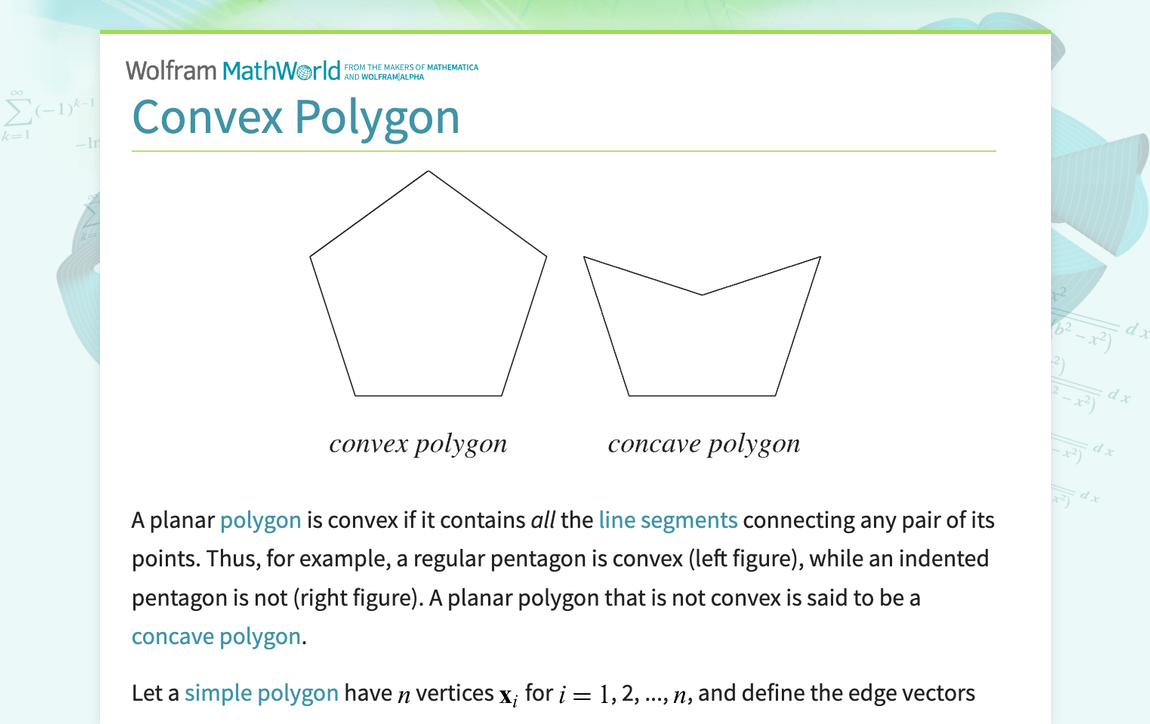
At its core, a polygon is a closed, two-dimensional shape made up of straight line segments connected end-to-end, forming a perimeter. While all polygons share these characteristics, the distinction between convex and concave polygons introduces a critical property that dictates their behavior and utility in computational applications. Grasping this distinction is not merely an academic exercise; it’s a practical necessity for anyone looking to optimize performance, enhance accuracy, or develop robust solutions in software engineering, computer graphics, artificial intelligence, and more. This article delves into the definition, significance, applications, and implementation of convex polygons, revealing why these unassuming geometric figures are so central to the digital advancements we experience daily.
The Fundamental Nature of Polygons in Computing
The digital realm is, in many ways, an abstraction of the physical world, represented through mathematical models. Polygons, with their straightforward definition and ability to approximate complex curves and surfaces, are the universal language for describing objects in two and three dimensions within computer systems. Understanding their basic properties and classifications is the first step towards leveraging their power.
Defining Polygons: The Building Blocks of Digital Worlds
A polygon is formally defined as a closed planar figure, formed by a finite sequence of straight line segments (edges) connected to form a polygonal chain or circuit, enclosing a single region. The points where the segments meet are called vertices. The simplest polygon is a triangle (three sides), followed by quadrilaterals (four sides), pentagons (five sides), and so on. In computer graphics and CAD software, objects are often tessellated (broken down) into networks of polygons, typically triangles, because they are the simplest planar elements and inherently convex, making them easy to manipulate and render. These polygonal meshes form the visual surfaces of characters, environments, and objects in virtually every digital application, from architectural visualizations to medical imaging.
Differentiating Convex from Concave: The Core Distinction
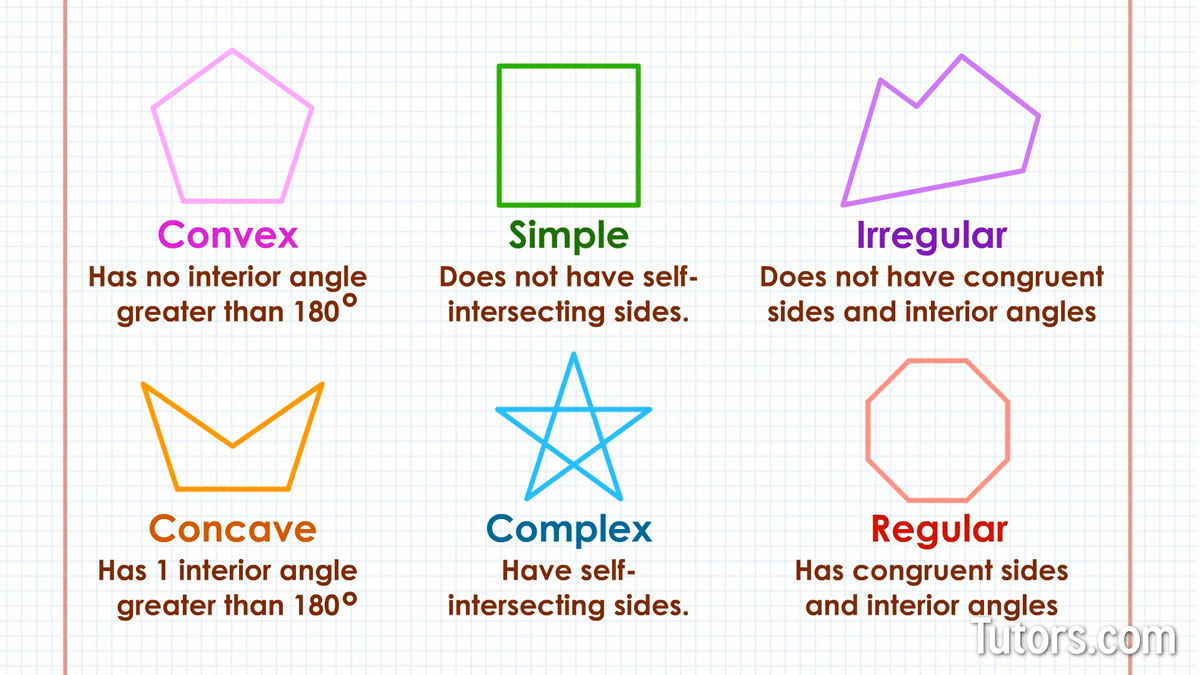
The crucial characteristic that distinguishes a convex polygon from its concave counterpart lies in its “inward” or “outward” bending. A polygon is defined as convex if, for any two points chosen inside or on the boundary of the polygon, the line segment connecting these two points lies entirely within or on the boundary of the polygon. An alternative, perhaps more intuitive, definition states that a polygon is convex if all its internal angles are less than or equal to 180 degrees. Furthermore, if you extend any edge of a convex polygon, the entire polygon will lie on one side of that line. Think of a perfect square, a regular pentagon, or an equilateral triangle – these are all classic examples of convex polygons.
Conversely, a polygon is concave if it is not convex. This means there is at least one pair of points within the polygon whose connecting line segment extends outside the polygon’s boundaries. It also implies that at least one internal angle is greater than 180 degrees (a “reflex angle”), or that extending at least one edge will cause part of the polygon to lie on both sides of that line. A star shape, a crescent moon, or the shape of the letter ‘L’ are common examples of concave polygons. This fundamental difference in geometry has profound implications for how algorithms interact with these shapes.
Key Properties and Mathematical Rigor
Convex polygons possess several elegant mathematical properties that make them particularly attractive for computational tasks:
- Simplicity of Containment Tests: Determining if a point lies inside a convex polygon is significantly simpler and faster than for a concave one.
- Convex Hull: For any set of points, there exists a unique smallest convex polygon that contains all the points. This is known as the convex hull and is a fundamental concept in computational geometry.
- Decomposition: Any concave polygon can be decomposed into a set of convex polygons (typically triangles or other simple convex shapes). This decomposition is a common strategy to handle complex shapes in algorithms by breaking them down into simpler, more manageable convex parts.
- Guaranteed Visibility: From any point inside a convex polygon, every other point inside the polygon is visible. This property simplifies visibility calculations in rendering and pathfinding. These properties translate directly into efficiency gains and algorithmic robustness in diverse tech applications.
Why Convexity Matters: Practical Applications in Software and AI
The theoretical elegance of convex polygons translates directly into tangible benefits across a spectrum of technological disciplines. Their inherent simplicity and predictable behavior make them a cornerstone for designing efficient and reliable algorithms.
Streamlining Computer Graphics and Rendering
In computer graphics, every 3D object is ultimately represented as a mesh of polygons. While complex objects are often concave, rendering engines frequently break them down into convex components, most commonly triangles. This triangulation is crucial because graphics hardware is highly optimized for rendering triangles.
- Faster Culling: Convex shapes simplify back-face culling (removing polygons facing away from the viewer) and frustum culling (removing objects outside the camera’s view), significantly reducing the number of polygons that need to be processed.
- Optimized Shading and Lighting: Calculating how light interacts with surfaces (shading) is more straightforward for convex polygons, leading to more efficient rendering pipelines and smoother visual output.
- Level of Detail (LOD) Systems: When generating different levels of detail for objects further away, convex polygon approximations can be used to simplify geometry without losing too much visual fidelity, saving computational resources.
Enhancing Game Development and Collision Detection
Game engines heavily rely on geometric computations, and collision detection is one of the most critical. When two objects in a game world interact, the engine must determine if they are colliding and how to respond.
- Efficient Collision Detection: Checking for collisions between two convex polygons (or convex hulls of more complex objects) is far more computationally efficient than checking between two arbitrary concave polygons. Algorithms like the Separating Axis Theorem (SAT) are particularly effective for convex shapes, offering rapid and precise collision detection.
- Physics Simulations: Many physics engines model objects as collections of convex shapes because the mathematics of resolving forces and impacts is much simpler and more stable for convex bodies. This helps in creating realistic and predictable physical interactions in games.
- Pathfinding and Navigation Meshes: For AI agents to navigate game environments, pathfinding algorithms often operate on navigation meshes (navmeshes) composed of convex polygons. These simplify the environment into walkable regions, making it easier for agents to find optimal paths without getting stuck or colliding with obstacles.
Geometric Algorithms and Computational Efficiency
Beyond graphics and games, convex polygons are central to various geometric algorithms that underpin a wide array of software functionalities.
- Point in Polygon Tests: Determining if a given point lies inside or outside a polygon is a common operation. For convex polygons, simpler and faster algorithms exist, such as the winding number algorithm or ray casting, often optimized further due to convexity.
- Proximity Queries: Finding the closest distance between two geometric objects is significantly simplified when those objects are convex. This is vital in fields like robotics for obstacle avoidance and in industrial design for analyzing clearances.
- Computational Geometry Libraries: Libraries like CGAL (Computational Geometry Algorithms Library) and various modules in scientific computing environments (e.g., NumPy, SciPy) provide highly optimized functions for operations on convex polygons, recognizing their computational advantages.
Role in AI, Robotics, and Computer Vision

The principles of convex geometry extend into cutting-edge fields like artificial intelligence, robotics, and computer vision, offering robust solutions to complex problems.
- Robotics Path Planning: Robots often need to navigate complex environments. Representing the robot’s shape and obstacles as convex polygons or polyhedra simplifies collision checking and allows for efficient path planning using techniques like configuration space planning.
- Computer Vision and Object Recognition: In image processing, features are often extracted and analyzed based on their geometric properties. Convex hulls of segmented objects can be used for shape analysis, feature extraction, and coarse object recognition.
- Machine Learning (Convex Optimization): Many machine learning algorithms, especially in optimization, rely on the concept of convexity. Convex functions have a single global minimum, making them much easier to optimize using gradient descent and other iterative methods. While not directly about convex polygons, the underlying mathematical principle of convexity is shared, demonstrating its pervasive influence in AI.
Implementing Convex Polygons in Code and Design
For developers, understanding how to represent, manipulate, and utilize convex polygons in code is a fundamental skill. From choosing appropriate data structures to employing specialized algorithms, practical implementation is where the theoretical advantages come to life.
Data Structures for Representing Polygons
At a basic level, a polygon is represented as an ordered list of vertices. For example, in 2D, each vertex is a pair of (x, y) coordinates.
- Array of Vertices: A simple array or list of
Vector2(orVector3for 3D) objects is the most common representation. The order of vertices defines the edges and direction (clockwise or counter-clockwise) of the polygon. - Edge List: For more complex topological operations, a representation that explicitly stores edges (pairs of vertex indices) can be useful, though less common for simple polygon definitions.
- Adjacency List/Matrix: In graph theory contexts, especially when dealing with polygon meshes (networks of connected polygons), adjacency lists or matrices are used to describe how vertices and edges are connected.
When dealing specifically with convex polygons, the simplicity of the definition often means that standard vertex list representations are sufficient, with additional algorithms applied to ensure or leverage convexity.
Algorithms for Convex Hull Computation
A key operation in computational geometry is finding the convex hull of a set of points. The convex hull is the smallest convex polygon that contains all given points. This operation is crucial for simplifying complex point clouds or object shapes into a convex approximation for faster processing.
- Graham Scan: A popular and relatively simple algorithm with O(N log N) time complexity. It involves sorting points by angle around a reference point and then iteratively building the hull.
- Jarvis March (Gift Wrapping): Another O(N*H) algorithm (where H is the number of points on the hull), useful when the hull has few points. It works by “wrapping” a string around the points.
- Monotone Chain (Andrew’s Algorithm): An efficient O(N log N) algorithm that sorts points by x-coordinate and then constructs upper and lower hulls.
- Quickhull: A divide-and-conquer algorithm with average-case O(N log N) complexity, similar in principle to quicksort.
These algorithms are fundamental tools for developers needing to create convex representations of arbitrary point sets or complex concave shapes, allowing them to then apply more efficient convex-specific algorithms.
Tools and Libraries Leveraging Convexity (e.g., CAD, Game Engines)
Modern software tools and libraries abstract away much of the low-level geometric math, but they inherently rely on convex polygon principles:
- Game Engines (Unity, Unreal Engine): These engines use convex shapes extensively for collision detection (often through physics libraries like PhysX or Havok), pathfinding (navigation meshes), and optimized rendering. Developers can define custom collision shapes as convex hulls or simple primitives.
- CAD/CAM Software (AutoCAD, SolidWorks): These applications use NURBS and other surface representations, which are ultimately discretized into polygonal meshes for display and analysis. Geometric operations like boolean operations and interference checking often benefit from breaking down complex shapes into convex parts.
- GIS Software (ArcGIS, QGIS): Geographic Information Systems frequently perform spatial analyses on polygonal regions. Operations like union, intersection, and containment are often optimized when dealing with convex regions.
- Computer Vision Libraries (OpenCV): Functions for contour analysis, shape approximation, and feature detection often include methods for finding convex hulls of image contours, which can then be used for recognition or tracking.
Best Practices for Developers
When working with convex polygons in development, several best practices can lead to more robust and efficient code:
- Always Prefer Convexity: Whenever possible, design your computational geometry to leverage convex shapes. If an object is concave, consider decomposing it into convex components or using its convex hull as an approximation for initial broad-phase calculations.
- Understand Your Tools: Familiarize yourself with the geometric capabilities of your chosen game engine, physics library, or CAD software. Many provide built-in functions for convex hull computation, collision detection with convex shapes, and convex decomposition.
- Numerical Stability: Be mindful of floating-point precision issues in geometric calculations. Use robust algorithms and consider tolerances when comparing floating-point numbers for equality or proximity.
- Optimization Strategies: For performance-critical applications (like real-time games), employ techniques like broad-phase/narrow-phase collision detection, where broad-phase uses simple convex shapes (like bounding boxes/spheres) to quickly rule out non-collisions before performing more detailed checks on complex geometry.
Beyond the Basics: Advanced Concepts and Future Trends
While the fundamental definition of convex polygons remains constant, their application continues to evolve, pushing the boundaries of what’s possible in digital environments and contributing to more sophisticated technological solutions.
Convex Decompositions and Approximation
Handling complex concave shapes efficiently often involves decomposing them into a set of simpler, convex polygons. This process, known as convex decomposition, is a crucial technique in computational geometry. Various algorithms exist, ranging from ear clipping for simple polygons to more advanced techniques like V-HACD (Hierarchical Approximate Convex Decomposition) that approximate complex 3D meshes with a set of convex polyhedra. This allows concave objects to benefit from the speed and stability of convex algorithms by processing their convex parts individually. The trade-off is often between the number of convex parts (more parts mean more precise approximation but higher computational overhead) and the quality of the approximation.
Convex Optimization and Machine Learning
The mathematical principle of convexity extends far beyond simple polygons into the realm of convex optimization. This field deals with minimizing convex functions over convex sets. In machine learning, many algorithms—such as Support Vector Machines (SVMs), Logistic Regression, and various forms of neural network training with specific activation functions and loss functions—can be formulated as convex optimization problems. The guarantee of finding a global minimum in convex optimization makes these algorithms highly reliable and predictable. While this isn’t directly about polygonal shapes, it highlights the profound impact of convexity as a mathematical concept on core AI technologies and algorithms, showcasing how fundamental geometric insights underpin advanced computational power.
The Evolving Landscape of Computational Geometry
The field of computational geometry continues to advance, driven by the increasing demands of realistic graphics, complex simulations, and intelligent systems. New algorithms for handling high-dimensional geometry, real-time topological changes, and more robust geometric queries are constantly being developed. Convex polygons and their generalizations (e.g., convex polyhedra in 3D, convex sets in higher dimensions) remain at the heart of these advancements. As hardware capabilities increase and new paradigms like quantum computing emerge, the ways we represent and manipulate geometric data, including convex polygons, will undoubtedly evolve, promising even more efficient and powerful solutions for the digital age.
Convex polygons, though seemingly a simple concept from elementary geometry, are foundational to a vast array of modern technological applications. Their inherent mathematical simplicity translates directly into computational efficiency, making them indispensable for everything from rendering immersive 3D graphics and enabling realistic physics simulations in games, to powering advanced AI pathfinding and robust geometric algorithms. For anyone delving into the intricacies of software development, computer graphics, or artificial intelligence, a solid understanding of what convex polygons are, why they matter, and how to implement them is not just beneficial—it’s essential for building efficient, stable, and cutting-edge digital experiences.
aViewFromTheCave is a participant in the Amazon Services LLC Associates Program, an affiliate advertising program designed to provide a means for sites to earn advertising fees by advertising and linking to Amazon.com. Amazon, the Amazon logo, AmazonSupply, and the AmazonSupply logo are trademarks of Amazon.com, Inc. or its affiliates. As an Amazon Associate we earn affiliate commissions from qualifying purchases.