
At first glance, the question “what are addition, subtraction, multiplication, and division called?” might seem almost simplistic, belonging more to an elementary math textbook than a deep dive into technology. After all, they are simply called addition, subtraction, multiplication, and division. Yet, to dismiss these fundamental operations as merely basic arithmetic is to overlook their profound and pervasive influence across the entire spectrum of modern technology. In the digital age, these four bedrock mathematical processes are not just abstract concepts; they are the very syntax and grammar of computation, the unseen architects that empower everything from the simplest calculator app to the most sophisticated artificial intelligence.
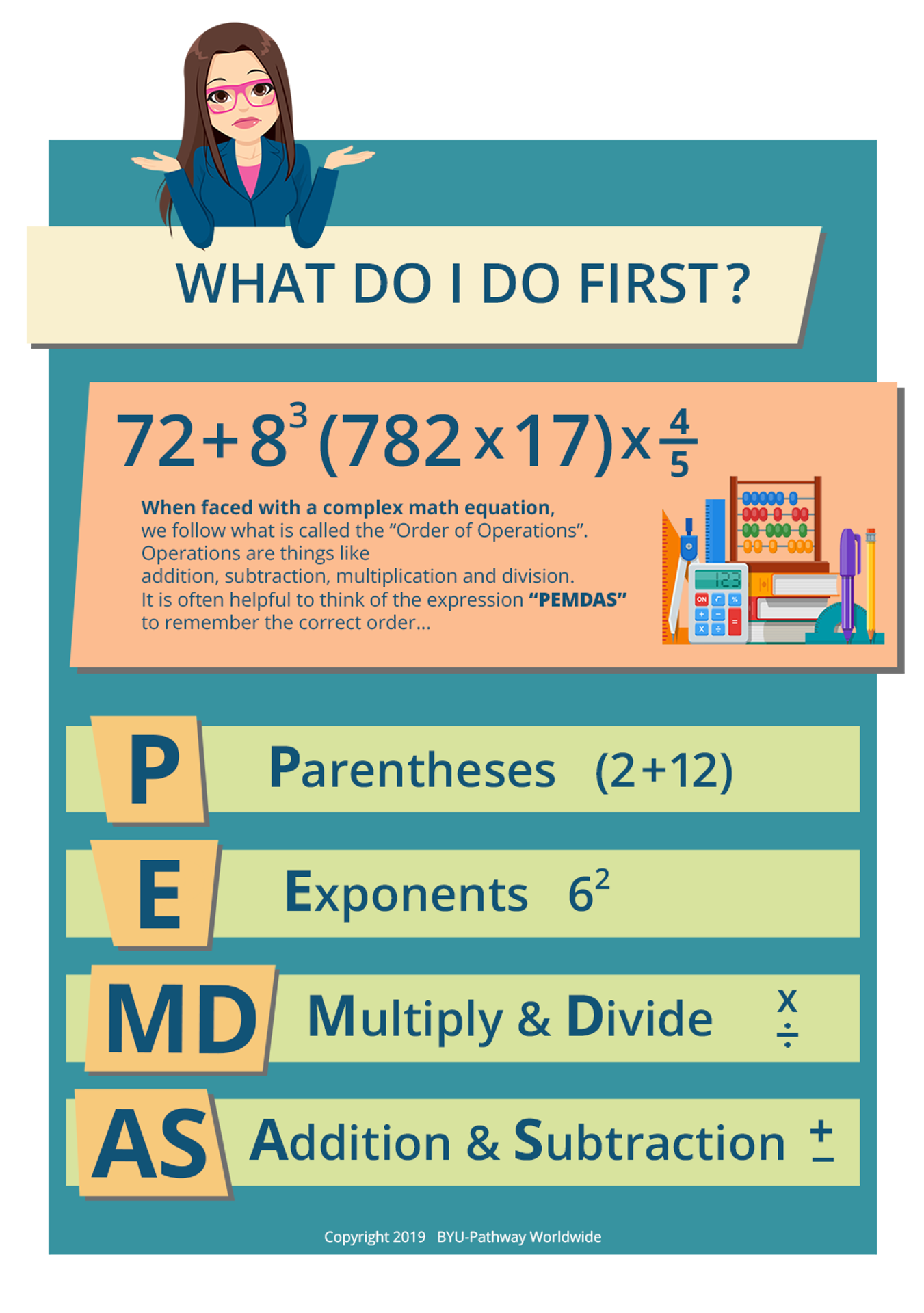
In the realm of technology, these operations transcend their basic definitions. They are the essential instructions that processors execute billions of times per second, the logical underpinnings of every algorithm, and the foundational elements that allow us to process, analyze, transform, and understand digital information. While their names remain constant, their embodiment and application in technology reveal a depth and complexity far beyond their schoolhouse origins. They are, in essence, the universal language spoken by every piece of silicon, the engine driving innovation, and the indispensable tools for navigating an increasingly data-driven world. This exploration delves into how these core arithmetic operations function as the unseen architecture, the transformative engines, and the critical analytical tools within the vast landscape of technology.
The Unseen Architecture: How Core Arithmetic Powers All Technology
The humble arithmetic operations of addition, subtraction, multiplication, and division are, in fact, the most fundamental building blocks of all digital technology. They are the invisible gears and levers that churn within every microchip, executing the commands that bring software to life and drive hardware functionality. Without them, there would be no computation, no data processing, and ultimately, no digital age.
Beyond Simple Numbers: The Digital Language of Operations
At its core, a computer doesn’t understand human languages or complex mathematical symbols directly. Instead, it operates on electricity, represented by binary digits: 0s and 1s. This binary system is the true native tongue of computation. When we ask a computer to perform an addition, for instance, it’s not “adding” in the way a human does with base-10 numbers. Instead, specialized circuits within the Central Processing Unit (CPU), known as the Arithmetic Logic Unit (ALU), manipulate these 0s and 1s using logic gates (AND, OR, NOT, XOR). For example, a binary adder circuit can take two binary numbers and produce their sum, along with a carry-out bit, purely through a cascade of logical operations.
Similarly, subtraction is often performed by adding the negative equivalent of a number (using two’s complement representation), effectively converting subtraction into an addition problem for the ALU. Multiplication, especially for larger numbers, is broken down into a series of additions and bit shifts. Division, conversely, is typically implemented as a series of subtractions and shifts. This illustrates a crucial point: these seemingly distinct operations are deeply interconnected at the hardware level, often reducing to the most basic logical manipulations of binary data. They are the “primitives” from which all higher-level computational tasks are constructed, forming the indispensable digital language that underpins all software instructions and hardware operations.
From Calculators to Quantum: The Evolution of Arithmetic Engines
The journey of arithmetic operations in technology traces a fascinating path, from rudimentary mechanical aids to the bleeding edge of quantum physics. Early computational devices like the abacus, Napier’s Bones, and later mechanical calculators developed by Pascal and Leibniz, physically embodied these operations through gears and levers. These machines were literal arithmetic engines, designed to perform calculations faster and more accurately than human hand.
The advent of electronic computers in the mid-20th century revolutionized this. Instead of physical movement, switches and vacuum tubes (later transistors) performed the logic operations at unprecedented speeds. Modern CPUs now contain incredibly complex ALUs capable of executing billions of arithmetic operations per second, often in parallel. These ALUs are highly optimized, with dedicated instruction sets for various forms of addition, subtraction, multiplication, and division, handling different data types (integers, floating-point numbers) with extreme precision and efficiency. The relentless pursuit of faster and more efficient arithmetic processing has been a driving force in CPU design, leading to multi-core processors, specialized co-processors (like GPUs for highly parallel matrix multiplications), and vectorized instruction sets. Looking ahead, quantum computing promises an entirely new paradigm for computation. While the fundamental operations remain, their execution leveraging quantum phenomena like superposition and entanglement could allow for certain types of arithmetic problems (especially those involving very large numbers or complex optimizations) to be solved in ways currently unimaginable, fundamentally altering the landscape of what is computationally feasible.
Addition: The Foundation of Aggregation and Growth in Tech
Addition, the simplest of the four operations, is far more than just summing two numbers in the digital world. It is the very principle of accumulation, aggregation, and growth that underpins vast swathes of technological processes, from basic data management to the sophisticated learning mechanisms of artificial intelligence.
Summing Up Data: Applications in Analytics and Databases
In the realm of data, addition is omnipresent. Every time a new entry is added to a database, a counter is incremented. In data analytics, addition is the backbone of aggregation. When tracking website visits, sales figures, user interactions, or sensor readings, analysts frequently sum up values over specific periods or categories to derive meaningful insights. Database management systems (DBMS) extensively use SUM() functions to calculate totals for columns, providing summaries essential for business intelligence and reporting. For example, summing up individual transaction amounts yields total revenue, or summing up unique user logins gives daily active users. Even in networking, addition plays a role in checksums (simple error detection mechanisms that sum bits) and calculating packet sizes. The ability to efficiently aggregate data through addition is crucial for making sense of large datasets, identifying trends, and driving data-informed decisions.
Building Blocks for Algorithms: From Simple Loops to Neural Networks
In programming, addition is a fundamental operational primitive. Counters in loops (i++ or i = i + 1) are perhaps the most ubiquitous example, driving iteration through arrays, lists, or sequences. Accumulating values in a loop to calculate a running total is another common pattern. In computer graphics, addition is used for translating objects (adding a vector to an object’s current position) or blending colors. More profoundly, in the advanced field of machine learning, especially in neural networks, addition is absolutely critical. During the “forward pass,” the weighted inputs to a neuron are summed up before being passed through an activation function. In the “backward pass” (backpropagation), gradients are accumulated and added to update the network’s weights and biases. Every single neuron in a deep learning model performs a series of multiplications and additions to process information, making addition the silent workhorse behind complex pattern recognition and predictive capabilities.
Subtraction: The Logic of Difference, Control, and Refinement
Subtraction, the inverse of addition, plays an equally vital role in technology by allowing us to identify differences, measure discrepancies, and exert control. It is the operation that quantifies deficits, determines distances, and enables systems to react to variations, forming the basis for error correction, regulation, and strategic resource management.
Measuring Discrepancies: Error Detection and Control Systems
The concept of “difference” is central to many technological applications, and subtraction is the operation that quantifies it. In control systems, whether for industrial machinery, robotic arms, or environmental regulation, subtraction is constantly used to calculate the “error signal.” This is typically the difference between a desired setpoint (e.g., a target temperature, position, or speed) and the actual measured value. This error signal then drives actuators to reduce the discrepancy, ensuring the system maintains its desired state. In digital audio and image processing, subtraction can be used for noise reduction, by subtracting a known noise profile from a signal, or for identifying changes between two frames in a video. Even in gaming, subtraction is omnipresent: deducting health points, ammunition counts, or resource levels are all basic applications of this operation, defining the limits and consequences within virtual worlds.
Optimization and Resource Management: Subtracting Waste, Gaining Efficiency
Beyond control, subtraction is crucial for optimizing resource usage and enhancing efficiency. In operating systems, available memory or disk space is constantly monitored and updated through subtraction as applications consume resources. Network bandwidth allocation also relies on subtracting used capacity from total available capacity. In financial technology, subtraction is fundamental for managing balances: every debit or withdrawal is a subtraction from an account, reflecting the current financial state. Algorithms for pathfinding or optimization often involve evaluating the “cost” or “distance” between points, and subtraction is used to calculate these differences to find the most efficient route or solution. By precisely measuring what is available versus what is consumed, subtraction enables systems to intelligently manage their resources, prevent overloads, and ensure smooth operation.
Multiplication: Scaling, Transformation, and Predictive Power
Multiplication stands as a powerhouse operation in technology, primarily enabling scaling, transformation, and the synthesis of complex relationships. It allows systems to amplify values, rotate and resize objects in digital space, and uncover intricate patterns essential for predictive models and realistic simulations.
Scaling and Transformations: Graphics, AI, and Simulations
Nowhere is multiplication’s power more evident than in computer graphics. Matrix multiplication is the cornerstone of 2D and 3D transformations, allowing objects to be scaled (enlarged or shrunk), rotated around an axis, and translated (moved) within a virtual environment. Every frame rendered in a video game, every animation, and every architectural visualization relies heavily on these matrix operations. In machine learning, particularly in deep neural networks, multiplication is critically important. The “weights” assigned to connections between neurons are multiplied by the input values to determine the strength of their influence. This matrix multiplication is the core mathematical operation performed millions of times during both the training and inference phases of AI models, enabling them to learn complex features and make predictions. Similarly, in simulations, multiplication is used to scale parameters, apply forces, and evolve states over time, modeling everything from weather patterns to financial markets.
Data Amplification and Prediction: Leveraging Patterns
Multiplication also plays a pivotal role in data amplification and prediction. In signal processing, multiplication is used to adjust the amplitude of signals, amplifying weak signals or attenuating strong ones, which is critical in audio processing or telecommunications. In statistical and predictive analytics, coefficients (which act as multipliers) are applied to independent variables to forecast outcomes or understand relationships within data. For instance, in linear regression models, each feature’s contribution to the predicted value is determined by multiplying its value by its learned coefficient. Cryptography, too, leans heavily on multiplication, particularly modular multiplication of very large prime numbers, to generate secure keys and encrypt/decrypt data, forming the backbone of digital security. These applications showcase how multiplication allows technology to scale relationships, transform data, and ultimately, predict and secure our digital future.
Division: Distribution, Ratios, and Proportional Understanding
Division, the final of the four fundamental operations, is crucial for allocation, creating ratios, and understanding proportionality. In the digital realm, it enables systems to distribute resources fairly, calculate averages, normalize data for comparison, and represent information in meaningful proportions.
Allocating Resources and Calculating Averages: Fair Shares in the Digital World
Division is the primary mechanism for fair resource allocation in computing environments. Operating systems use division to distribute CPU time slices or network bandwidth among multiple processes or users, ensuring that no single entity monopolizes resources. In distributed computing, tasks and data are often divided among various nodes for parallel processing. In data analysis, calculating averages (sum divided by count) is perhaps the most common application of division, providing a central tendency measure crucial for understanding data distributions. Percentages and proportions, vital for reporting and comparisons (e.g., market share, conversion rates), are also derived directly from division. Whether it’s balancing the load across servers or presenting aggregated metrics, division is essential for equitable distribution and meaningful statistical summarization.
Normalization and Proportionality: Making Sense of Complex Data
Beyond simple allocation, division is indispensable for normalization and understanding proportionality in complex data. Normalization techniques in machine learning and data science often involve dividing values by a maximum, a range, or a standard deviation to scale data into a common range. This is critical because algorithms often perform better when input features have similar scales, preventing features with larger numerical values from disproportionately influencing the model. In image processing, division can be used to adjust the brightness or contrast of pixels across an entire image. In financial tech, calculating ratios (e.g., price-to-earnings ratio, debt-to-equity ratio) through division provides crucial insights into a company’s health and performance. By allowing us to compare disparate quantities on a level playing field, division helps to reveal underlying structures, relationships, and relative importance within vast and varied datasets, transforming raw numbers into understandable context.
Conclusion
The question “what are addition, subtraction, multiplication, and division called?” reveals itself to be much more than a simple query about mathematical terminology when viewed through the lens of technology. While their names remain the same as they have for centuries, their digital embodiments and applications are nothing short of monumental. These four fundamental operations are not just abstract concepts; they are the very DNA of computation, woven into the fabric of every transistor, algorithm, and software instruction.
From the basic logic gates that perform binary arithmetic to the sophisticated matrix operations powering artificial intelligence and the meticulous calculations maintaining our financial systems, these operations are the silent, ubiquitous heroes of the digital age. They enable us to aggregate and grow data, control and refine systems, scale and transform information, and distribute and understand proportions. As technology continues its relentless march forward, creating ever more complex systems and demanding faster, more efficient processing, the foundational role of addition, subtraction, multiplication, and division will only continue to grow in importance. They are the unchanging, indispensable language that allows the digital world to function, evolve, and ultimately, redefine what is possible.
aViewFromTheCave is a participant in the Amazon Services LLC Associates Program, an affiliate advertising program designed to provide a means for sites to earn advertising fees by advertising and linking to Amazon.com. Amazon, the Amazon logo, AmazonSupply, and the AmazonSupply logo are trademarks of Amazon.com, Inc. or its affiliates. As an Amazon Associate we earn affiliate commissions from qualifying purchases.