
The terms “accounting” and “finance” are frequently used interchangeably, yet they represent distinct disciplines within the vast realm of money management. While intrinsically linked and mutually dependent, understanding their fundamental differences is crucial for anyone navigating personal investments, managing a business, or pursuing a career in the financial sector. Both are pillars of economic activity, but they operate with different time horizons, objectives, and methodologies. This article delves into the core distinctions, their synergistic relationship, and what each entails for individuals and organizations.
The Foundational Role of Accounting
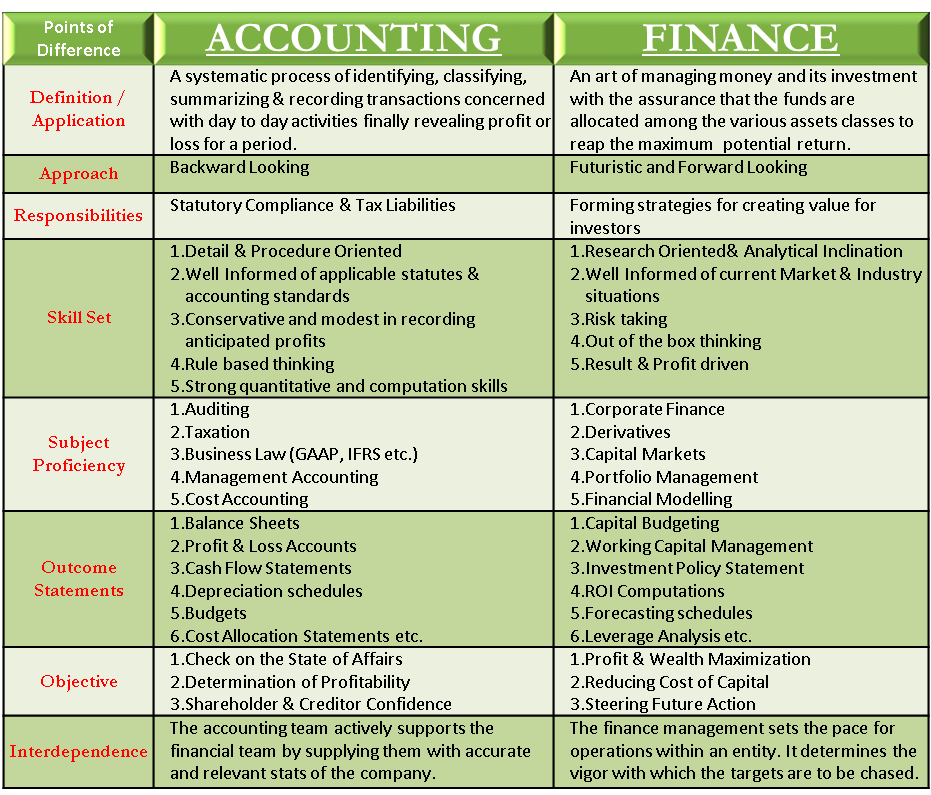
Accounting is often described as the “language of business.” It is a systematic process of recording, summarizing, analyzing, and reporting financial transactions. Its primary focus is on accuracy, compliance, and providing a clear historical record of an entity’s financial health. Think of accounting as the meticulous historian of an organization’s financial journey.
Defining Accounting: Recording and Reporting
At its heart, accounting is concerned with tracking every dollar that comes in and goes out. It involves the preparation of financial statements that provide a snapshot of a company’s performance and position at a given time. These statements – the Income Statement, Balance Sheet, and Cash Flow Statement – are vital for internal management, external investors, creditors, and regulatory bodies.
The process begins with transaction recording, often through double-entry bookkeeping, which ensures every financial event has an equal and opposite effect. This meticulous recording leads to the generation of ledgers and trial balances, culminating in the comprehensive financial reports. The objective is to present a truthful and fair view of financial activities, adhering to generally accepted accounting principles (GAAP) or International Financial Reporting Standards (IFRS) to ensure consistency and comparability.
Key Branches of Accounting
Accounting is not a monolithic field; it branches into several specialized areas, each serving a unique purpose:
- Financial Accounting: This is the most public-facing branch. It focuses on preparing financial statements for external stakeholders such such as investors, creditors, and regulators. Its primary goal is to provide transparent and standardized financial information to aid external decision-making. Compliance with reporting standards is paramount here.
- Managerial Accounting (or Management Accounting): In contrast to financial accounting, managerial accounting serves internal management. It provides financial insights and reports tailored to assist in internal decision-making, planning, and control. This includes budgeting, cost analysis, performance measurement, and strategic pricing. It’s less about historical reporting and more about providing forward-looking information for operational efficiency and strategic planning.
- Tax Accounting: This specialized area deals with the preparation of tax returns and compliance with tax laws. Tax accountants help individuals and businesses minimize their tax liabilities legally, navigate complex tax codes, and ensure timely filing with government authorities. This field requires a deep understanding of ever-evolving tax regulations.
- Auditing: Often considered a separate but related discipline, auditing involves the independent examination of financial records to ensure their accuracy and compliance with established standards. Auditors provide assurance that financial statements are free from material misstatement, adding credibility to the reported information.
The Importance of Historical Data and Compliance
A hallmark of accounting is its reliance on historical data. Accountants look backward, analyzing past transactions to accurately represent an entity’s financial position. This historical perspective is critical for understanding trends, identifying anomalies, and ensuring accountability. Moreover, compliance is a cornerstone of accounting. Adhering to regulatory frameworks, ethical standards, and industry best practices is not just good practice; it’s often a legal requirement. Failure to comply can lead to severe penalties, reputational damage, and loss of trust. Accurate accounting provides the raw, verified data upon which all sound financial decisions are built.
The Forward-Looking World of Finance
While accounting compiles the financial past, finance is concerned with shaping the financial future. It’s the art and science of managing money and other assets, making decisions about how to acquire capital, where to invest it, and how to allocate resources to achieve financial objectives. Finance professionals are forward-thinkers, strategists who seek to maximize value and manage risk.
Defining Finance: Managing and Maximizing Capital
Finance, at its core, is about making smart decisions regarding the allocation of scarce resources over time, taking into account risk and return. It answers questions like: “Where should we get the money?” (e.g., debt vs. equity), “Where should we put the money?” (e.g., projects, investments, acquisitions), and “How do we ensure we have enough money in the future?”
Finance involves forecasting, budgeting, risk management, and the valuation of assets and projects. It is inherently future-oriented, focusing on cash flows, market movements, and the potential for growth. Financial decisions are often strategic, impacting an organization’s long-term viability and profitability.
Core Areas of Finance
Like accounting, finance is a broad field with distinct specializations:
- Corporate Finance: This branch focuses on the financial decisions that businesses make to achieve their goals. It involves capital budgeting (deciding which projects to invest in), capital structure (determining the mix of debt and equity funding), and working capital management (managing short-term assets and liabilities). Corporate finance aims to maximize shareholder wealth and ensure the long-term health and growth of the company.
- Investments: This area deals with the analysis and selection of securities (like stocks, bonds, and real estate) for investment portfolios. Investment professionals assess risk and return, develop investment strategies, and manage portfolios for individuals, institutions, and mutual funds. It involves deep market analysis, valuation techniques, and an understanding of economic trends.
- Personal Finance: This branch focuses on individual financial planning and management. It encompasses budgeting, saving, investing for retirement, managing debt, insurance, and estate planning. The goal is to help individuals achieve their personal financial goals and secure their financial future.
- Financial Markets and Institutions: This area examines the structure and function of financial markets (stock markets, bond markets, foreign exchange markets) and the institutions that operate within them (banks, investment firms, insurance companies). It explores how these markets facilitate the flow of capital and influence economic activity.
The Focus on Future Value and Strategic Decisions
Finance is inherently about the future. It uses present information, often derived from accounting, to make informed predictions and strategic choices that will impact future financial outcomes. This involves assessing the time value of money, understanding risk-return tradeoffs, and forecasting market conditions. Financial professionals constantly evaluate opportunities and threats, striving to increase wealth and mitigate potential losses.
Strategic decision-making is central to finance. Whether it’s a corporate treasury deciding on a new bond issuance, an investment manager allocating assets across diverse portfolios, or an individual planning for retirement, these are all future-oriented decisions designed to optimize financial results.
Distinct Perspectives, Shared Goals
While accounting and finance serve different immediate purposes and employ different methodologies, they ultimately share the overarching goal of contributing to the financial health and success of an entity. Their distinctions primarily lie in their time horizon, the application of data, and the specific skill sets required.
Time Horizon: Past vs. Future
Perhaps the most significant difference lies in their temporal focus:
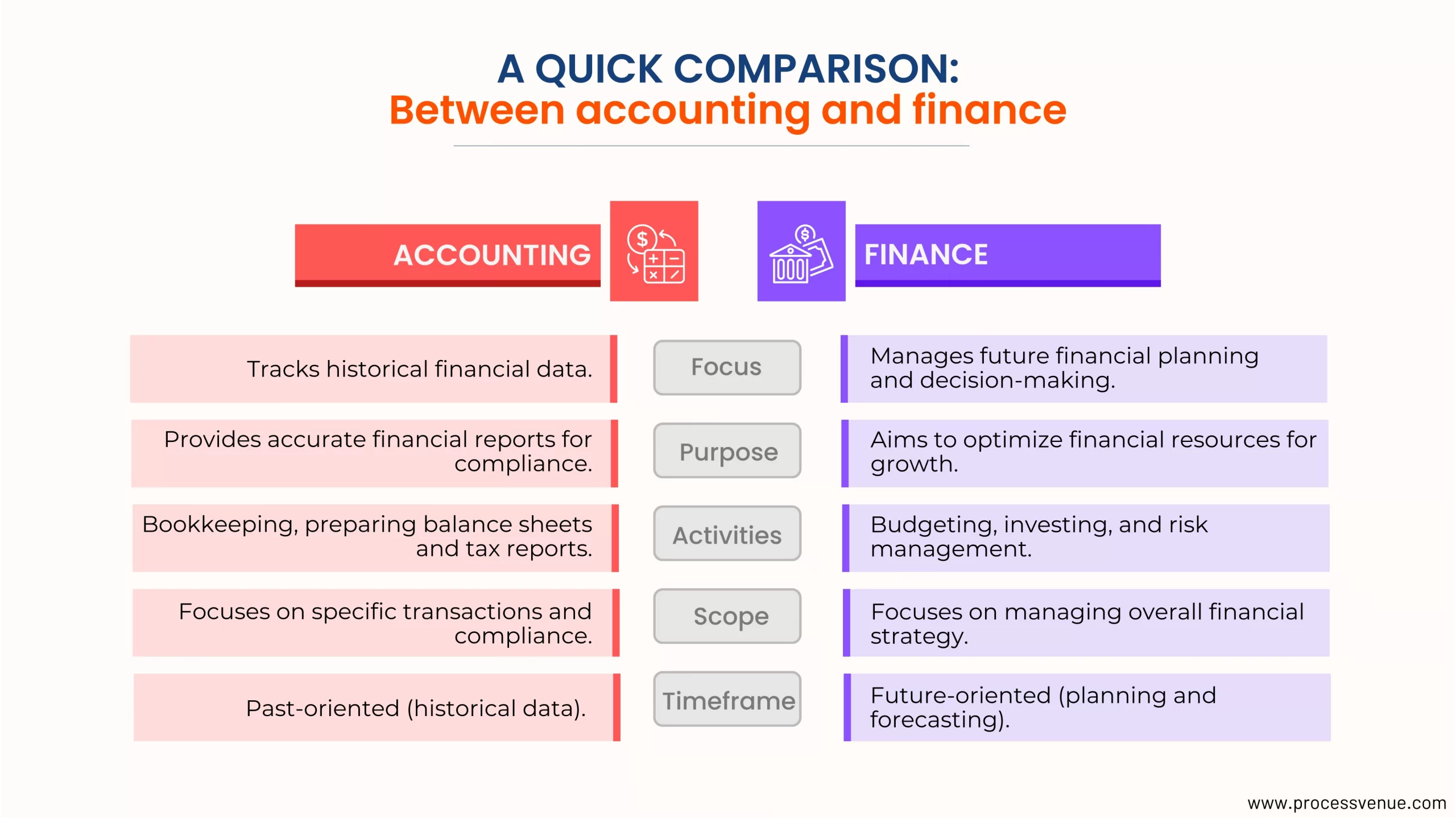
- Accounting is retrospective: It looks backward, meticulously recording and reporting what has already happened. It provides a factual, verifiable record of past transactions and financial performance. This historical data forms the basis for accountability and compliance.
- Finance is prospective: It looks forward, using historical data and current market information to forecast, plan, and make decisions about what should happen in the future. Its concern is with future cash flows, potential risks, and opportunities for growth and value creation.
Data Application: Reporting vs. Decision-Making
Both fields work with financial data, but they use it for different primary purposes:
- Accounting focuses on reporting and stewardship: Its main output is financial statements that accurately reflect the financial position and performance. This reporting is crucial for compliance, transparency, and allowing stakeholders to assess past performance.
- Finance focuses on decision-making and value creation: It takes the data provided by accounting and, along with other market and economic information, analyzes it to make strategic choices that will maximize wealth, optimize resource allocation, and manage risk. Financial analysis transforms raw data into actionable insights for future growth.
Skill Sets and Professional Roles
The distinct focuses also lead to different critical skill sets and typical professional roles:
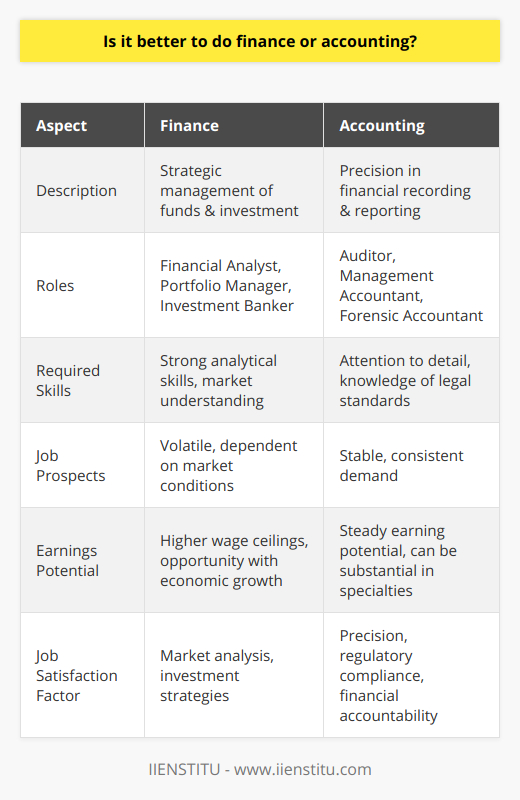
- Accountants typically excel in attention to detail, analytical rigor, understanding of regulations and standards, accuracy, and strong organizational skills. Roles include Financial Accountant, Auditor, Tax Accountant, Management Accountant, Controller. They are the meticulous record-keepers and compliance guardians.
- Financial Professionals require strong analytical skills, strategic thinking, risk assessment, economic forecasting, decision-making under uncertainty, and communication skills. Roles include Financial Analyst, Investment Banker, Portfolio Manager, Financial Planner, Chief Financial Officer (CFO). They are the strategists and value creators.
The Synergistic Relationship: How They Intersect
Despite their differences, accounting and finance are inextricably linked. They form a continuous feedback loop, with each discipline providing essential inputs for the other. Neither can function effectively in isolation; their combined strength drives sound financial management and strategic growth.
Accounting as the Foundation for Financial Analysis
Financial data generated by accountants is the lifeblood of finance. Without accurate, reliable, and timely financial statements, financial analysts would lack the foundational information needed to make informed decisions. Accountants provide the “raw ingredients” – the balance sheets, income statements, and cash flow statements – that financial professionals use to:
- Evaluate performance: Assess profitability, liquidity, and solvency ratios.
- Value assets and companies: Determine the intrinsic worth of investment opportunities.
- Forecast future earnings and cash flows: Project financial outcomes based on historical trends.
- Conduct due diligence: Analyze financial health during mergers and acquisitions.
In essence, finance builds upon the bedrock laid by accounting. You can’t effectively plan for the future without a clear understanding of the past.
Finance Guiding Accounting Practices
While accounting provides the data, financial objectives and strategies often influence how accounting information is prepared and presented. For instance:
- Strategic Planning: Financial goals, such as maximizing shareholder value or securing funding for expansion, can dictate the need for specific managerial accounting reports or influence how financial performance is measured and communicated.
- Risk Management: Financial considerations regarding risk exposure might lead to the implementation of specific accounting controls or reporting mechanisms to monitor potential vulnerabilities.
- Investment Decisions: When a company makes a major investment decision (a finance function), the subsequent impact on assets, liabilities, and equity needs to be accurately recorded and reported by accounting.
- Reporting Requirements: New financial regulations or investor demands (driven by finance) can necessitate changes in accounting standards or reporting practices.
Bridging the Gap for Business Success
For any business to thrive, accounting and finance must work hand-in-hand. A Chief Financial Officer (CFO) is a prime example of a role that bridges this gap, overseeing both the accounting and finance departments. The CFO relies on accounting data to ensure compliance and accurate reporting, while simultaneously using financial insights to drive strategic decision-making, manage capital, and communicate with investors.
A company with excellent accounting but poor financial management might have perfectly recorded losses. Conversely, a company with ambitious financial strategies but flawed accounting could be building its future on shaky, inaccurate ground. The seamless integration of both functions ensures that a business is not only compliant and transparent but also strategically positioned for growth and sustained profitability.
Choosing Your Path: Career and Business Implications
Understanding the distinction between accounting and finance is vital for anyone considering a career in the money world, as well as for entrepreneurs and business leaders looking to build robust financial operations.
Career Opportunities in Accounting
A career in accounting offers stability and a clear path for professional development. Typical roles include:
- Public Accountant: Working for an accounting firm, providing audit, tax, and consulting services to various clients.
- Corporate Accountant: Working within a company, managing its internal financial records, preparing statements, and ensuring compliance.
- Government Accountant: Working for federal, state, or local government agencies, managing public funds and ensuring fiscal responsibility.
- Forensic Accountant: Investigating financial crimes and discrepancies, often working with law enforcement or legal firms.
- Internal Auditor: Ensuring the effectiveness of internal controls and risk management processes within an organization.
These roles often require certifications like Certified Public Accountant (CPA) in the US or similar professional designations globally.
Career Opportunities in Finance
Finance offers a dynamic and often high-stakes environment with diverse career paths:
- Investment Banker: Advising companies on mergers, acquisitions, and raising capital.
- Financial Analyst: Researching and analyzing financial data to make investment recommendations.
- Portfolio Manager: Managing investment portfolios for clients, aiming to achieve specific financial goals.
- Corporate Treasurer: Managing a company’s cash flow, capital structure, and funding.
- Financial Planner: Helping individuals and families plan for retirement, investments, and other financial goals.
- Risk Manager: Identifying and mitigating financial risks within an organization.
Many finance professionals pursue certifications like Chartered Financial Analyst (CFA) or Financial Risk Manager (FRM).
Strategic Integration for Entrepreneurs and Businesses
For entrepreneurs, understanding both accounting and finance is critical. Initially, they might handle both roles, meticulously tracking expenses (accounting) while also making strategic decisions about funding and pricing (finance). As a business grows, separating these functions and hiring specialists becomes crucial.
- Robust accounting systems ensure a clear picture of cash flow, profitability, and tax obligations, preventing costly errors and ensuring compliance.
- Strategic financial management allows a business to optimize capital, make informed investment decisions for expansion, manage debt effectively, and navigate economic challenges, ultimately driving long-term value creation.
Ignoring one for the other is a recipe for disaster. A business needs accurate data to make smart financial decisions, and it needs a strong financial strategy to make that data meaningful and propel growth.
Conclusion
Accounting and finance, though distinct in their focus and methodology, are two sides of the same monetary coin. Accounting provides the precise, historical record-keeping and reporting that ensures transparency and compliance. It tells us where we’ve been financially. Finance, on the other hand, is the strategic foresight, using that historical data to make forward-looking decisions about managing and maximizing wealth, guiding where we’re going financially.
For individuals, businesses, and the economy at large, a deep appreciation for both disciplines is indispensable. They are not in opposition but in a perpetual dance of data provision and strategic action, each vital for navigating the complex world of money and securing a prosperous future.
aViewFromTheCave is a participant in the Amazon Services LLC Associates Program, an affiliate advertising program designed to provide a means for sites to earn advertising fees by advertising and linking to Amazon.com. Amazon, the Amazon logo, AmazonSupply, and the AmazonSupply logo are trademarks of Amazon.com, Inc. or its affiliates. As an Amazon Associate we earn affiliate commissions from qualifying purchases.