
The concept of “Mach 1” conjures images of sleek fighter jets, groundbreaking aviation feats, and the dramatic shattering of the sound barrier. More than just a number, Mach 1 represents a fundamental threshold in aerospace engineering and a perpetual benchmark for technological innovation. It’s not a fixed velocity like the speed limit on a highway; instead, it’s a dynamic measurement intrinsically linked to the speed of sound – a speed that varies with the environment. Understanding Mach 1 is crucial for anyone interested in high-speed technology, from supersonic transport to advanced defense systems and the future of space exploration. This article delves into the core definition of Mach 1, explores the profound technological advancements it has inspired, dissects the engineering challenges overcome, and looks ahead to the future of supersonic and hypersonic flight.
The Science Behind Supersonic Flight: Understanding Mach Number
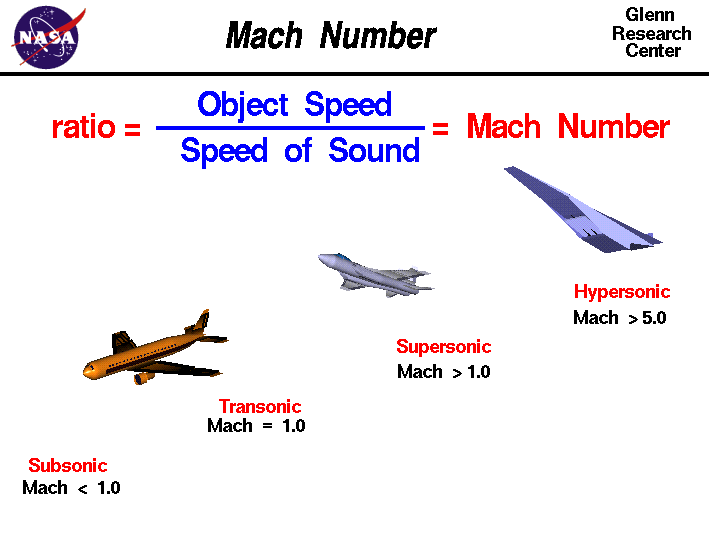
At its heart, Mach 1 is a ratio, not a specific speed. Named after Austrian physicist Ernst Mach, the Mach number quantifies an object’s speed relative to the speed of sound in the surrounding medium. This makes it an indispensable tool for aerospace engineers and scientists studying phenomena at extreme velocities.
Defining Mach 1: The Sound Barrier
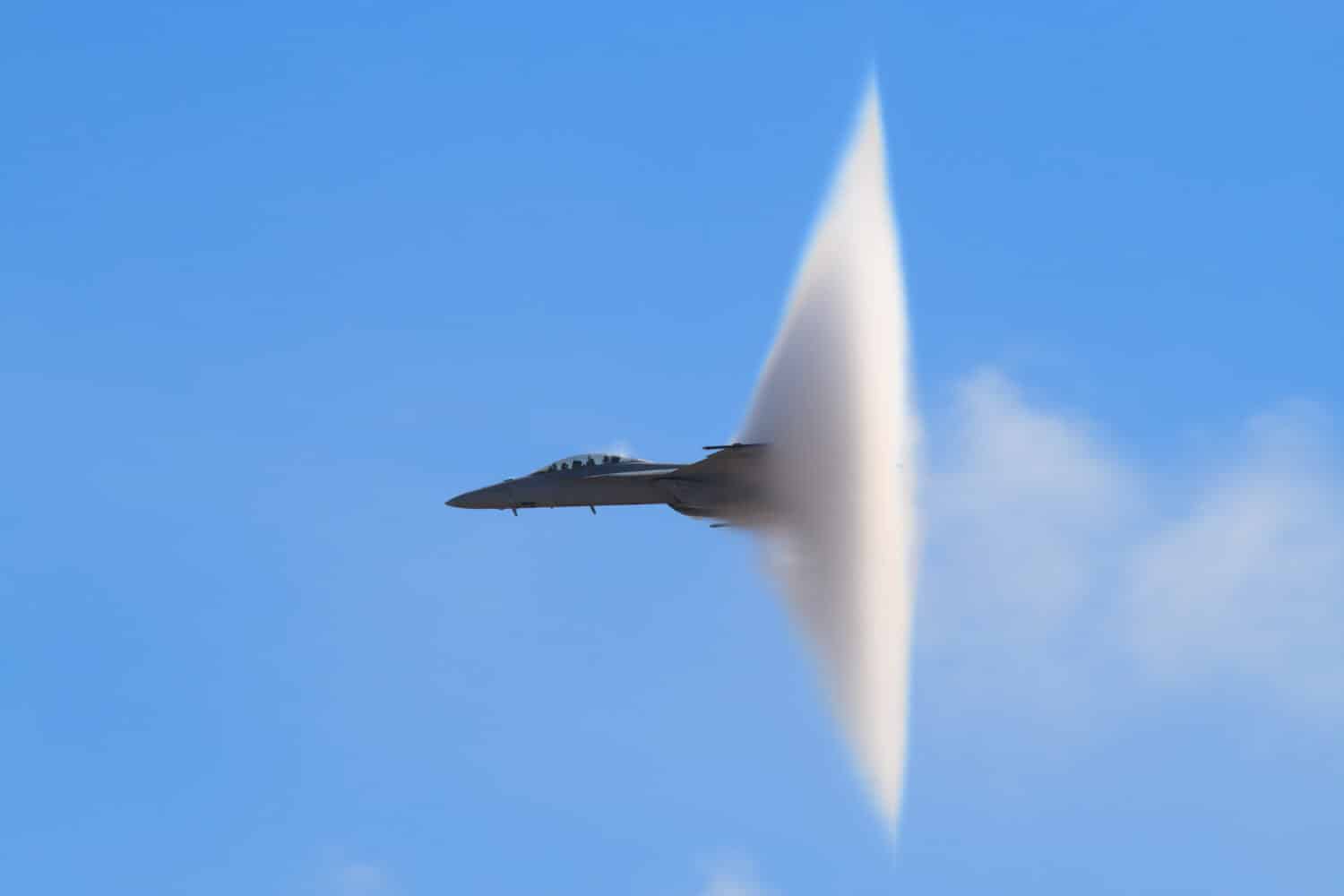
Mach 1 specifically denotes the exact speed of sound. When an object travels at Mach 1, it is moving at the same speed as the sound waves it generates. This phenomenon is famously known as the “sound barrier.” As an object approaches Mach 1, it begins to “catch up” to its own sound waves, causing them to compress and pile up in front of it. This creates a significant increase in drag and turbulence, forming a formidable barrier that early aviators struggled to overcome.
The critical insight here is that the speed of sound is not constant. It changes based on the properties of the medium through which it travels, primarily temperature, and to a lesser extent, pressure and humidity. In standard atmospheric conditions at sea level (around 15°C or 59°F), the speed of sound is approximately 343 meters per second, or about 767 miles per hour (1,235 kilometers per hour). However, as an aircraft ascends, the atmospheric temperature drops, causing the speed of sound to decrease. For instance, at cruising altitudes of 35,000 feet, where temperatures can plummet to -55°C (-67°F), the speed of sound is closer to 660 mph (1,062 km/h). Therefore, an aircraft flying at Mach 1 at sea level is traveling much faster than an aircraft flying at Mach 1 at high altitude. This variability underscores why Mach number, rather than absolute speed, is the preferred metric in high-speed aeronautics.
How Mach Numbers are Calculated
The calculation of the Mach number (M) is elegantly simple: it is the ratio of the true airspeed (TAS) of an object to the local speed of sound (a) in the fluid medium surrounding it.
M = TAS / a
For example, if an aircraft is flying at 600 mph and the local speed of sound is 700 mph, its Mach number would be 0.857. If that same aircraft accelerates to 700 mph when the local speed of sound is 700 mph, it is flying at Mach 1. This straightforward calculation allows engineers to consistently analyze aerodynamic forces and design aircraft capable of operating across various speed regimes, from subsonic (M < 1) to transonic (M ≈ 1), supersonic (M > 1), and eventually, hypersonic (M ≥ 5).
Beyond Mach 1: Transonic and Supersonic Regimes
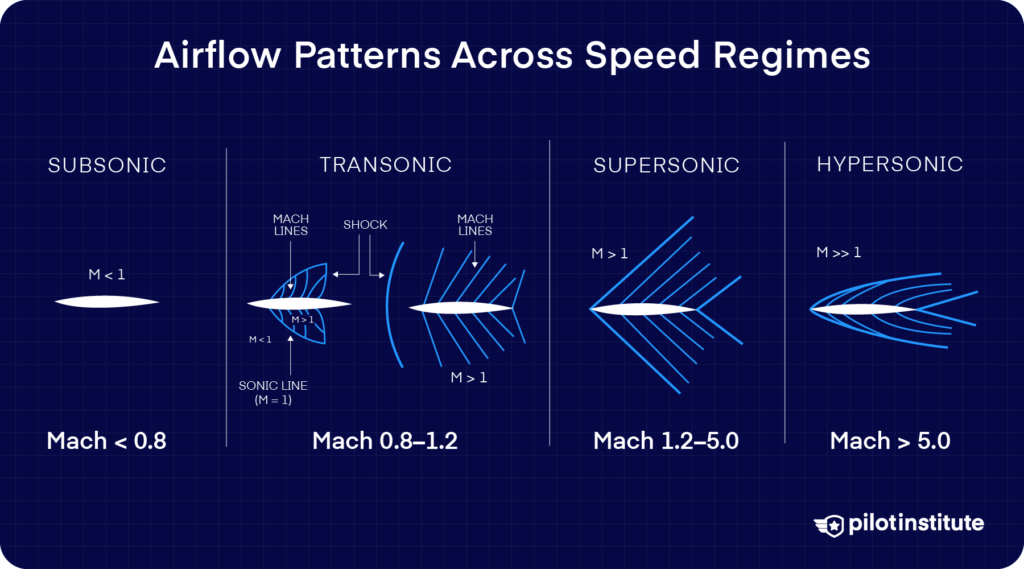
The journey through the Mach spectrum involves distinct aerodynamic challenges and characteristics:
- Subsonic (M < 0.8): Airflow over the entire aircraft remains below the speed of sound. This is the realm of most commercial aircraft.
- Transonic (0.8 < M < 1.2): This is perhaps the most complex and challenging regime. As an aircraft approaches Mach 1, localized areas on the aircraft (like the upper surface of the wings) can reach supersonic speeds even while the aircraft’s overall speed is still subsonic. This mix of subsonic and supersonic flow creates shockwaves, leading to significant increases in drag, buffeting, and control difficulties. Overcoming these issues was a major hurdle in early supersonic design.
- Supersonic (M > 1.2): Once the aircraft fully penetrates the sound barrier, it creates distinct shockwaves that trail behind it, forming the characteristic “sonic boom.” In this regime, drag characteristics change significantly, and the airflow becomes less turbulent than in the transonic phase, allowing for more stable flight, though at the cost of immense fuel consumption.
Understanding these regimes is paramount for aircraft design, propulsion systems, and flight control software, ensuring stability and efficiency across the entire speed envelope.
Technological Breakthroughs Enabled by Understanding Mach 1
The pursuit of Mach 1 and beyond has been a driving force behind some of the most profound technological advancements in aerospace, pushing the boundaries of what is possible in flight.
Early Pioneers and Breaking the Sound Barrier
The quest to exceed Mach 1 was one of the 20th century’s most formidable technological challenges. For years, the “sound barrier” was considered an impenetrable wall, responsible for violent shaking, loss of control, and even structural failures in aircraft attempting to reach it. It took the brilliant collaboration of engineers and test pilots to overcome this.
The monumental breakthrough came on October 14, 1947, when U.S. Air Force Captain Chuck Yeager, flying the rocket-powered Bell X-1 aircraft, became the first human to officially break the sound barrier. The X-1 was a marvel of engineering, featuring thin, sharply swept wings designed to cut through the air with minimal drag and a robust structure to withstand the extreme forces of transonic flight. This achievement was not just a stunt; it provided invaluable data on aerodynamics, material stresses, and control systems at speeds previously unattainable. It validated theoretical models and paved the way for systematic research into supersonic flight, fundamentally altering the trajectory of aviation technology.
Supersonic Aviation: Military and Commercial Applications
Following Yeager’s flight, supersonic capabilities rapidly became a cornerstone of military aviation. Fighter jets like the F-86 Sabre, F-4 Phantom, and later, the F-16 Fighting Falcon and F-22 Raptor, were designed from the ground up for supersonic performance, enabling rapid interception, unparalleled maneuverability, and strategic advantage. Reconnaissance aircraft like the SR-71 Blackbird pushed the envelope even further, sustaining Mach 3+ speeds to outrun threats and gather intelligence across vast distances. These aircraft showcased advanced materials, sophisticated aerodynamics, and powerful afterburning turbojet engines, all developed to operate efficiently in the high-Mach environment.
The allure of commercial supersonic travel also captivated the world. The Anglo-French Concorde, entering service in 1976, was a stunning feat of engineering, capable of transporting passengers across the Atlantic at Mach 2. Its distinctive delta wing, droop nose, and advanced turbojet engines allowed it to drastically cut travel times. However, the Concorde’s commercial viability was ultimately limited by its high operating costs, immense fuel consumption, environmental concerns (sonic boom over land), and a tragic accident in 2000. Despite its eventual retirement, Concorde provided invaluable lessons in high-speed passenger transport and demonstrated the feasibility and challenges of commercial supersonic flight, inspiring a new generation of engineers and entrepreneurs.
Hypersonic Flight: The Next Frontier
While supersonic flight revolutionized aviation, the frontier of hypersonic flight (typically defined as Mach 5 and above) represents an even greater leap in technology. At these extreme speeds, the air itself behaves differently – it becomes a superheated plasma, causing immense friction and thermal stress on the aircraft’s structure. Materials science, propulsion systems, and aerodynamic control become exponentially more complex.
Current hypersonic research focuses on a range of applications, including:
- Rapid Global Travel: Reducing travel times from continents to hours, offering unprecedented connectivity.
- Advanced Weaponry: Developing hypersonic missiles and glide vehicles capable of striking targets anywhere on Earth with unparalleled speed, posing significant challenges to existing defense systems.
- Space Access: Creating reusable launch systems that can accelerate to orbital speeds within the atmosphere, making space travel more efficient and affordable.
Developing hypersonic capabilities requires breakthroughs in novel materials (e.g., ceramics, carbon-carbon composites), advanced thermal management systems, and revolutionary propulsion technologies like ramjets and scramjets, which breathe air for combustion at extreme speeds.
Engineering Challenges and Innovations in Supersonic Design
Achieving sustained supersonic flight is not merely about attaching a powerful engine to an aircraft. It involves overcoming a myriad of complex engineering challenges that demand innovative solutions across aerodynamics, propulsion, and materials science.
Aerodynamic Design for High Speeds
The transition from subsonic to supersonic flight introduces radical changes in airflow behavior, requiring entirely different aerodynamic philosophies.
- Wing Shapes: Unlike the thick, cambered wings optimized for lift at lower speeds, supersonic aircraft typically feature thin, swept-back wings (like those on fighter jets) or delta wings (as seen on the Concorde). These designs are crucial for minimizing wave drag – the significant drag generated by shockwaves at and above Mach 1. They efficiently slice through the air, creating weaker shockwaves.
- Area Rule: A pivotal innovation developed by Richard Whitcomb in the 1950s, the “area rule” dictates that for minimal wave drag at transonic and supersonic speeds, the aircraft’s cross-sectional area should change smoothly along its length. This often results in the distinctive “coke bottle” fuselage shape seen on many supersonic aircraft, where the fuselage narrows at the wing junction to compensate for the wing’s cross-sectional area.
- Computational Fluid Dynamics (CFD): Modern supersonic design heavily relies on CFD. These powerful simulation tools allow engineers to model complex airflow patterns, predict drag, analyze pressure distributions, and optimize aerodynamic shapes virtually, drastically reducing the need for costly and time-consuming physical wind tunnel testing.
Propulsion Systems for Supersonic Flight
Generating the immense thrust required to push an aircraft through the sound barrier and sustain supersonic speeds demands specialized propulsion systems.
- Turbojets and Afterburners: Early supersonic aircraft primarily used turbojet engines. To provide extra thrust for breaking the sound barrier and sustaining supersonic speeds, these engines often incorporated afterburners. An afterburner injects additional fuel into the hot exhaust gases of the engine and ignites it, creating a powerful burst of thrust, albeit with extremely high fuel consumption.
- Ramjets and Scramjets: For sustained high-Mach (supersonic to hypersonic) flight, ramjets and scramjets are essential. Unlike turbojets, these engines have few or no moving parts. Ramjets compress incoming air simply by the forward motion of the vehicle, ideal for speeds above Mach 2-3. Scramjets (Supersonic Combustion Ramjets) take this a step further, allowing combustion to occur within supersonic airflow, making them theoretically capable of propelling aircraft into the hypersonic regime (Mach 5+). Developing efficient scramjet technology is a major focus of current hypersonic research.
Material Science and Thermal Management
One of the most daunting challenges in high-Mach flight is dealing with the extreme heat generated by air friction. As an aircraft accelerates, the compression and friction of air against its surfaces cause temperatures to soar, a phenomenon known as the “thermal thicket.”
- Advanced Alloys and Composites: Traditional aluminum alloys quickly lose strength at high temperatures. Supersonic and hypersonic aircraft necessitate the use of advanced materials such as titanium alloys (known for their strength-to-weight ratio and heat resistance), nickel-based superalloys, and carbon-carbon composites (used for nose cones and leading edges due to their exceptional heat tolerance).
- Thermal Management Systems: Beyond just heat-resistant materials, effective cooling systems are vital. This can involve active cooling (circulating coolant fluids), ablative coatings (which burn away slowly to dissipate heat), or passive designs that distribute heat efficiently. For hypersonic vehicles, managing the immense thermal load is arguably the single greatest hurdle.
The Future of Supersonic and Hypersonic Technology
The legacy of Mach 1 continues to inspire new generations of engineers and innovators. Far from being a relic of the past, the pursuit of high-speed flight is experiencing a significant resurgence, driven by advancements in digital design, materials, and a renewed commercial interest.
Resurgence of Commercial Supersonic Travel
After the Concorde’s retirement, the dream of faster-than-sound commercial travel seemed to fade. However, recent technological advancements and a renewed market interest have spurred a “new space race” for commercial supersonic jets. Companies like Boom Supersonic, with its Overture jet, are at the forefront, aiming to build a more economically viable, environmentally friendly, and quieter supersonic aircraft. Their focus is on:
- Efficiency: Utilizing advanced turbofan engines, lighter composite materials, and sophisticated aerodynamic designs to drastically reduce fuel consumption compared to Concorde.
- Noise Reduction: Developing innovative wing designs and flight profiles to mitigate the infamous sonic boom, potentially allowing supersonic flight over land.
- Sustainability: Exploring sustainable aviation fuels (SAFs) and more efficient operations to minimize environmental impact.
While challenges remain, these efforts signal a potential renaissance for commercial travel, promising to shrink the world’s perceived size once again.
Defense and Space Applications
The strategic implications of high-speed flight remain paramount for national defense and space exploration.
- Hypersonic Missiles and Glide Vehicles: Several nations are actively developing hypersonic weaponry, capable of traveling at Mach 5+ with maneuverability that makes them extremely difficult to detect and intercept. This represents a significant shift in military technology, requiring entirely new defense paradigms.
- Reusable Launch Systems (RLS): Hypersonic technology is integral to the development of RLS for space. Vehicles designed for atmospheric re-entry at hypersonic speeds, like space shuttles or future reusable orbital vehicles, leverage advanced thermal protection systems and aerodynamic control derived from Mach 1 research.
- Point-to-Point Suborbital Travel: Beyond orbital launches, the concept of using hypersonic vehicles for rapid suborbital travel is gaining traction. Imagine flying from New York to Sydney in just a few hours via a brief trip into the upper atmosphere, bypassing conventional air routes.
Beyond Aerospace: Other Tech Implications
The pursuit of Mach 1 and beyond has ripple effects across various technological domains:
- High-Speed Computing for Simulation: The complex physics of supersonic and hypersonic flight have driven advancements in computational power and algorithms, particularly in fields like Computational Fluid Dynamics (CFD), which are now applied in diverse industries from automotive design to weather prediction.
- Material Testing: The development of materials capable of withstanding extreme temperatures and pressures at high Mach numbers pushes the boundaries of material science, leading to innovations that find applications in energy, manufacturing, and other high-performance environments.
- Atmospheric Research: Studying the phenomena associated with supersonic and hypersonic flight provides critical insights into atmospheric dynamics, shockwave physics, and high-altitude environments, benefiting meteorological and climate science.
In conclusion, Mach 1 is far more than just “the speed of sound.” It is a dynamic threshold that has catalyzed immense technological progress, pushing the limits of human ingenuity. From breaking the sound barrier to conceiving hyper-fast travel, the journey through the Mach spectrum continues to define the cutting edge of aerospace engineering. As we look to the future, the ongoing pursuit of greater speeds promises to unlock new possibilities in travel, defense, and our understanding of physics, solidifying Mach 1’s enduring legacy as a cornerstone of technological advancement.
aViewFromTheCave is a participant in the Amazon Services LLC Associates Program, an affiliate advertising program designed to provide a means for sites to earn advertising fees by advertising and linking to Amazon.com. Amazon, the Amazon logo, AmazonSupply, and the AmazonSupply logo are trademarks of Amazon.com, Inc. or its affiliates. As an Amazon Associate we earn affiliate commissions from qualifying purchases.