
The question of how much one Bitcoin costs is deceptively simple. Unlike a gallon of milk or a subscription service, the price of Bitcoin is not fixed by a central authority or a manufacturer. It is a live, breathing figure that fluctuates every second of every day across thousands of global exchanges. To understand the cost of Bitcoin is to understand the intersection of technology, psychology, and global economics. As of the current market cycle, Bitcoin has evolved from an experimental digital token into a trillion-dollar asset class, often referred to as “digital gold.”
To truly answer “how much does it cost,” one must look beyond the ticker symbol and explore the underlying mechanics of price discovery, the macroeconomic factors that drive its value, and the practicalities of acquiring it in a modern financial landscape.
Understanding the Mechanics of Bitcoin Price Discovery
The price of Bitcoin is determined primarily by the balance between supply and demand on open markets. Because Bitcoin is decentralized, there is no “official” price. Instead, the price you see on news sites or financial apps is typically a volume-weighted average of the prices across the world’s largest cryptocurrency exchanges.
The Role of Supply and Demand
Bitcoin’s supply is mathematically capped at 21 million coins. This absolute scarcity is a fundamental driver of its price. Unlike fiat currencies (like the US Dollar or the Euro), which central banks can print in unlimited quantities, Bitcoin’s supply schedule is hardcoded into its protocol. When demand for the asset increases—whether due to institutional interest, retail FOMO (Fear Of Missing Out), or geopolitical instability—and the supply remains fixed, the price must rise to accommodate the new buyers. Conversely, when large holders (often called “whales”) sell their positions, or when negative news dampens demand, the price retreats.
Market Liquidity and Exchange Spreads
The “cost” of a Bitcoin can also vary slightly depending on where you buy it. This is due to liquidity—the ease with which an asset can be converted into cash without affecting its price. High-volume exchanges like Coinbase or Binance usually have very tight spreads (the difference between the buying price and the selling price). However, in regions with strict capital controls or on smaller, less liquid exchanges, Bitcoin may trade at a premium or a discount. This phenomenon, known as the “Kimchi Premium” in South Korea, illustrates how local demand can cause the cost of 1 Bitcoin to decouple from the global average.
Divisibility: You Don’t Have to Buy a Whole Coin
A common misconception among new investors is the belief that they must purchase one full Bitcoin. In reality, Bitcoin is divisible down to eight decimal places. The smallest unit is called a “Satoshi,” named after the anonymous creator Satoshi Nakamoto. One Satoshi represents 0.00000001 BTC. This means that while the cost of “one Bitcoin” might be tens of thousands of dollars, the “cost of entry” into the market is as low as a few dollars, allowing for micro-investing and dollar-cost averaging.
Key Factors Influencing Bitcoin’s Market Value
To understand why Bitcoin costs what it does today—and why that price might change tomorrow—we must examine the external and internal catalysts that influence investor sentiment.
Macroeconomic Trends and Inflation Hedging
In recent years, Bitcoin has become increasingly sensitive to global macroeconomic shifts. Investors often view Bitcoin as a “risk-on” asset during times of low interest rates and high liquidity. However, a growing cohort of institutional investors treats it as a hedge against monetary debasement. When central banks engage in aggressive quantitative easing, the purchasing power of fiat currency tends to decline. In this environment, the “cost” of Bitcoin often rises as investors flee devaluing currencies in favor of an asset with a fixed supply.
Institutional Adoption and the Regulatory Landscape
The entry of Wall Street has fundamentally altered Bitcoin’s price floor. The approval of Spot Bitcoin ETFs (Exchange-Traded Funds) in the United States marked a turning point, allowing trillions of dollars in traditional pension funds and 401(k)s to flow into the asset. As institutional giants like BlackRock and Fidelity integrate Bitcoin into their offerings, the increased demand exerts upward pressure on the price. Furthermore, regulatory clarity—or the lack thereof—plays a massive role. Clear frameworks that allow for corporate balance sheet inclusion generally drive the price up, while threats of bans or restrictive tax laws can cause sharp price corrections.
The Impact of Bitcoin Halving Cycles
One of the most unique aspects of Bitcoin’s monetary policy is the “Halving.” Approximately every four years, the reward given to Bitcoin miners for securing the network is cut in half. This effectively reduces the daily production of new Bitcoins by 50%. Historically, these halving events have preceded major bull runs. By tightening the new supply while demand is either constant or growing, the halving creates a supply shock that has historically forced the market price to seek new all-time highs.
The Difference Between Price and Value
In the world of personal finance, there is a famous saying: “Price is what you pay; value is what you get.” This distinction is critical when discussing Bitcoin. The cost of one Bitcoin reflects the current market consensus, but its value is derived from its utility as a decentralized, censorship-resistant network.
Intrinsic Value vs. Market Price
Critics often argue that Bitcoin has no intrinsic value because it isn’t backed by a physical commodity or a government. Proponents, however, argue that Bitcoin’s value lies in its properties: it is portable, divisible, durable, fungible, and, most importantly, immutable. The “cost” of 1 Bitcoin is essentially the price the market is willing to pay for a seat at the table of the world’s first global, private, digital monetary system. If you believe the future of finance is decentralized, the current price may seem like a bargain; if you believe it is a speculative bubble, any price may seem too high.
Network Effect and Metcalfe’s Law
The value of Bitcoin is also tied to the size of its network. Metcalfe’s Law states that the value of a telecommunications network is proportional to the square of the number of connected users. The same principle applies to Bitcoin. As more merchants accept it, more developers build on its layers (like the Lightning Network), and more individuals use it for cross-border remittances, the utility of the network grows. This network effect provides a fundamental “floor” for what the asset should be worth, regardless of short-term price volatility.
Practical Ways to Track and Purchase Bitcoin
For those looking to monitor how much 1 Bitcoin costs or those ready to make a purchase, the process has become significantly more streamlined and professionalized over the last decade.
Utilizing Real-Time Financial Tools
To stay updated on the current cost, investors use a variety of financial tools. Aggregators like CoinMarketCap and CoinGecko provide a global average by pulling data from hundreds of sources. For more advanced traders, platforms like TradingView offer technical analysis tools to track price movements against moving averages and historical support levels. For the casual observer, most major financial news outlets (CNBC, Bloomberg, Wall Street Journal) now list Bitcoin alongside the S&P 500 and Gold.
Managing Transaction Costs and Fees
When calculating the total cost of acquiring Bitcoin, one must account for transaction fees. These include:
- Exchange Fees: Platforms charge a percentage or a flat fee for matching your buy order.
- Network Fees (Miner Fees): When you move your Bitcoin from an exchange to a private wallet, you must pay a fee to the miners who process the transaction on the blockchain. These fees fluctuate based on network congestion.
- Spread Costs: The hidden cost of the difference between the bid and ask price.
Professional investors often use “Limit Orders” to specify the exact price they are willing to pay, ensuring they don’t overpay during moments of high volatility.
Future Outlook: Volatility and Long-term Growth
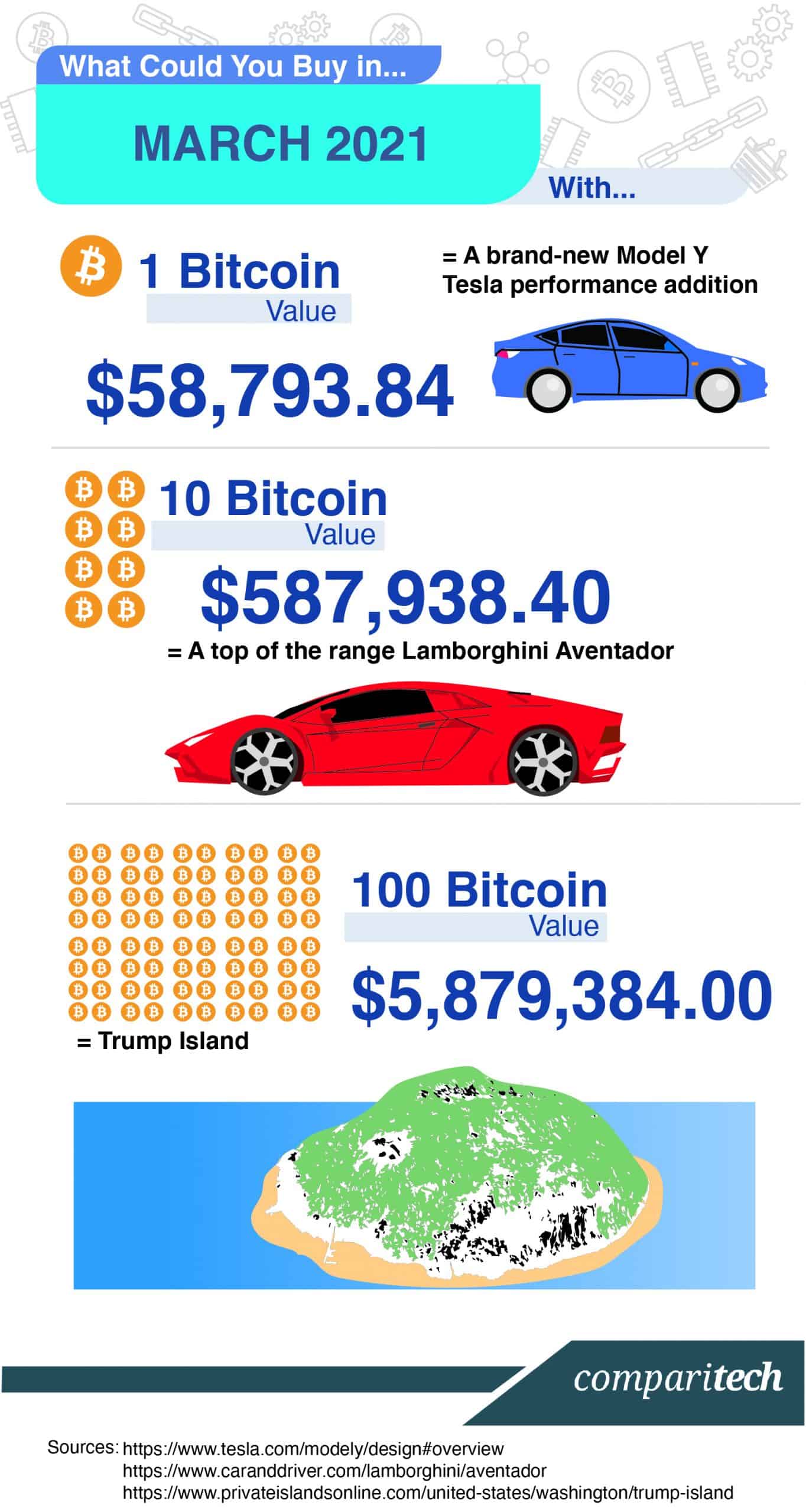
The cost of 1 Bitcoin has historically been characterized by extreme volatility. It is not uncommon for the price to swing 5–10% in a single day. However, looking at the long-term chart, Bitcoin has been one of the best-performing assets of the last decade.
As the asset matures, many analysts expect volatility to decrease. The introduction of institutional liquidity and regulated derivative markets (like futures and options) helps dampen the wild swings seen in Bitcoin’s early years. For the individual looking at the “cost” of Bitcoin, the focus is shifting from short-term speculation to long-term wealth preservation. Whether Bitcoin eventually costs $100,000, $500,000, or more will depend on its continued adoption as a global reserve asset and its ability to maintain the security and decentralization that gave it value in the first place.
In conclusion, the cost of 1 Bitcoin is a reflection of the world’s collective confidence in a decentralized financial future. It is a price determined by millions of participants, influenced by global politics, and anchored by the immutable laws of mathematics. Understanding this cost requires looking beyond the number on the screen and recognizing the revolutionary shift in how humanity defines and transfers value.
aViewFromTheCave is a participant in the Amazon Services LLC Associates Program, an affiliate advertising program designed to provide a means for sites to earn advertising fees by advertising and linking to Amazon.com. Amazon, the Amazon logo, AmazonSupply, and the AmazonSupply logo are trademarks of Amazon.com, Inc. or its affiliates. As an Amazon Associate we earn affiliate commissions from qualifying purchases.