
Silver, a lustrous and highly malleable metal, has captivated humanity for millennia, first for its beauty and later for its intrinsic value. However, beyond its aesthetic appeal and role in adornment, silver possesses a suite of remarkable physical and chemical properties that make it indispensable in the relentless march of technological innovation. Among these properties, its melting point stands as a fundamental characteristic, dictating its processability, stability, and ultimate utility in a vast array of high-tech applications. Understanding “what temperature does silver melt at” is not merely an academic exercise; it’s a gateway to comprehending its critical role in everything from advanced electronics to nascent nanotechnology.
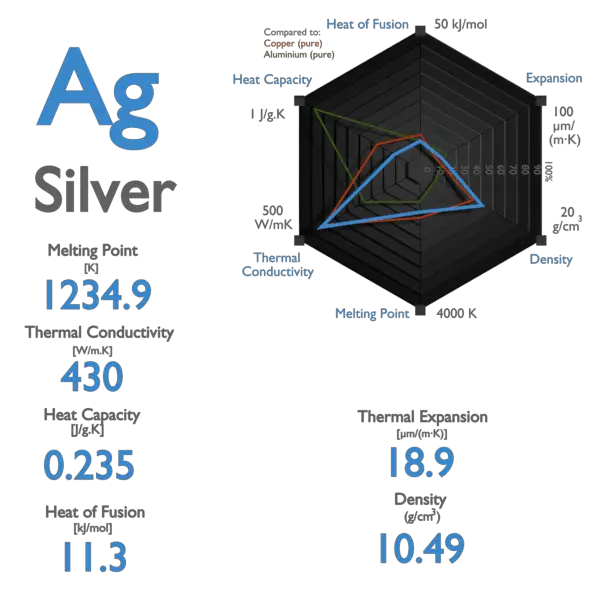
The pure elemental silver (Ag) melts at precisely 961.8 degrees Celsius (1763.2 degrees Fahrenheit), or 1234.9 Kelvin. This specific temperature marks the phase transition from its solid crystalline state to a liquid, a pivotal point that engineers, material scientists, and manufacturers meticulously consider when designing, fabricating, and operating cutting-edge systems. This article delves into the scientific underpinnings of silver’s melting point and explores its profound implications across various technological domains, showcasing why this single physical constant is so vital to modern engineering.
The Fundamental Science: Silver’s Melting Point Explained
To fully appreciate silver’s technological significance, one must first grasp the science behind its melting point. This isn’t just an arbitrary number; it’s a consequence of its atomic structure and the forces that bind its atoms together.
Defining the Melting Point
The melting point of a substance is the temperature at which it changes state from solid to liquid. For a pure crystalline solid like silver, this transition occurs at a specific, constant temperature under standard pressure, assuming thermodynamic equilibrium. Below this temperature, silver maintains its rigid lattice structure; above it, the atoms possess enough thermal energy to overcome the forces holding them in fixed positions, allowing them to move freely as a liquid.
The measurement of a material’s melting point is crucial for quality control and process design. Techniques such as Differential Scanning Calorimetry (DSC), which measures the heat flow associated with phase transitions, or pyrometry, for high-temperature measurement, are employed to precisely determine this critical temperature. The accuracy of these measurements ensures that materials meet specifications and can be processed effectively.
Atomic Structure and Metallic Bonding
Silver’s relatively high melting point is directly attributable to its robust metallic bonding. In silver, as with other metals, the valence electrons are not localized to individual atoms but are delocalized, forming a “sea” of electrons that are shared among all the positively charged silver ions in a crystal lattice. This strong electrostatic attraction between the positive metal ions and the mobile electron sea constitutes metallic bonding.
To melt silver, enough thermal energy must be supplied to disrupt this ordered, strong metallic lattice. While silver’s melting point is lower than that of copper (1084.6°C) and gold (1064.18°C), it is significantly higher than that of less robust metals like lead (327.5°C) or tin (231.9°C). This balance in bond strength makes silver incredibly stable for many applications while still being workable through conventional melting and casting techniques. The specific energy required to overcome these bonds dictates not only its melting point but also other properties like its impressive electrical and thermal conductivity.
Impurities and Alloys: Modifying the Melting Behavior
While pure silver melts at a distinct temperature, the presence of impurities or the deliberate alloying of silver with other metals can significantly alter its melting behavior. Adding other elements disrupts the uniform lattice structure of pure silver, leading to changes in the interatomic forces.
Many silver alloys are designed to have specific melting points, often lower than pure silver, to facilitate manufacturing processes like brazing and soldering. For instance, eutectic alloys, which are mixtures of two or more metals, have a unique composition that melts at a single, lowest possible temperature compared to any other composition of the same constituent metals. Silver-copper eutectic alloys, for example, have a lower melting point than either pure silver or pure copper, making them ideal for joining applications where localized heating and minimal thermal stress are desired. This ability to tailor the melting characteristics through alloying is a cornerstone of modern materials engineering, expanding silver’s utility far beyond its pure form.
Silver’s Role in Electronics and High-Tech Manufacturing
The precise knowledge of silver’s melting point, coupled with its unparalleled electrical and thermal conductivity, underpins its indispensable role in the fabrication of electronic components and other high-tech devices.
Conductors and Electrical Contacts
Silver boasts the highest electrical conductivity of all metals, making it the preferred material for high-performance electrical contacts, switches, and conductive traces in applications where reliability and efficiency are paramount. Think of high-voltage switches, critical connectors in telecommunications, or precision instruments. In these scenarios, the melting point of silver is crucial. Engineers must ensure that the operating temperatures generated by current flow, especially during surges or continuous operation, remain well below silver’s melting point to prevent thermal degradation, contact welding, or outright failure.
Furthermore, the manufacturing processes for these components, which often involve soldering, welding, or sintering, depend on precise temperature control. The melting point dictates the minimum temperature required for these processes and also sets the upper limit for safe operating temperatures, preventing damage to the silver components themselves or adjacent sensitive electronics.
Brazing and Soldering Applications
Silver’s melting characteristics, especially when alloyed, are critical in brazing and soldering—processes used to join metals together without melting the base metals. Silver-based brazing alloys are widely used in demanding industries like aerospace, medical devices, refrigeration, and automotive manufacturing. These alloys flow readily when molten, creating strong, hermetic bonds between dissimilar metals (e.g., steel to copper).
The specific melting range of a silver brazing alloy is selected to be above the desired service temperature of the joint but below the melting points of the parent metals. This precise control over the melting behavior ensures a strong metallurgical bond without compromising the integrity of the components being joined. For instance, in an aircraft engine, a silver-brazed joint must withstand extreme thermal cycling and mechanical stress, meaning the alloy’s melting point and post-brazing properties are critical for safety and performance.

Advanced Sensor Technology
Silver’s excellent thermal stability up to its melting point, coupled with its electrical properties, makes it valuable in advanced sensor technology. It’s used in certain types of thermistors (temperature-sensitive resistors), high-temperature thermocouples (often as a contact material), and specialized electrodes where consistent performance across a wide temperature range is essential.
In these applications, the material’s integrity and electrical properties must remain stable right up to its maximum operational temperature. Understanding silver’s melting point allows designers to select the appropriate grade of silver or silver alloy and to specify safe operating limits, ensuring the sensor provides accurate and reliable data without degradation or failure. For example, in industrial process control, sensors monitoring extreme temperatures rely on materials that will not deform or lose conductivity well below their melting threshold.
Beyond Traditional Electronics: Emerging Applications and Challenges
As technology advances, silver’s unique properties, including its melting point, continue to be explored in novel and sophisticated ways, pushing the boundaries of what’s possible in advanced manufacturing and materials science.
Additive Manufacturing with Silver
Additive manufacturing, commonly known as 3D printing, is revolutionizing how complex geometries are fabricated. For metals, techniques like Selective Laser Melting (SLM) or Electron Beam Melting (EBM) involve melting and fusing powdered metal layers to build up a component. Silver, with its distinct melting point, is increasingly being used for 3D printing of intricate electronic circuits, custom medical implants, and high-performance jewelry.
The melting point of silver directly dictates the laser power or electron beam energy required, the build chamber temperature, and the cooling rates in these processes. Precise control over these parameters is essential to achieve full densification, prevent warping, and ensure the desired mechanical and electrical properties of the printed silver part. Challenges lie in managing the high thermal conductivity of silver, which can make it difficult to maintain a localized melt pool, but ongoing research is yielding sophisticated solutions.
Nanotechnology and Miniaturization
At the nanoscale, materials can exhibit properties significantly different from their bulk counterparts. Silver nanoparticles, for example, are employed in conductive inks for flexible electronics, antimicrobial coatings, and catalysts. Interestingly, the melting point of nanoparticles can be significantly lower than that of bulk silver—a phenomenon known as melting point depression. As particle size decreases, the surface-to-volume ratio increases, and the relative contribution of surface energy to the overall energy of the system becomes more pronounced, leading to a reduction in the energy required for phase transition.
This phenomenon is critical in fabricating nanosilver-based components. For instance, conductive inks containing silver nanoparticles can be “sintered” at much lower temperatures than the bulk melting point of silver, allowing them to be printed on heat-sensitive substrates like plastics. Understanding this size-dependent melting behavior is crucial for designing effective low-temperature processing techniques for next-generation flexible and wearable electronics.
High-Temperature Superconductors and Fuel Cells
While silver itself is not a superconductor at high temperatures, its melting point and excellent conductivity make it a valuable material in the development and practical application of high-temperature superconducting (HTS) materials and fuel cells. In HTS tapes and wires, silver is often used as a stabilizer, a protective cladding, or a matrix material for the superconducting compounds (e.g., YBCO). Its role is to provide a conductive bypass in case the superconductor loses its superconductivity, preventing localized overheating and damage. Silver’s stability up to its melting point ensures the integrity of these critical components under operational and fault conditions.
Similarly, in certain types of fuel cells, particularly solid oxide fuel cells (SOFCs) that operate at elevated temperatures, silver or silver alloys can be used for interconnects or contact layers. Its stability at high temperatures, good electrical conductivity, and resistance to oxidation make it suitable for maintaining efficient energy transfer without degradation, provided temperatures remain below its melting point.
Material Selection and Engineering Considerations
The decision to use silver in a technological application is rarely based solely on its melting point but rather on a holistic consideration of its properties, performance requirements, and economic factors.
Balancing Performance and Cost
Despite its superior electrical conductivity and thermal properties, silver is a precious metal, making it significantly more expensive than alternatives like copper. Engineers constantly weigh the performance benefits of silver against its cost. In applications where absolute performance, reliability, and minimal signal loss are paramount (e.g., high-frequency RF circuits, critical medical devices, high-end audio equipment), the investment in silver is justified. In other cases, copper might be chosen, perhaps with a silver plating to enhance contact surfaces, balancing cost with performance. The melting point plays a role here too; processing temperatures and subsequent operational thermal stability are key factors in material selection.
Thermal Management
In many electronic devices, especially those that are highly integrated and operate at high power, effective thermal management is crucial to prevent overheating and component failure. Silver’s high thermal conductivity (even higher than copper’s) makes it excellent for dissipating heat. Understanding its melting point allows engineers to design heat sinks, thermal interface materials, and conductive pathways that can safely manage the thermal loads generated during operation. If a component is expected to generate significant heat, knowing the silver’s thermal limits (its melting point) helps prevent catastrophic failure due to localized melting or degradation of the material.

Future of Silver in Tech
The demand for smaller, faster, and more efficient electronic devices continues to drive innovation in materials science. Silver, with its unique blend of electrical, thermal, and chemical properties, along with a well-understood melting point, will remain a cornerstone of this technological evolution. Future advancements might involve new silver alloys with tailored melting characteristics for specific additive manufacturing processes, or advanced nanosilver structures that leverage melting point depression for novel flexible electronics and sensing applications. As new frontiers in energy, communication, and computation emerge, the fundamental property of “what temperature does silver melt at” will continue to be a critical data point for the architects of tomorrow’s technology.
In conclusion, silver’s melting point of 961.8°C is far more than a simple number in a materials science textbook. It is a critical parameter that underpins its widespread utility in modern technology. From guiding the manufacturing processes of intricate electronic circuits and robust brazed joints to enabling the development of advanced sensors and exploring the frontiers of nanotechnology, silver’s thermal characteristics are fundamental to its irreplaceable role. As technology pushes boundaries, the precise understanding and manipulation of silver’s melting behavior will continue to be a key enabler for innovation across diverse engineering disciplines.
aViewFromTheCave is a participant in the Amazon Services LLC Associates Program, an affiliate advertising program designed to provide a means for sites to earn advertising fees by advertising and linking to Amazon.com. Amazon, the Amazon logo, AmazonSupply, and the AmazonSupply logo are trademarks of Amazon.com, Inc. or its affiliates. As an Amazon Associate we earn affiliate commissions from qualifying purchases.