
In the dynamic landscape of software development, where new languages and frameworks emerge with startling regularity, Rust has carved out a unique and increasingly prominent niche. Heralded by its community as a revolutionary force, Rust consistently tops developer surveys as the “most loved” programming language. But beyond the fervent enthusiasm, what exactly is Rust good for? This article delves into Rust’s core strengths, its diverse application domains, and the compelling reasons behind its growing adoption, offering a professional and insightful look into why this language is making waves in the tech world.
Rust’s Core Strengths: Safety, Performance, and Concurrency
At the heart of Rust’s appeal lies its trifecta of core strengths: an unprecedented combination of memory safety, high performance, and fearless concurrency. These attributes, often difficult to achieve simultaneously in other languages, are fundamental to Rust’s design philosophy and empower developers to build robust, efficient, and reliable software.

Memory Safety Without Garbage Collection
One of Rust’s most significant innovations is its approach to memory management. Unlike languages like C++, which rely heavily on manual memory management (often leading to common bugs like null pointer dereferences, data races, and buffer overflows), or languages like Java and Python, which employ garbage collection (incurring performance overhead), Rust achieves memory safety through its unique ownership system. This system, enforced by the compiler at compile-time, ensures that memory is correctly managed without runtime garbage collection, providing both safety and predictable performance. The compiler uses a set of rules (borrow checker) to guarantee that references always point to valid data and that data is not modified by multiple references simultaneously in an unsafe manner. This rigorous static analysis eliminates entire classes of bugs before the code even runs, dramatically improving software reliability and security.
Unparalleled Performance for System-Level Programming
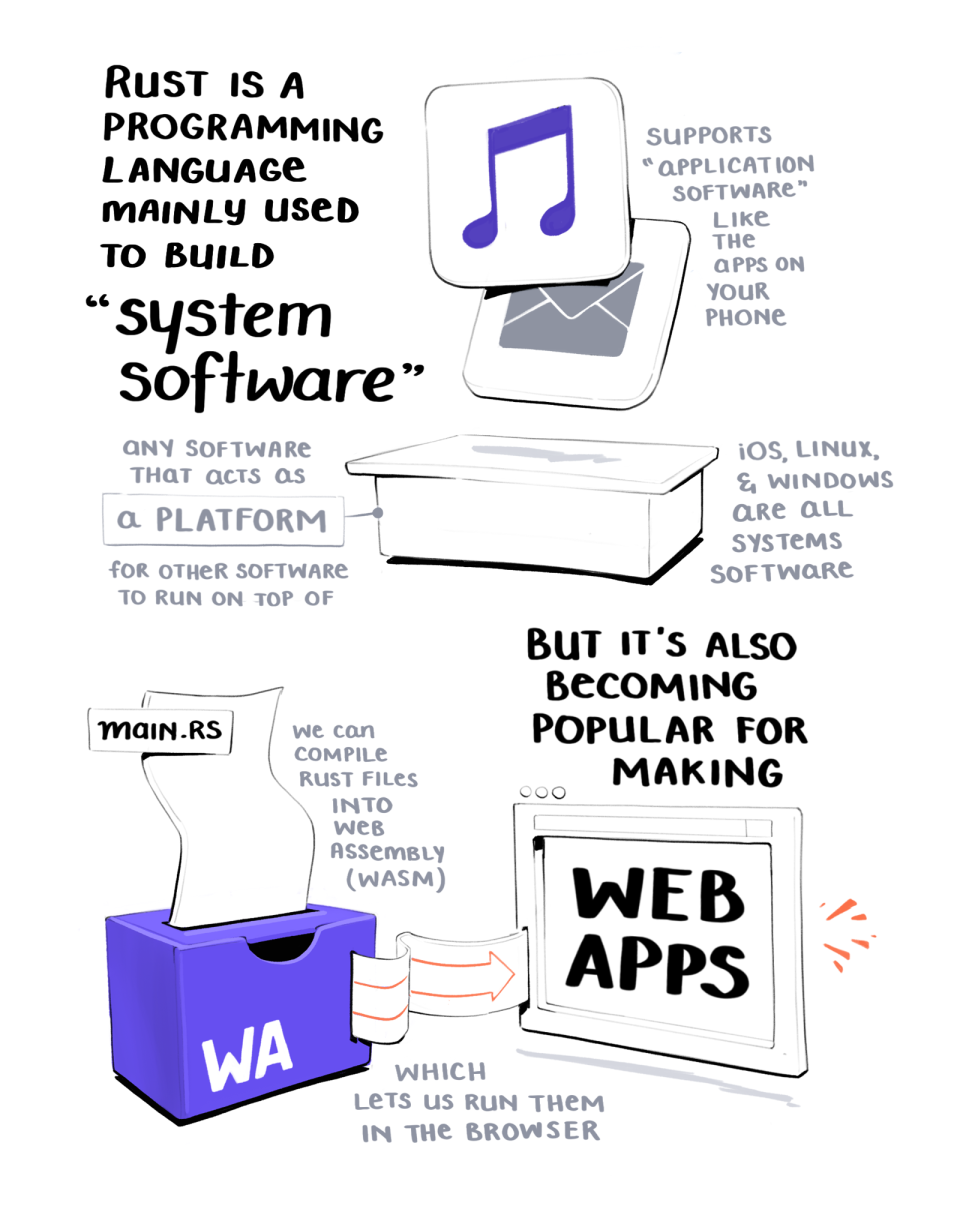
Rust is designed to be a systems programming language, meaning it operates close to the hardware, offering fine-grained control over system resources. This low-level control, combined with zero-cost abstractions, allows Rust to deliver performance comparable to C and C++. Its type system and module system are designed to minimize runtime overhead, resulting in highly optimized binaries. This makes Rust an ideal choice for performance-critical applications where every clock cycle counts, such as operating systems, game engines, embedded systems, and high-performance computing. Developers can write code that runs extremely fast without sacrificing the safety guarantees typically associated with higher-level languages.
Fearless Concurrency: Building Robust Multithreaded Applications
Concurrency is notoriously challenging to implement correctly, often leading to subtle and hard-to-debug issues like race conditions and deadlocks. Rust tackles this head-on with its “fearless concurrency” paradigm. The ownership and borrowing system extends its safety guarantees to concurrent programming, preventing common concurrency bugs at compile time. By ensuring that data is accessed and modified safely across multiple threads, Rust allows developers to write highly concurrent applications without the fear of introducing dangerous bugs. This makes it significantly easier to leverage the full power of multi-core processors, leading to more responsive and scalable software. The language’s Send and Sync traits, along with its robust standard library primitives for concurrency, provide powerful tools for building reliable concurrent systems.
Key Application Domains for Rust
Rust’s unique combination of safety, performance, and concurrency makes it incredibly versatile, suitable for a wide array of application domains where these qualities are paramount.
Systems Programming and Operating Systems
Given its genesis as a language for low-level control and performance, systems programming is a natural fit for Rust. It’s being increasingly used to write operating system components, device drivers, and core utilities. Projects like Redox OS, a Unix-like operating system written entirely in Rust, demonstrate its capability in this domain. Its memory safety guarantees are particularly valuable here, as bugs in system-level code can have catastrophic consequences.
WebAssembly (Wasm) and Frontend Development
WebAssembly (Wasm) allows developers to run high-performance code in web browsers. Rust’s ability to compile efficiently to Wasm, combined with its compact binaries and excellent performance, makes it an ideal language for creating highly performant web applications or critical components within them. This enables complex computational tasks, graphics rendering, or even entire game engines to run client-side with near-native speeds, overcoming the performance limitations often associated with JavaScript. Frameworks like wasm-bindgen simplify the integration of Rust-compiled Wasm modules into JavaScript projects.
Backend Services and APIs
Many companies are leveraging Rust to build high-performance, reliable backend services and APIs. Its efficiency in handling requests, coupled with its memory safety, makes it an excellent choice for microservices, API gateways, and serverless functions where uptime and throughput are critical. Frameworks like Actix-web, Rocket, and Warp provide robust foundations for building scalable web services that can handle significant load while maintaining low latency. Companies like Discord have publicly shared their positive experiences with using Rust to optimize their core services.
Command-Line Tools and Utilities
For developers who frequently build CLI tools, Rust offers a compelling alternative to scripting languages like Python or Ruby. Rust applications compile to native binaries, meaning they are fast, self-contained, and don’t require an interpreter to be installed. The clap crate for argument parsing, along with Rust’s excellent error handling, makes it straightforward to build sophisticated and user-friendly command-line applications that are both performant and reliable. Many popular open-source tools, such as ripgrep (a fast line-oriented search tool), are written in Rust.
Game Development and High-Performance Computing
In game development, performance is paramount. Rust’s near-bare-metal performance and fine-grained control over memory make it suitable for game engines, game logic, and high-performance simulations. While still an emerging player compared to C++, several game engines and libraries, such as Bevy and Veloren, are being developed in Rust, showcasing its potential in creating complex, high-fidelity interactive experiences. Similarly, for scientific computing and data analysis where computational intensity is high, Rust can be used to accelerate critical components.
Blockchain and Web3 Technologies
The nascent but rapidly evolving blockchain and Web3 space places a strong emphasis on security, performance, and reliability—qualities where Rust excels. Many foundational blockchain projects, including Polkadot and Solana, are written in Rust. Its ability to create secure, efficient, and predictable smart contracts and decentralized applications (dApps) makes it a preferred language for building the next generation of decentralized internet infrastructure.
Embedded Systems and IoT

For embedded systems and the Internet of Things (IoT), resource constraints (memory, CPU power) and safety are critical. Rust’s low-level control, minimal runtime, and memory safety guarantees without a garbage collector make it an excellent choice for programming microcontrollers and edge devices. It allows developers to write safer, more reliable firmware, reducing the risk of bugs that could lead to system failures or security vulnerabilities in critical applications.
Why Developers Are Embracing Rust
Beyond its technical capabilities, Rust’s growing popularity is also fueled by its strong developer experience and the long-term benefits it offers to software projects.
The Developer Experience: Tooling and Community
Rust boasts a world-class tooling ecosystem centered around Cargo, its official package manager and build system. Cargo simplifies dependency management, compilation, testing, and documentation generation, providing a cohesive and pleasant development workflow. The rust-analyzer language server offers excellent IDE support, including auto-completion, refactoring, and inline diagnostics. Moreover, the Rust community is known for being welcoming, supportive, and highly active, contributing to a rich ecosystem of crates (libraries) and providing ample resources for learning and problem-solving. This robust tooling and vibrant community significantly ease the development process.
Eliminating Entire Classes of Bugs
The most compelling reason for many to adopt Rust is its ability to eliminate common programming errors at compile time. Memory safety bugs, data races, and null pointer dereferences, which plague C++ and other systems languages, are simply not possible in safe Rust code. This dramatically reduces debugging time, improves code quality, and leads to more stable and secure applications. For businesses, this translates into lower maintenance costs, fewer security incidents, and greater confidence in their software products.
Future-Proofing Software Architecture
By investing in Rust, organizations are future-proofing their software architecture. The language’s emphasis on stability, backward compatibility, and robust design principles ensures that Rust projects can evolve and scale effectively over time. Its performance characteristics mean that applications written in Rust are likely to remain performant as demands increase, and its strong type system makes large-scale refactoring safer and more manageable. This leads to more sustainable and maintainable codebases that can adapt to changing requirements without complete rewrites.
Addressing Common Misconceptions and Challenges
While Rust offers many advantages, it’s not without its perceived challenges, which are often subjects of discussion and sometimes misunderstanding.
The Learning Curve: Initial Investment for Long-Term Gain
One of the most frequently cited challenges with Rust is its steep learning curve. The compiler’s strictness, particularly with the borrow checker, can initially be frustrating for developers accustomed to more lenient languages. Understanding concepts like ownership, borrowing, and lifetimes requires a shift in mindset. However, this initial investment in learning pays off handsomely. Once developers grasp these core concepts, they find that the compiler acts as a helpful assistant, guiding them towards correct and efficient code, preventing bugs that would otherwise manifest at runtime. The “Rustacean” community often frames this as “fighting the borrow checker” initially, followed by a profound appreciation for its preventative powers.
Compilation Times and Iteration Speed
For very large projects, Rust’s compilation times can be longer than those of some other languages, especially during initial builds or after significant code changes. This is partly due to the extensive static analysis performed by the compiler to guarantee safety and optimize performance. While the Rust team is continually working on improving compilation speed, and incremental compilation helps mitigate this, it can occasionally impact development iteration cycles. However, the trade-off is often considered worthwhile for the resulting reliability and performance of the compiled binaries.
Ecosystem Maturity Compared to Older Languages
While Rust’s ecosystem is rapidly growing, it is still younger than those of languages like C++, Java, or Python, which have decades of accumulated libraries and frameworks. This means that for certain niche applications, a readily available “crate” (Rust package) might not exist, requiring developers to implement solutions from scratch or integrate with C libraries. However, the community is incredibly active, and new high-quality crates are being published constantly, quickly closing this gap. For core functionalities and major application domains, the Rust ecosystem is already robust and mature.
The Future of Rust: Expanding Horizons
Rust’s journey is far from over. Its strong foundations and vibrant community point towards an increasingly influential role in the future of software development.
Growing Adoption in Enterprise and Open Source
Major tech companies like Microsoft, Google, Amazon, and Meta are increasingly integrating Rust into their critical infrastructure, acknowledging its benefits for performance and security. This enterprise adoption, combined with its popularity in open-source projects, signals a widening impact across various industry sectors. As more mission-critical systems are built with Rust, its reputation and perceived reliability will only strengthen.
Innovations in Async Programming and Tooling
The Rust community is continually pushing the boundaries of what’s possible. Asynchronous programming in Rust, through async/await and robust runtime libraries like Tokio, is rapidly maturing, enabling efficient I/O-bound operations and highly scalable network services. Further advancements in tooling, compiler optimizations, and ergonomic improvements will continue to refine the developer experience, making Rust even more approachable and powerful.
Rust’s Role in Emerging Technologies
Rust is poised to play a crucial role in emerging technology frontiers beyond its current applications. From advanced AI/ML models requiring high-performance backends to the complex demands of quantum computing interfaces and new paradigms in distributed systems, Rust’s core strengths make it an ideal candidate for pushing the boundaries of innovation. Its deterministic performance and safety characteristics are particularly appealing for areas where unpredictability or vulnerabilities are unacceptable.
In conclusion, “what is Rust good for?” The answer is increasingly broad and compelling. Rust excels wherever safety, performance, and concurrency are non-negotiable requirements. From the deepest layers of operating systems to high-performance web services, from embedded devices to the cutting edge of Web3, Rust offers a powerful, reliable, and increasingly ubiquitous solution. While it demands an initial learning investment, the long-term benefits in terms of software quality, security, and developer productivity make Rust an invaluable language for tackling the most challenging problems in modern software engineering.
aViewFromTheCave is a participant in the Amazon Services LLC Associates Program, an affiliate advertising program designed to provide a means for sites to earn advertising fees by advertising and linking to Amazon.com. Amazon, the Amazon logo, AmazonSupply, and the AmazonSupply logo are trademarks of Amazon.com, Inc. or its affiliates. As an Amazon Associate we earn affiliate commissions from qualifying purchases.