
When we think of a chainsaw today, the imagery is almost industrial: the roar of a two-stroke engine, the scent of gasoline, and the sight of heavy timber falling in a forest. It is a tool defined by its ruggedness and its utility in landscaping, construction, and disaster relief. However, in the world of technology and engineering, the lineage of a tool rarely follows a straight line. If we peel back the layers of mechanical history, we find that the chainsaw did not begin its life in the hands of a lumberjack. Instead, it was an advanced piece of medical technology designed for the most delicate—and harrowing—of surgical procedures.

To understand the evolution of the chainsaw is to understand the broader history of technological iteration. It is a story of how a specialized mechanical solution for human anatomy was redesigned, scaled, and re-engineered to become one of the most powerful portable tools in the modern industrial arsenal.
The Medical Origins of Chainsaw Technology
The history of the chainsaw begins in the late 18th century, long before the invention of the internal combustion engine. The “tech” of the era was purely mechanical, relying on gears, cranks, and human power. In the 1780s, two Scottish doctors, John Aitken and James Jeffray, developed a prototype of what we would now recognize as a chainsaw. However, its intended application was not for cutting wood, but for cutting through bone and cartilage during childbirth.
Symphysiotomy and the Need for Precision
In an era before the modern Cesarean section was a safe or common procedure, doctors relied on a technique called a symphysiotomy. This involved widening the pelvic outlet by cutting through the pubic symphysis—the cartilage connecting the pelvic bones. Before the invention of the medical chainsaw, this was done with a small knife and a saw, a process that was notoriously slow, imprecise, and incredibly painful for the patient.
Aitken and Jeffray recognized a fundamental engineering problem: a straight saw blade requires a long back-and-forth stroke, which is difficult to manage in the confined space of a surgical site. Their solution was a technological breakthrough—a fine serrated chain that could be rotated around a guide, allowing for continuous cutting in a localized area.
The Osteotome: Dr. Bernard Heine’s Innovation
By 1830, the technology was refined by German orthopedist Bernard Heine. He invented the “osteotome,” a tool that featured a chain with small cutting teeth that were moved by a hand crank. Heine’s design introduced the concept of the “guide bar,” which kept the chain stable. This was a masterclass in 19th-century hardware engineering. The osteotome allowed surgeons to perform bone resections with a level of precision that was previously impossible. This device remained a staple of surgical kits for decades, proving that the fundamental mechanics of the “chain saw” were perfected in a clinical environment long before they were ever applied to forestry.
From Operating Rooms to Timber: The Industrial Shift
As the Industrial Revolution gained momentum, the focus of mechanical engineering shifted from individual craftsmanship to mass-scale efficiency. Engineers began looking for ways to automate labor-intensive tasks, and the logging industry was at the top of the list. The transition of the chainsaw from a surgical instrument to a forestry tool represents a classic case of technological “cross-pollination”—taking a proven mechanical concept from one niche and scaling it for another.
Scaling the Tech: The Transition to External Combustion
The first attempts to move chainsaw technology into the woods occurred in the late 19th century. These early “logging saws” were massive, heavy, and often required multiple operators. The engineering challenge was no longer about surgical precision; it was about torque and durability. In 1905, the first patent for an endless chain saw designed for timber was granted to Samuel J. Bens. His machine was a behemoth, powered by a steam engine.
The “tech stack” of these early industrial saws was incredibly complex. They required water, fuel for the boiler, and a team of men to move them. While they were faster than manual crosscut saws, they lacked the portability required to revolutionize the industry. It wasn’t until the miniaturization of the internal combustion engine that the chainsaw truly found its modern form.
Engineering Challenges in Early Mechanical Saws
The shift from manual or steam power to gasoline engines in the 1920s—led by pioneers like Andreas Stihl and Joseph Buford Cox—presented significant mechanical hurdles. Engineers had to solve the problem of power-to-weight ratios. An engine powerful enough to cut through hardwood was initially too heavy for a single person to carry.
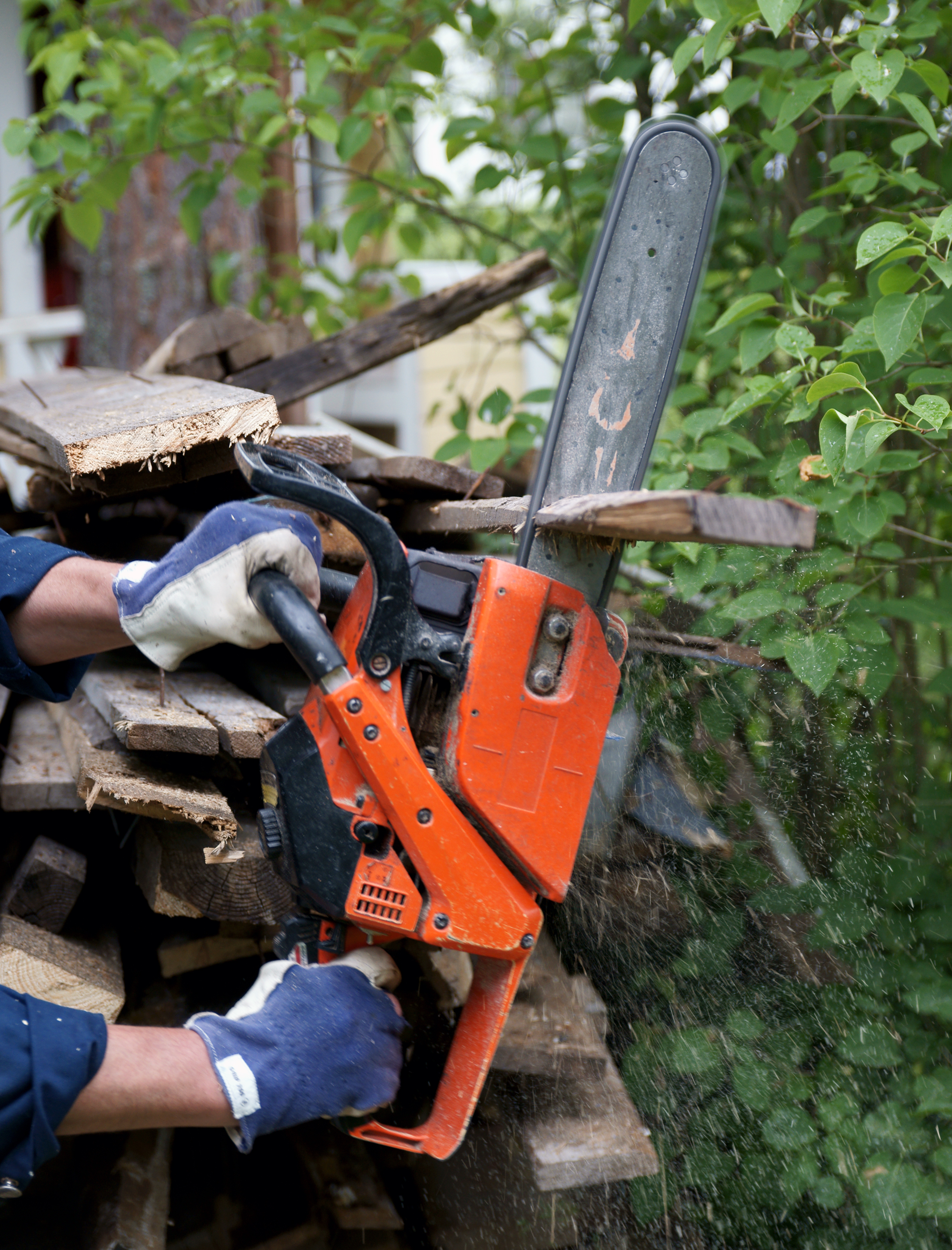
Furthermore, the “chain” itself had to be redesigned. The surgical teeth of the 1800s were too fine for wood. Joseph Cox famously observed the larvae of the timber beetle, noting how their C-shaped mandibles easily chewed through wood. This bio-mimicry led to the invention of the “chipper chain” in 1947, a technological leap that increased cutting efficiency exponentially and is still the standard for modern chainsaw teeth today.
Modern Chainsaw Engineering: Safety, Power, and Portability
In the 21st century, the chainsaw is no longer just a mechanical tool; it is a sophisticated piece of hardware integrated with modern electronics and material science. The focus has shifted from mere cutting power to operator safety, ergonomic efficiency, and environmental sustainability.
Ergonomics and Human-Machine Interface (HMI)
Early industrial chainsaws were notorious for causing “Vibration White Finger” (VWF), a permanent neurological and vascular condition caused by the intense tremors of the engine. To combat this, modern engineering has introduced complex anti-vibration systems. These systems use heavy-duty springs and rubber bushings to decouple the engine and the bar from the handles.
Additionally, the development of the “chain brake” was a pivotal safety innovation. Using a sophisticated weighted mechanism or an inertia-activated trigger, the brake can stop a chain spinning at 60 miles per hour in less than a fraction of a second. This represents the integration of mechanical physics and safety-first design thinking.
Battery Tech and the Future of Cordless Power
Perhaps the most significant tech trend in the chainsaw industry today is the shift from gasoline to lithium-ion battery power. For decades, the energy density of batteries was insufficient for the high-torque demands of woodcutting. However, advancements in brushless motor technology and high-voltage battery cells have changed the landscape.
Modern professional-grade electric chainsaws now rival the power of 40cc or 50cc gas engines. This shift offers several technological advantages:
- Instant Torque: Unlike gas engines that must “rev up,” electric motors provide maximum torque immediately.
- Software Integration: Electric saws use onboard microcontrollers to manage power consumption, monitor heat, and prevent motor burnout.
- Reduced Noise and Emissions: This allows for work in urban environments and noise-sensitive areas, expanding the tool’s utility beyond the deep woods.
The Intersection of Digital Tech and Forestry Equipment
As we look toward the future, the chainsaw is becoming part of the “Internet of Things” (IoT). The logging industry is no longer just about brawn; it is about data-driven management and precision forestry.
IoT and Smart Sensors in Modern Logging
High-end professional chainsaws are now being equipped with sensors and Bluetooth connectivity. This allows fleet managers to track a tool’s usage hours, maintenance schedules, and even its location via GPS. This “Smart Tool” ecosystem helps companies optimize their workflows and reduce downtime. By analyzing data from the saw’s ignition system or motor controller, software can predict when a component is likely to fail before it actually does—a concept known as “predictive maintenance.”
The Software Behind the Blade
In large-scale industrial logging, the chainsaw mechanism is often integrated into massive “harvesters”—robotic vehicles that can cut, de-limb, and process a tree in seconds. These machines run on complex software that calculates the optimal yield for every log, ensuring that wood is cut to lengths that maximize profit based on current market demands. The “chainsaw” at the end of the harvester’s arm is guided by sensors that detect wood density and diameter, adjusting the chain speed and pressure in real-time.

Conclusion: A Legacy of Adaptation
The journey of the chainsaw from a 1780s operating room to a 2024 smart-forestry fleet is a testament to the power of technological adaptation. What began as a terrifying but necessary solution to a biological problem was reimagined through the lens of mechanical engineering to solve an industrial one.
Today, the chainsaw sits at the intersection of several tech disciplines: material science (in the form of high-carbon steel alloys), mechanical engineering (in the form of high-output engines and vibration dampening), and increasingly, digital software (in the form of battery management and IoT connectivity). While we may no longer use them for their “original” purpose, the core concept of the rotating serrated chain remains one of the most efficient ways to sever material. It is a reminder that in the world of technology, the most impactful innovations often come from looking at a problem—whether it is a medical emergency or a standing timber—and finding a smarter, more mechanical way to solve it.
aViewFromTheCave is a participant in the Amazon Services LLC Associates Program, an affiliate advertising program designed to provide a means for sites to earn advertising fees by advertising and linking to Amazon.com. Amazon, the Amazon logo, AmazonSupply, and the AmazonSupply logo are trademarks of Amazon.com, Inc. or its affiliates. As an Amazon Associate we earn affiliate commissions from qualifying purchases.