
At its core, the concept of volume is fundamental: it quantifies the three-dimensional space an object occupies. For centuries, humanity has relied on geometric formulas to calculate this critical measure, from estimating the capacity of storage vessels to designing monumental architecture. While the basic “volume formula” might evoke memories of high school geometry, its relevance in the modern technological landscape is far from rudimentary. In fact, understanding and applying volume formulas, often through sophisticated computational methods, is absolutely central to countless innovations across engineering, artificial intelligence, virtual reality, and manufacturing.

This article delves into the foundational concept of volume formulas, not merely as abstract mathematical principles, but as indispensable tools powering the technological advancements that shape our world. We’ll explore how these formulas are translated into digital processes, enabling engineers to design with precision, AI to interpret physical environments, and designers to craft immersive digital experiences. From the intricate circuits of a microchip to the vast data centers housing our digital lives, the principles of volume, in various forms, underpin much of the tech we interact with daily.
The Digital Significance of Volume: Beyond Basic Geometry
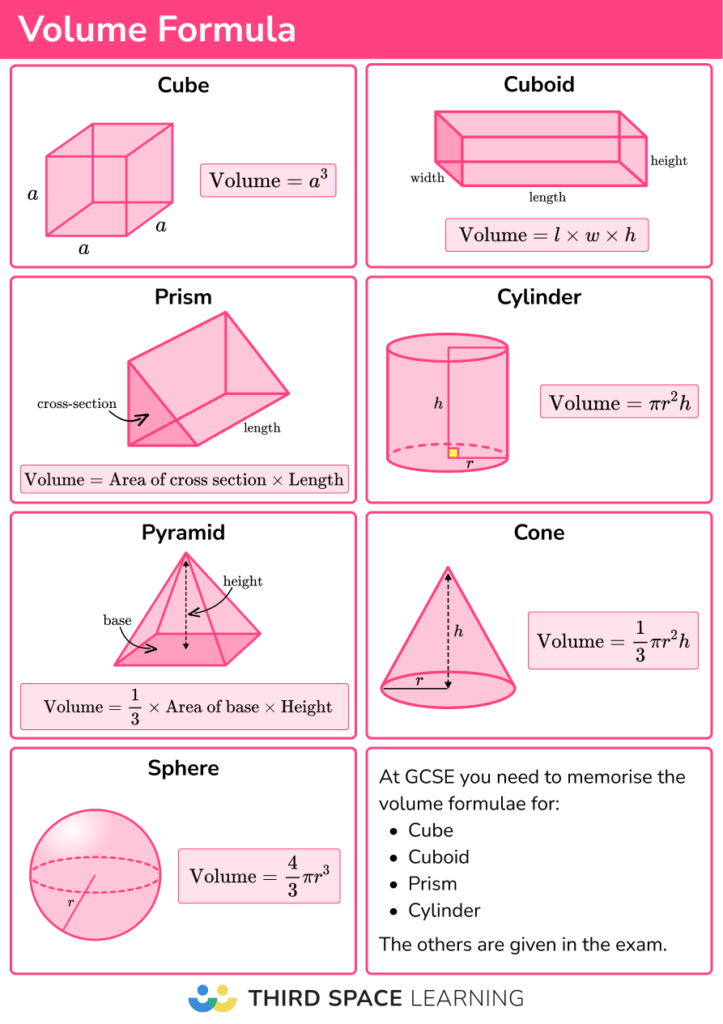
To appreciate the technological impact of volume formulas, it’s essential to first grasp their fundamental definition and then connect it to the unique demands of digital environments. Volume, typically measured in cubic units (like cubic meters or cubic inches), provides a quantitative measure of space. For simple, regular shapes—like cubes, cylinders, or spheres—the formulas are straightforward. For instance, the volume of a cube is side cubed ($s^3$), a cylinder is $pi r^2 h$, and a sphere is $frac{4}{3} pi r^3$. These seemingly simple equations are the bedrock upon which complex digital calculations are built.
Defining Geometric Volume in a Tech Context
In the realm of technology, “geometric volume” takes on new dimensions of application. It’s not just about measuring physical objects but about representing, manipulating, and understanding three-dimensional data digitally. Tech applications often deal with virtual models, point clouds, meshes, and complex mathematical representations of objects that exist purely in binary code. The volume formula, in this context, is less about a single number and more about an algorithmic process that can derive that number from a digital representation, or even optimize a shape based on desired volume constraints.
For instance, CAD (Computer-Aided Design) software doesn’t just display a 3D model; it understands its intrinsic geometric properties, including its volume. This allows engineers to perform virtual stress tests, simulate fluid dynamics, or calculate the material cost of a design before a single physical prototype is made. The underlying principle, however, remains rooted in the classic volume formulas, albeit applied to incredibly intricate digital geometries.
Why Volume Matters for Digital Innovation
The ability to accurately calculate, manipulate, and optimize volume is a cornerstone of digital innovation for several reasons:
- Resource Management: In manufacturing, knowing the exact volume of material needed for a part prevents waste and optimizes logistics.
- Performance Prediction: In engineering simulations, fluid volume, gas volume, or even the volume of force applied can predict how a system will behave under stress.
- Spatial Understanding: AI systems, particularly in robotics and autonomous navigation, rely on understanding the volume occupied by objects in their environment to avoid collisions, plan paths, and interact safely.
- Immersive Experiences: In virtual reality (VR) and augmented reality (AR), accurately rendered volumes contribute to the realism and believability of digital worlds and objects.
- Data Density: While not strictly geometric, the concept of “data volume”—the sheer quantity of information—is a parallel in tech that highlights the importance of managing spatial or informational “occupancy.”
The digital transformation has elevated volume formulas from classroom exercises to critical components of advanced computational tasks, demonstrating their enduring power and versatility.
Engineering Precision: Volume in CAD, Simulation, and Manufacturing
The most direct and impactful application of volume formulas in technology is found within the engineering and manufacturing sectors. Here, computational tools leverage these formulas to bring designs to life, optimize production processes, and ensure the structural integrity and performance of physical products.
From Blueprint to Reality: CAD Software and Volume
Computer-Aided Design (CAD) software is the modern architect’s and engineer’s drafting board. Tools like AutoCAD, SolidWorks, and Fusion 360 allow users to create complex 3D models with incredible precision. A crucial feature of these platforms is their ability to instantly calculate the volume of any created part or assembly. This isn’t just a numerical readout; it’s a dynamic property that informs design decisions. Engineers can quickly assess how changes to a part’s dimensions impact its volume, which in turn affects its weight, material cost, and physical properties. For example, designing an engine block requires precise volume calculations for its combustion chambers, cooling channels, and overall material usage to optimize power, efficiency, and weight.
Optimizing Production: 3D Printing and Material Volume
The advent of 3D printing (additive manufacturing) has further amplified the importance of volume formulas. When a 3D model is sent to a printer, the software slices it into thousands of layers, and the printer then extrudes material layer by layer to build the object. The exact amount of material consumed is directly related to the object’s volume and the chosen infill density. Accurate volume calculation is essential for:
- Material Cost Estimation: Manufacturers can precisely quote production costs based on the required material volume.
- Print Time Prediction: The volume and complexity dictate how long a print will take.
- Structural Integrity: Designing parts with optimal internal infill (which affects the effective volume of material) allows for balancing strength with reduced material usage and weight.
Without robust algorithms rooted in volume formulas, 3D printing would be an inefficient and unpredictable process, unable to scale for industrial applications.
Performance Prediction: Simulating Physical Interactions
Beyond static design, volume formulas are critical in engineering simulations. Finite Element Analysis (FEA) and Computational Fluid Dynamics (CFD) are powerful simulation techniques used to predict how designs will behave under real-world conditions.
- FEA: By dividing complex objects into tiny elements (often tetrahedrons or hexahedrons, whose volumes are easily calculated), FEA software can simulate stress, strain, heat transfer, and vibration throughout a structure. The volume of each element contributes to the overall structural behavior, allowing engineers to identify weak points or areas of high thermal load.
- CFD: Used to simulate fluid flow (liquids or gases), CFD relies heavily on defining the volume of fluid domains and the objects within them. Understanding how air flows around an aircraft wing (its aerodynamic volume) or how water moves through a pipe system requires precise volume definitions to solve complex Navier-Stokes equations and predict performance.
These simulations save billions in prototyping costs and accelerate innovation across aerospace, automotive, civil engineering, and medical device development, all thanks to the computational application of volume formulas.
Virtual Worlds and Intelligent Systems: Volume in AI and Graphics
The application of volume formulas extends beyond the tangible, playing an equally vital role in crafting digital realities and empowering intelligent systems to understand their environments. From the immersive landscapes of video games to the spatial awareness of autonomous robots, volume is a key underlying principle.
Crafting Immersive Experiences: Volume in Game Engines and VR
Video game developers and virtual reality (VR) creators meticulously construct vast digital worlds. Every object, character, and environment in these worlds occupies a defined volume, even if it’s not a physically rendered solid. Game engines like Unity and Unreal Engine use volumetric data for various purposes:
- Collision Detection: To prevent characters from walking through walls or objects from intersecting unnaturally, bounding volumes (simple shapes like spheres or boxes that enclose complex objects) are used. When the bounding volumes of two objects overlap, a collision is detected.
- Lighting and Shadows: Volumetric lighting effects, such as fog or atmospheric scattering, calculate how light interacts with a specified volume of space, adding depth and realism to scenes.
- Sound Propagation: In advanced audio engines, the volume of a room or space influences how sound reverberates and propagates, creating more immersive auditory experiences.
- Level Design: Designers consider the playable volume of a level, ensuring there’s enough space for player movement, combat, and exploration, while avoiding performance bottlenecks caused by excessively complex volumetric rendering.
Spatial Understanding: How AI Leverages Volume Data
Artificial intelligence systems, especially those involved in perception and robotics, rely heavily on understanding the three-dimensional space occupied by objects. AI models trained for object recognition and scene understanding process sensor data (from cameras, LiDAR, radar) to construct a volumetric representation of their surroundings.
- Autonomous Vehicles: Self-driving cars use LiDAR scanners to create dense “point clouds” – millions of data points representing surfaces in 3D space. AI algorithms process these points to identify and estimate the volume of other vehicles, pedestrians, and obstacles, enabling safe navigation and path planning.
- Robotics: Industrial robots performing pick-and-place tasks or assembly operations use computer vision and depth sensors to map their workspace. By understanding the volume of objects they need to manipulate and the volume of available space, robots can execute precise movements and avoid collisions.
- Medical Imaging: In healthcare, AI assists in analyzing MRI and CT scans, which are essentially volumetric datasets. AI models segment organs, tumors, and other structures, calculating their exact volumes to aid diagnosis, treatment planning, and monitoring disease progression.
Robotics and Navigation: Avoiding Collisions, Maximizing Space
The practical application of volume in robotics is perhaps one of the most compelling. For a robot to operate effectively in an unstructured environment, it must continuously build and update a volumetric map of its surroundings. This map allows it to:
- Path Planning: Compute optimal collision-free paths for its manipulators or for itself as a mobile platform.
- Object Manipulation: Gripping an object requires an understanding of its volume to apply the correct pressure and orientation, preventing damage or dropping.
- Workspace Optimization: In warehouses, robots might calculate the volume of goods to be stored and the available volumetric space to optimize stacking and retrieval processes, leading to highly efficient logistics.
The ability of AI to interpret and act upon volumetric data is transforming industries, making automation safer, smarter, and more efficient.
Computational Geometry: Algorithms and Advanced Applications
The seamless integration of volume formulas into modern technology is made possible by sophisticated computational geometry algorithms. These algorithms provide the framework for computers to not only calculate but also analyze, optimize, and render complex 3D shapes.
Optimizing Algorithms for Volume Calculation
While simple shapes have straightforward volume formulas, real-world objects in tech are often irregular or composed of many interconnected surfaces. For such complex geometries, direct application of basic formulas is impossible. Instead, algorithms break down complex shapes into simpler, calculable units. Techniques include:
- Triangulation/Tetrahedralization: Dividing a 3D object into a mesh of triangles (for surfaces) or tetrahedrons (for solids). The total volume is then the sum of the volumes of these simpler components. This is fundamental in CAD, FEA, and 3D graphics.
- Voxelization: Representing a 3D object as a grid of tiny cubes (voxels). Each voxel either contains part of the object or is empty. The object’s volume can be approximated by counting the number of occupied voxels and multiplying by the volume of a single voxel. This is common in medical imaging and certain simulation types.
- Monte Carlo Methods: For extremely complex or irregular shapes, statistical methods can be used to estimate volume by randomly sampling points within a defined bounding box and determining how many fall within the object.
Developing efficient algorithms that can perform these calculations rapidly, even for models with millions of polygons, is a key area of research in computational geometry, directly enabling faster rendering, more realistic simulations, and quicker design iterations.
Point Clouds, Meshes, and Complex Geometries
Modern 3D scanning technologies, such as LiDAR and photogrammetry, generate “point clouds” – vast collections of individual 3D data points representing the surface of an object or environment. These raw point clouds often need to be converted into “meshes” (networks of connected triangles or polygons) before volume can be accurately calculated. Algorithms are crucial for:
- Surface Reconstruction: Turning disjointed point clouds into coherent, watertight 3D models.
- Mesh Simplification: Reducing the number of polygons in a mesh without significantly altering its shape or volume, which improves performance in real-time applications like games or VR.
- Volume Preserving Deformations: Allowing designers to sculpt or deform a 3D model while ensuring its volume remains constant, which is important for certain animations or ergonomic designs.
The ability to process and interpret these complex digital representations of space is central to a wide array of technological applications, from cultural heritage preservation to advanced product design.
Scientific Computing and Resource Allocation
In scientific computing, especially in fields like astrophysics, materials science, and biochemistry, volume formulas take on highly specialized roles. Simulations of molecular structures, fluid dynamics in extreme conditions, or the distribution of matter in the cosmos often involve calculating or optimizing volumes within multi-dimensional spaces.
Furthermore, in high-performance computing (HPC) and cloud computing, “resource allocation” can be viewed through a volumetric lens. While not geometric volume, the allocation of compute units, memory, and storage to different processes can be optimized by understanding the “volume” of resources each task demands, ensuring efficient utilization of powerful hardware. This conceptual extension underscores how the underlying principles of quantifying space (or capacity) are pervasive across diverse tech domains.
The Future of Spatial Understanding: Emerging Tech and Volume Formulas
As technology continues its relentless march forward, the significance of volume formulas is only set to grow. Emerging fields are finding innovative ways to apply these foundational principles, pushing the boundaries of what’s possible in design, intelligence, and human-computer interaction.
AI-Driven Design and Generative Volume
Generative design, powered by artificial intelligence, is revolutionizing how products are conceived. Engineers define desired performance criteria (e.g., strength, weight, material type, and crucially, volume constraints), and AI algorithms explore thousands of design variations, often producing organic, highly optimized shapes that human designers might never conceive. These AI-generated designs frequently feature intricate internal lattices or topologically optimized structures, where every void and solid volume is meticulously placed to achieve maximum efficiency. Understanding and controlling these complex, algorithmically generated volumes is at the heart of producing lighter, stronger, and more sustainable products, from aerospace components to medical implants.
Quantum Computing’s Potential for Geometric Analysis
While still in its nascent stages, quantum computing holds immense promise for tackling problems currently intractable for classical computers. One potential area of impact is in complex geometric analysis and volume calculation. Quantum algorithms could potentially process vast point clouds or volumetric datasets much faster, or even model higher-dimensional geometries that are currently beyond our computational reach. This could lead to breakthroughs in materials science, drug discovery (modeling molecular volumes and interactions), and advanced simulations that require unprecedented levels of volumetric fidelity.

Educational Tech and Interactive Volume Exploration
Beyond professional applications, educational technology is also finding creative ways to make volume formulas more intuitive and engaging. Interactive simulations, VR/AR applications, and gamified learning platforms allow students to visually manipulate 3D objects, see how changing dimensions affects volume, and even “step inside” volumetric representations of data. This hands-on, immersive approach transforms abstract mathematical concepts into tangible experiences, fostering a deeper understanding that can inspire the next generation of engineers, designers, and scientists.
In conclusion, the simple question “what is volume formula?” opens a gateway to a universe of technological application. From the meticulous precision required in advanced manufacturing to the immersive realism of virtual worlds and the spatial intelligence of AI, volume formulas are not just relics of basic geometry; they are dynamic, computational tools that are continuously refined and reapplied to drive innovation. As technology evolves, our understanding and utilization of these fundamental principles will only deepen, further cementing their indispensable role in shaping our digital and physical futures.
aViewFromTheCave is a participant in the Amazon Services LLC Associates Program, an affiliate advertising program designed to provide a means for sites to earn advertising fees by advertising and linking to Amazon.com. Amazon, the Amazon logo, AmazonSupply, and the AmazonSupply logo are trademarks of Amazon.com, Inc. or its affiliates. As an Amazon Associate we earn affiliate commissions from qualifying purchases.