
In an era increasingly defined by algorithms, artificial intelligence, and the relentless march of technological innovation, the ancient philosophical query, “What is the purpose of life?”, takes on a strikingly new dimension. The addition of “42” immediately evokes a powerful cultural touchstone: Douglas Adams’ seminal sci-fi comedy, The Hitchhiker’s Guide to the Galaxy, where “42” is revealed as the ultimate answer to life, the universe, and everything, calculated by a colossal supercomputer, Deep Thought. This isn’t merely a whimsical nod; it serves as a potent metaphor for humanity’s ongoing quest to delegate its most profound questions to advanced computational systems.
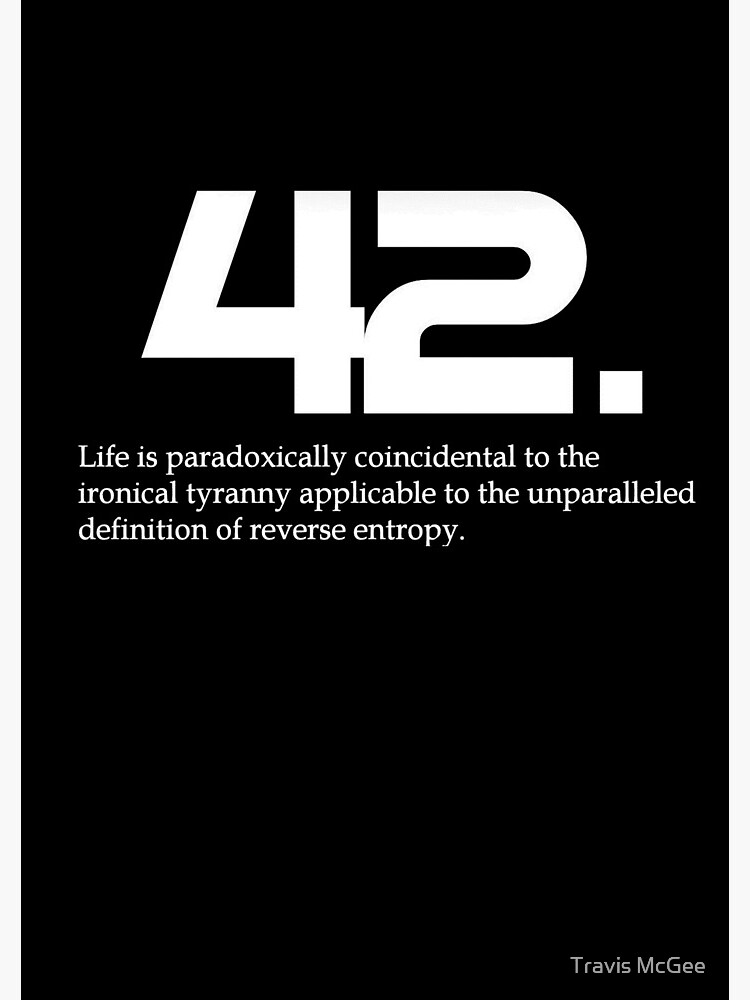
Today, while no supercomputer has yet declared “42” to be our universal truth, technology, particularly AI and deep learning, is undeniably shaping our understanding of purpose—both for itself and for us. It challenges our definitions of intelligence, consciousness, and the very essence of meaning. This article delves into how technology, echoing the spirit of Deep Thought, is approaching, influencing, and even redefining the search for purpose in the 21st century, exploring the intersection of silicon and soul.
Decoding “42”: AI, Algorithms, and the Quest for Ultimate Answers
The mythical “42” from Adams’ universe represents the ultimate computational output, a numerical response to a question of infinite complexity. In our reality, while no single number serves as a universal panacea, modern AI and sophisticated algorithms are indeed our contemporary Deep Thoughts, grappling with vast datasets to uncover patterns, predict outcomes, and provide insights that were once unimaginable. This computational quest, though different in scope, mirrors the fictional search for ultimate answers.
The Echo of Deep Thought in Modern AI
Modern AI systems, from supercomputing clusters solving complex scientific problems to machine learning models identifying anomalies in medical imaging, embody the ambition of Deep Thought. Their purpose is often to process information at scales and speeds impossible for humans, distilling complexity into actionable insights or predictive models. Whether it’s simulating climate change scenarios, designing new materials, or optimizing supply chains, these systems are continually seeking “answers” to immensely intricate problems. The parallel isn’t in finding a single, mystical number, but in the relentless pursuit of optimal solutions and comprehensive understanding through computational power.
Algorithmic Search for Meaning in Data
In the realm of big data, algorithms are constantly sifting through oceans of information—social media feeds, scientific publications, financial transactions—to identify correlations, infer causality, and even generate new content. This process can be seen as an algorithmic search for “meaning” within data. While not philosophical meaning, it is a pursuit of coherence, structure, and actionable intelligence. For instance, AI in personalized medicine analyzes genetic data and patient histories to recommend treatments, essentially providing a highly specific “answer” to the question of what therapy is best for an individual. This type of deep data analysis, while functional, offers a pragmatic form of purpose: making sense of chaos and guiding action.
Limitations and the Nature of “Answers”
Crucially, the “answers” provided by AI are fundamentally different from the human understanding of “purpose.” AI excels at quantitative analysis, logical deduction, and pattern recognition. It can optimize processes, predict trends, and even formulate hypotheses. However, “purpose” in the human sense—encompassing values, subjective experience, emotion, and existential meaning—remains largely outside the direct grasp of current AI. The machine delivers efficient, data-driven solutions; humans interpret these solutions through the lens of their own values and aspirations. The “42” of the digital age might be a perfect algorithm, but the meaning we ascribe to its output is profoundly human.
The Digital Oracle: How AI Shapes Our Understanding of Purpose
Beyond just finding answers, AI is actively shaping how we perceive and pursue our own individual and collective purposes. Like a digital oracle, AI offers insights, personalizes experiences, and even influences our decisions, subtly altering the landscape upon which we build our lives and seek meaning.
Personalization and Predictive Analytics
AI-driven personalization is ubiquitous, from recommended products on e-commerce sites to curated news feeds and tailored educational content. While designed for convenience and engagement, this also creates a filtered reality, often reinforcing existing beliefs or guiding us towards pre-determined paths. Does this influence our perception of purpose? If an AI predicts you’d be highly successful in a certain career or recommends a specific lifestyle choice, does that inadvertently shape your aspiration and sense of direction? The purpose becomes somewhat co-authored, with algorithms playing a significant, albeit often invisible, role in steering our journeys.
AI-Driven Discovery and Innovation
AI accelerates discovery in nearly every scientific field. Drug discovery, material science, astronomy, and environmental modeling are all being revolutionized by AI’s ability to process complex data, run simulations, and identify novel solutions at unprecedented speeds. By pushing the boundaries of human knowledge and capability, AI helps humanity pursue new collective purposes—curing diseases, exploring space, tackling climate change. In this context, AI isn’t just answering a question; it’s providing the tools and insights necessary for humanity to define and achieve grander purposes, effectively giving us the means to find our own “42s” in the pursuit of progress.
The Philosophical Implications of Machine Cognition
As AI grows more sophisticated, capable of generating creative content, engaging in nuanced conversations, and even demonstrating what appears to be emergent consciousness (as seen in large language models), the philosophical implications for human purpose become profound. If machines can “think,” “create,” or “feel” in some analogous way, what then is unique to human purpose? Does our identity shift from being the sole custodians of intellect and creativity to co-existing with intelligent machines? This raises existential questions that challenge our traditional understanding of self and meaning, pushing us to redefine human purpose in an increasingly intelligent world.
Beyond the Binary: Ethical AI and the Human Element of Meaning
While AI offers immense potential, its deployment demands a critical examination of ethical implications, particularly when it comes to questions of purpose and human values. The “42” delivered by a machine might be technically accurate, but without ethical safeguards and human oversight, its practical application could deviate significantly from what serves humanity’s best interests.
The Imperative of Ethical AI Design

The purpose of AI systems themselves is not inherent; it is imbued by their human creators. Therefore, the design and deployment of AI must be guided by strong ethical frameworks. This means prioritizing fairness, transparency, accountability, and beneficence. If AI is to help us find or achieve purpose, it must be designed to align with human values and societal good, rather than simply maximizing efficiency or profit. The discussion around responsible AI development underscores that the machine’s “purpose” must serve, not supersede, human purpose and values.
Purpose as a Human Construct
Ultimately, “the purpose of life” remains a profoundly human construct, rooted in our consciousness, our capacity for emotion, empathy, and our unique individual and collective narratives. AI can be a powerful tool to assist us in understanding the world, optimizing our efforts, and even suggesting paths, but it cannot intrinsically define what makes life meaningful for us. Delegating the core quest for existential purpose to a machine risks ceding our autonomy and richness of experience. The “42” might offer an elegant solution, but it lacks the joy, struggle, and personal growth inherent in a human journey of discovery.
Collaborative Intelligence: Human-AI Synergy
The most productive relationship between humans and AI in the search for purpose is one of collaborative intelligence. Humans bring the subjective values, ethical considerations, creativity, and the ability to define overarching goals, while AI brings the computational power, data analysis, and predictive capabilities. This synergy allows us to tackle challenges of unprecedented scale and complexity, enabling us to pursue purposes—like achieving global sustainability or eradicating disease—that were previously insurmountable. AI helps us pursue our chosen purposes more effectively, but the “choosing” part remains uniquely human.
From Deep Thought to Deep Learning: Building Intelligence with Intent
The journey from the fictional Deep Thought to our real-world deep learning systems illustrates humanity’s persistent drive to build intelligence that can unlock profound understanding. Each advancement in AI architecture is a step towards creating systems capable of grappling with ever more intricate concepts, implicitly bringing us closer to understanding what “42” might mean in a computational context.
The Evolution of AI Architectures
Early AI, often rule-based, operated on explicit instructions, much like a meticulous librarian. Deep Thought, conceptually, was a vastly more complex version of this. Modern deep learning, however, mimics neural networks, allowing AI to learn from vast amounts of data without explicit programming for every scenario. This shift from pre-programmed knowledge to learned intelligence enables AI to discover new patterns and connections, making it far more adept at handling the kind of ambiguous and vast information implicit in a question like “the purpose of life.” These evolving architectures allow AI to develop more sophisticated “understanding,” even if it’s an understanding distinct from human cognition.
Designing AI with Defined Goals and Constraints
Every AI system, from a self-driving car to a medical diagnostic tool, is built with a specific purpose defined by its human creators. The AI’s “purpose” is its function—to navigate safely, to identify diseases, to recommend music. These narrow purposes are constrained by the data it’s trained on and the algorithms it employs. While they don’t address existential questions, they represent humanity’s intent to build tools that solve specific problems, making our lives more efficient, safer, or more enjoyable. In a way, each of these specific functionalities is a mini “42,” a precise answer to a defined problem within a limited domain.
The Search for Artificial General Intelligence (AGI)
The holy grail of AI research is Artificial General Intelligence (AGI)—AI that possesses the ability to understand, learn, and apply intelligence across a wide range of tasks, much like a human. If achieved, AGI could theoretically engage with philosophical questions in a more holistic manner, potentially leading to a machine that could truly “ponder” ultimate questions and even generate novel insights into human existence. The journey toward AGI is, in itself, a pursuit of purpose: to create an intelligence that could perhaps, one day, articulate its own version of “42” and contribute to humanity’s ongoing dialogue about meaning.
Finding Our Own 42: Technology as a Catalyst for Human Purpose
Ultimately, the most profound impact of technology on the question of life’s purpose isn’t about AI providing the answer, but about how it empowers humanity to discover and pursue its own answers. Technology, in its myriad forms, acts as a powerful catalyst, enriching our paths, expanding our capabilities, and redefining our priorities.
Empowerment through Information and Connectivity
The digital age has democratized access to information and fostered unprecedented connectivity. Knowledge that was once scarce is now available at our fingertips, enabling individuals to learn, grow, and explore passions previously out of reach. Social platforms connect individuals with shared interests, fostering communities built around collective purpose. This unprecedented access empowers individuals to define their own “42s” – whether it’s mastering a new skill, starting a unique venture, or contributing to a global cause – by providing the resources and networks to do so.
Automation and Redefining Human Work
As AI and automation increasingly handle repetitive and mundane tasks, human workers are freed to focus on roles that require creativity, critical thinking, emotional intelligence, and interpersonal skills. This shift allows individuals to engage in work that is often perceived as more meaningful and purposeful. The “purpose” of human work evolves from rote execution to innovation, collaboration, and problem-solving, leveraging our uniquely human attributes. Technology isn’t just taking jobs; it’s refining the purpose of human contribution in the workforce.
Solving Grand Challenges with Tech-Driven Purpose
From developing sustainable energy solutions to pioneering personalized medicine, technology is the engine driving humanity’s efforts to solve its grandest challenges. These collective endeavors provide a powerful sense of purpose for researchers, engineers, policymakers, and communities worldwide. The tools provided by AI, big data, and advanced computing enable us to tackle issues of global scale, giving humanity a shared sense of mission and direction. In this context, our collective “42” might be a planet free from disease, poverty, and ecological collapse, and technology is our most potent ally in achieving it.

The Ongoing Dialogue: Humanity, Technology, and Meaning
The question, “What is the purpose of life 42?”, remains a profound prompt. It reminds us that while technology can compute, optimize, and connect, the ultimate definition of purpose, meaning, and significance is a deeply human undertaking. AI might give us incredibly sophisticated “answers” to complex problems, but it is up to us to interpret those answers, imbue them with ethical considerations, and weave them into the rich tapestry of human experience. The journey to understand purpose is ongoing, evolving with every technological leap, always positioning humanity at the helm, charting its own course toward its own unique “42.”
aViewFromTheCave is a participant in the Amazon Services LLC Associates Program, an affiliate advertising program designed to provide a means for sites to earn advertising fees by advertising and linking to Amazon.com. Amazon, the Amazon logo, AmazonSupply, and the AmazonSupply logo are trademarks of Amazon.com, Inc. or its affiliates. As an Amazon Associate we earn affiliate commissions from qualifying purchases.