
Retirement is no longer a fixed date on a calendar marked by a gold watch and a pension. In the modern financial landscape, retirement is a mathematical target—a “number” that represents the point at which your assets can generate enough income to support your lifestyle indefinitely. The most common tool used to find this number is the retirement calculator. However, a calculator is only as good as the data fed into it and the user’s understanding of the underlying financial principles.
Achieving financial independence requires a deep dive into your spending habits, investment returns, and the economic forces that will shape the next several decades of your life. This guide explores how to effectively use retirement calculators and the strategic steps necessary to ensure your nest egg lasts as long as you do.
Understanding the Core Variables of Retirement Planning
Before inputting numbers into a retirement calculator, you must understand the variables that drive the results. Retirement planning is essentially a balancing act between your current lifestyle and your future security.
The Role of Current Income and Spending Habits
Most financial experts suggest the “80% Rule,” which posits that you will need approximately 80% of your pre-retirement annual income to maintain your lifestyle after you stop working. However, this is a broad generalization. For a more accurate calculation, you must analyze your current cash flow.
In retirement, certain costs—like commuting, professional wardrobes, and payroll taxes—disappear. Conversely, other costs, particularly healthcare and leisure travel, often increase. A robust retirement calculator will allow you to input specific spending projections rather than relying on a flat percentage of your current salary. Understanding whether you intend to downsize your home or move to a lower-tax jurisdiction is critical for setting a realistic baseline.
Factoring in Inflation and Purchasing Power
Inflation is the “silent thief” of retirement. Even a modest 2% or 3% annual inflation rate can erode the purchasing power of your money significantly over twenty or thirty years. If a calculator does not account for inflation, the “number” it provides will be dangerously misleading.
When planning, you must distinguish between nominal returns (the raw percentage your investments grow) and real returns (growth minus inflation). Professional-grade retirement tools often allow you to toggle inflation expectations, helping you see how a million-dollar portfolio today might only have the buying power of $500,000 in three decades.
How Retirement Calculators Work: Behind the Algorithms
Retirement calculators use various mathematical models to project your financial future. Understanding the difference between these models can help you interpret the “success rate” of your plan.
Life Expectancy and the “Safe Withdrawal Rate”
One of the most difficult inputs in any retirement calculator is life expectancy. While it feels morbid to estimate your own longevity, it is a financial necessity. Planning to age 90 or 95 is a standard “safety first” approach to avoid outliving your money.
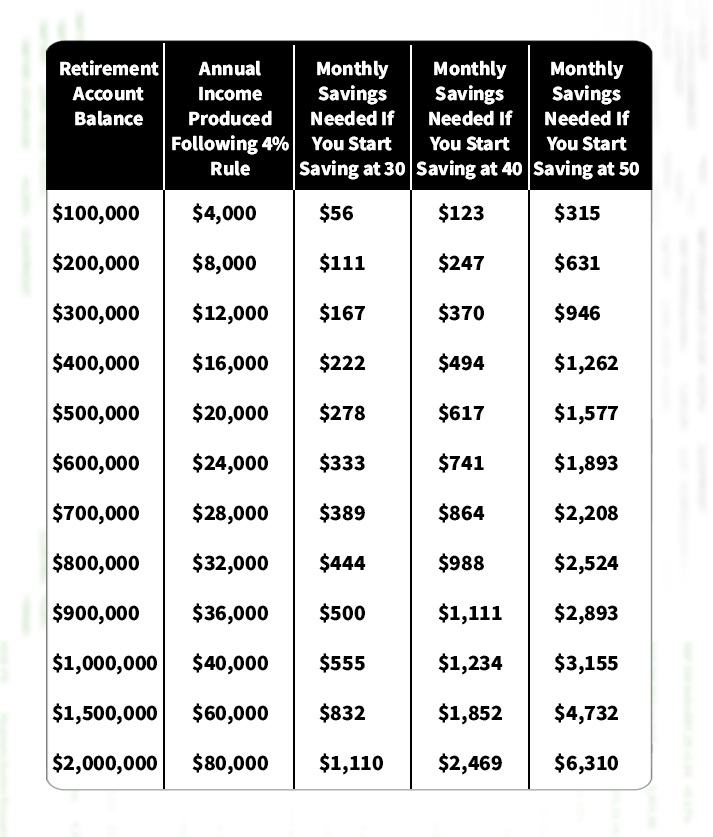
Connected to this is the concept of the “Safe Withdrawal Rate” (SWR). Traditionally, the “4% Rule” has been the benchmark. This rule suggests that if you withdraw 4% of your total portfolio in the first year of retirement and adjust that amount for inflation every year thereafter, your money has a high probability of lasting 30 years. Modern calculators often allow you to test different SWRs—such as 3% or 3.5%—to see how they impact your required “nest egg” total.
Estimating Investment Returns and Asset Allocation
Your retirement number is heavily influenced by how your money is invested. A portfolio heavily weighted in equities (stocks) has higher growth potential but comes with greater volatility. A portfolio weighted in fixed income (bonds) offers stability but may struggle to outpace inflation.
When using a calculator, it is vital to be conservative with projected returns. While the S&P 500 has historically returned about 10% annually, a diversified retirement portfolio involving bonds and cash will likely return less. High-quality calculators use “Monte Carlo Simulations,” which run thousands of different market scenarios—including market crashes and boom periods—to tell you the probability of your money lasting. Instead of a single “yes or no,” these tools provide a confidence interval, such as an “85% chance of success.”

Strategic Pillars for Reaching Your Retirement Goal
Once the calculator provides your target number, the focus shifts to the strategy required to reach it. This involves optimizing your “engine of wealth” through disciplined saving and tax efficiency.
Maximizing Tax-Advantaged Accounts
In the world of personal finance, it’s not just about how much you make, but how much you keep. Utilizing tax-advantaged accounts is the most efficient way to accelerate your progress toward your retirement number.
- 401(k) and 403(b): Employer-sponsored plans often come with a “match.” This is effectively a 100% return on your investment and should be the first priority for any saver.
- Traditional vs. Roth IRAs: A Traditional IRA provides a tax break today but requires you to pay taxes on withdrawals in the future. A Roth IRA uses after-tax dollars today but allows for tax-free growth and tax-free withdrawals in retirement. Balancing these accounts—a strategy known as “tax diversification”—gives you more control over your tax bracket during your retirement years.
The Power of Compounding and Early Contributions
The most valuable asset in retirement planning is time, not money. The principle of compound interest means that the dollars you invest in your 20s are worth significantly more than the dollars you invest in your 40s.
For example, an individual who invests $500 a month starting at age 25 will likely have a much larger nest egg by age 65 than someone who starts at age 45 and invests $2,000 a month. Retirement calculators vividly demonstrate this “opportunity cost” of waiting. If your calculator shows you are falling short of your goal, the two most effective levers are increasing your contribution rate or extending your working years to allow your investments more time to compound.
Beyond the Calculator: Adjusting for Life’s Uncertainties
A calculator provides a linear projection, but life is rarely linear. Successful financial planning requires accounting for “black swan” events and the nuances of the American social safety net.
Healthcare Costs and Long-Term Care
Healthcare is often the largest expense in retirement, yet it is the one most frequently underestimated in basic calculators. Even with Medicare, out-of-pocket costs for premiums, co-pays, and dental care can reach hundreds of thousands of dollars over a lifetime.
Furthermore, long-term care—such as assisted living or nursing home stays—is generally not covered by Medicare. A comprehensive retirement plan must include a strategy for these costs, whether through a dedicated Health Savings Account (HSA), long-term care insurance, or a significant “buffer” in the total retirement goal.
Social Security and Diversified Income Streams
While the retirement calculator focuses on your personal savings, you should also factor in external income streams. Social Security remains a cornerstone of American retirement, though the age at which you claim benefits significantly impacts your monthly check. Waiting until age 70 to claim benefits can increase your monthly payment by roughly 8% per year compared to claiming at your full retirement age.
Beyond Social Security, consider building “passive” income streams. This might include rental income from real estate, dividend-paying stocks, or a small business. Diversifying your income sources reduces the pressure on your investment portfolio, allowing you to be more flexible during market downturns.

Conclusion: Taking Action Toward Financial Independence
The question “How much do I need to retire?” does not have a static answer. It is a moving target that evolves as your career progresses, your family grows, and the economy shifts. A retirement calculator is an essential diagnostic tool, but it is not a substitute for a comprehensive financial strategy.
To reach your goal, start with a conservative estimate of your future needs, account for the erosive power of inflation, and maximize your use of tax-advantaged investment vehicles. Most importantly, remember that retirement planning is an iterative process. You should revisit your calculations at least once a year to adjust for changes in your income, market performance, and life goals. By combining the data-driven insights of a calculator with disciplined financial habits, you can transform the dream of retirement into a mathematical certainty.
aViewFromTheCave is a participant in the Amazon Services LLC Associates Program, an affiliate advertising program designed to provide a means for sites to earn advertising fees by advertising and linking to Amazon.com. Amazon, the Amazon logo, AmazonSupply, and the AmazonSupply logo are trademarks of Amazon.com, Inc. or its affiliates. As an Amazon Associate we earn affiliate commissions from qualifying purchases.