
The question of how much one needs for retirement is perhaps the most significant financial calculation a person will ever make. It is a number that represents more than just a balance in a brokerage account; it represents freedom, security, and the ability to dictate the terms of one’s later years. However, because every individual’s lifestyle, health, and goals are unique, there is no universal “magic number.”
Determining your retirement needs requires a blend of historical mathematical benchmarks, an honest assessment of future lifestyle expectations, and an understanding of the economic variables—such as inflation and market volatility—that can impact a portfolio over a thirty-year horizon. This guide provides a strategic framework to help you calculate your target and build a resilient plan to reach it.
Defining Your Retirement Lifestyle and Essential Expenses
The first step in calculating your retirement number is not looking at your bank account, but looking at your future self. Your “number” is a direct reflection of your anticipated expenses. Financial planners often suggest the “replacement ratio” method, which posits that you will need approximately 70% to 80% of your pre-retirement annual income to maintain your current standard of living. However, this is a broad generalization that may not account for your specific reality.
Identifying Fixed vs. Variable Costs
To get a precise estimate, you must categorize your projected spending into “needs” and “wants.” Fixed costs—your needs—include housing (mortgage or rent), utilities, groceries, insurance premiums, and taxes. In retirement, many people find that while work-related expenses (commuting, professional attire) disappear, other costs may rise. Variable costs—the “wants”—include travel, hobbies, dining out, and charitable giving. By establishing a baseline for your essential expenses, you can determine the absolute minimum your portfolio must generate to keep you afloat.
The Impact of Health Care and Longevity
One of the most underestimated components of retirement planning is the cost of healthcare. Even with Medicare, out-of-pocket expenses for supplemental insurance, prescriptions, and dental care can be substantial. According to recent industry estimates, a healthy 65-year-old couple may need nearly $300,000 to $350,000 just to cover medical expenses throughout retirement. Furthermore, as life expectancy increases, the risk of “outliving your money” becomes greater. Planning for a 30-year retirement is now the standard, meaning your capital must be preserved and grown even as you draw from it.
Factoring in Inflation and Purchasing Power
Inflation is the “silent killer” of retirement portfolios. If the cost of goods rises by an average of 3% per year, the purchasing power of a fixed dollar amount will be cut in half in roughly 24 years. This means that a retirement budget that feels comfortable today will feel increasingly tight a decade or two into the future. When calculating how much you need, your projections must include an inflation adjustment to ensure that your lifestyle remains sustainable in the face of rising prices.
Common Mathematical Benchmarks and Rules of Thumb
Once you have a sense of your annual spending needs, you can apply established financial formulas to determine the total nest egg required. While these rules are not infallible, they provide a vital starting point for any long-term strategy.
The 4% Rule Explained
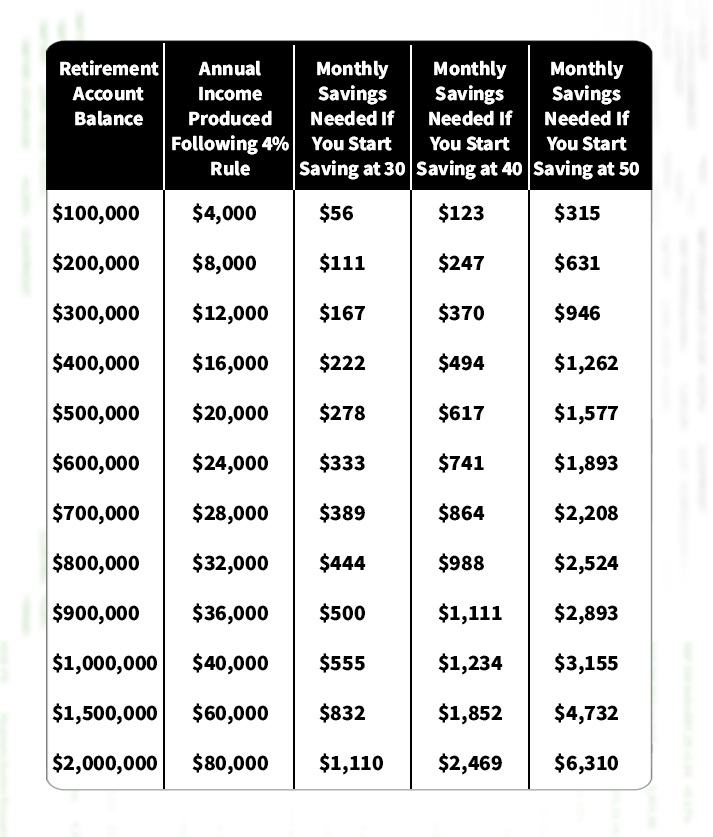
The 4% Rule originated from the “Trinity Study,” a piece of financial research that examined historical market returns to find a “safe withdrawal rate.” The rule suggests that if you withdraw 4% of your initial portfolio value in the first year of retirement and adjust that amount for inflation every year thereafter, your money has a high probability of lasting 30 years. For example, if you have a $1 million portfolio, you would withdraw $40,000 in year one. If inflation is 3%, you would withdraw $41,200 in year two, and so on.
The Multiplier Method: 25x Your Annual Expenses
The inverse of the 4% Rule is the “25x Rule.” This is a quick way to find your total retirement goal. Simply multiply your desired annual retirement income (minus any guaranteed income like Social Security) by 25. If you determine you need $60,000 a year from your investments to live comfortably, your target number is $1.5 million. This multiplier provides a clear, tangible goal for your savings efforts during your working years.
Limitations of Traditional Formulas in a Modern Economy
While the 4% and 25x rules are helpful, they are based on historical averages that may not repeat. In an era of lower interest rates or heightened market volatility, some experts argue for a more conservative 3.3% or 3.5% withdrawal rate. Conversely, those who retire during a “bull market” might find they can afford more. The key is to treat these rules as guidelines rather than laws, remaining flexible enough to adjust your spending if the market underperforms in the early years of your retirement—a concept known as “sequence of returns risk.”
Strategic Asset Allocation and Retirement Accounts
Getting to your retirement number is only half the battle; the other half is ensuring that your money is housed in the right vehicles and invested in a way that balances growth with capital preservation.
Maximizing Tax-Advantaged Accounts
The efficiency of your savings depends heavily on your use of tax-advantaged accounts like 401(k)s, 403(b)s, and IRAs. Contributions to traditional accounts provide an immediate tax break, allowing more of your money to compound over time, though withdrawals are taxed as ordinary income. Roth accounts, on the other hand, offer no immediate tax break but allow for tax-free withdrawals in retirement. A strategic mix of both (tax diversification) allows you to manage your tax bracket effectively once you stop working, potentially saving you hundreds of thousands of dollars over the long term.
The Role of Diversification in Portfolio Longevity
As you approach your retirement date, your asset allocation should typically shift from aggressive growth to a more balanced approach. While stocks are necessary to combat inflation and provide long-term growth, bonds and cash equivalents provide a buffer against market downturns. A well-diversified portfolio ensures that you aren’t forced to sell equities at a loss during a market crash just to cover your monthly bills.
Understanding Safe Withdrawal Rates in Volatile Markets
A “safe” withdrawal rate is one that accounts for the worst-case scenarios in the stock and bond markets. Professional financial tools often use “Monte Carlo simulations”—running thousands of market scenarios—to determine the probability of your portfolio’s success. Understanding these probabilities helps you decide if your current “number” is truly enough or if you need to build a larger margin of safety to account for potential “black swan” events in the global economy.
Bridging the Gap: Income Streams Beyond Savings
Your retirement number doesn’t have to be funded entirely by your personal savings. Most retirees have “legs” of a stool that support their financial structure, including government benefits and passive income.
Optimizing Social Security Benefits
Social Security remains a cornerstone of retirement for millions. The timing of when you claim benefits can drastically change your retirement math. While you can claim as early as age 62, your monthly check increases by roughly 8% for every year you delay until age 70. For many, waiting to claim acts as a form of “longevity insurance,” providing a higher guaranteed, inflation-adjusted floor for their income, which in turn reduces the amount they need to pull from their personal investments.
Real Estate and Passive Income Strategies
For those who prefer tangible assets, real estate can be a powerful supplement to a paper-asset portfolio. Rental properties provide a steady stream of income that often keeps pace with inflation. Similarly, dividend-paying stocks or private business interests can offer cash flow that allows the principal of your portfolio to remain untouched. When calculating your retirement number, subtract this reliable annual passive income from your total expense needs to see how much your liquid savings actually need to cover.
The “Side Hustle” Retirement: Staying Mentally and Financially Active
Modern retirement is increasingly “hybrid.” Many retirees choose to consult, teach, or turn a hobby into a small business. Even a modest income of $15,000 to $20,000 a year can significantly lower the amount of capital you need to have saved. Beyond the financial benefits, staying engaged in some form of work can provide social connection and cognitive stimulation, which are vital for a healthy retirement.
Building Your Personalized Retirement Roadmap
The journey to your retirement number is not a “set it and forget it” endeavor. It is a dynamic process that requires regular maintenance and a willingness to adapt to changing life circumstances.
Regular Audits and Adjustments
At least once a year, you should perform a financial audit. Has your spending increased? Have your investment returns exceeded or fallen short of your projections? By checking in regularly, you can make small course corrections—such as increasing your savings rate by 1% or slightly delaying retirement—rather than facing a crisis a decade down the line.
The Importance of a Cash Buffer
To protect against market volatility, many successful retirees maintain a “cash bucket” consisting of one to three years’ worth of living expenses in high-yield savings accounts or short-term CDs. This ensures that if the stock market enters a bear phase, you have the liquidity to pay your bills without being forced to liquidate your portfolio at the bottom. This psychological safety net is often just as important as the mathematical one.

Seeking Professional Financial Advice
While DIY investing is more accessible than ever, the complexity of tax planning, estate laws, and withdrawal strategies often warrants professional guidance. A fee-only financial advisor can provide an objective perspective, helping you run the numbers with sophisticated software and ensuring that your estate plan is in order. Ultimately, knowing exactly how much you need for retirement provides the peace of mind necessary to transition into the next chapter of your life with confidence and clarity.
aViewFromTheCave is a participant in the Amazon Services LLC Associates Program, an affiliate advertising program designed to provide a means for sites to earn advertising fees by advertising and linking to Amazon.com. Amazon, the Amazon logo, AmazonSupply, and the AmazonSupply logo are trademarks of Amazon.com, Inc. or its affiliates. As an Amazon Associate we earn affiliate commissions from qualifying purchases.