
In the realm of personal finance, the ability to quickly and accurately calculate percentages is more than just a mathematical skill; it is a fundamental pillar of financial literacy. Whether you are standing in a retail aisle trying to determine the true value of a discount, sitting in a bank discussing mortgage rates, or analyzing the year-to-date performance of your investment portfolio, the percentage is the universal language of money. While modern smartphones and specialized financial software have automated many of these tasks, understanding how to manually execute these calculations on a standard calculator remains a vital competency for any savvy consumer or investor.

This guide explores the technical and strategic applications of percentage calculations through the lens of money management. By mastering the buttons on your calculator, you move from passive consumption to active financial oversight.
The Fundamentals of Percentage Calculations in Personal Finance
To manage money effectively, one must first understand that a percentage is simply a way of expressing a number as a fraction of 100. In financial terms, this represents a portion of a whole—be it a portion of your income, a portion of a loan, or a portion of a market index.
Understanding the Percent Key vs. Manual Division
Most standard and business calculators feature a dedicated percent (%) key. However, the way this key functions can vary slightly between models. On a basic calculator, pressing the percent key usually converts the number on the screen into its decimal form (e.g., pressing 5 then % results in 0.05).
For financial calculations, there are two primary ways to find a percentage:
- The Percent Key Method: To find 15% of $200, you type
200 x 15 % =. The calculator automatically treats “15%” as 0.15 and provides the answer: 30. - The Decimal Method: If your calculator lacks a percent key or you prefer a more manual approach, you divide the percentage by 100 first. To find 15% of $200, you calculate
15 / 100 = 0.15, then multiply by the principal:200 x 0.15 = 30.
Understanding both methods ensures that you can navigate any financial tool, from a simple handheld device to a complex spreadsheet.
Converting Fractions to Percentages for Budgeting
Effective budgeting often requires dividing your income into specific categories, such as the 50/30/20 rule (50% needs, 30% wants, 20% savings). To see what percentage of your income a specific expense represents, you use the division function.
Suppose your monthly take-home pay is $4,500 and your rent is $1,350. To find what percentage of your “money pie” goes to housing, the formula is (Part / Total) x 100. On your calculator: 1350 / 4500 = 0.3. Then, 0.3 x 100 = 30%. This calculation is the first step in identifying where your money is leaking and how to reallocate resources toward wealth-building.
Using Your Calculator for Smart Shopping and Tax Planning
The most frequent daily use of percentages occurs at the point of sale. Retailers often use percentage-based marketing to entice buyers, but without a calculator (or the skill to use one), it is difficult to know if a “sale” is truly a bargain.
Calculating Sales Discounts on the Go
When a store offers “25% off” a $120 jacket, there are two ways to arrive at the final price using your calculator.
- The Subtraction Method: Calculate the discount amount first.
120 x 25% = 30. Then subtract that from the original:120 - 30 = 90. - The Net Percentage Method (The “Pro” Way): If the discount is 25%, you are paying 75% of the original price (100% – 25% = 75%). Simply type
120 x 0.75 = 90. This method is significantly faster when you are comparing multiple items under time pressure.
Determining Sales Tax and Value Added Tax (VAT)
Unlike discounts, taxes are an additive percentage. If you are buying a piece of equipment for $1,500 in a jurisdiction with a 7.5% sales tax, you need to know the total “out-the-door” cost.
- The Addition Method:
1500 x 7.5% = 112.50. Then,1500 + 112.50 = 1612.50. - The Multiplier Method: To find the total in one step, multiply the base price by 1 plus the tax rate (in decimal form). In this case,
1500 x 1.075 = 1612.50. This “1.X” multiplier is a shortcut used by business professionals to quickly estimate project costs including overhead or tax.
Calculating Gratuity and Service Charges
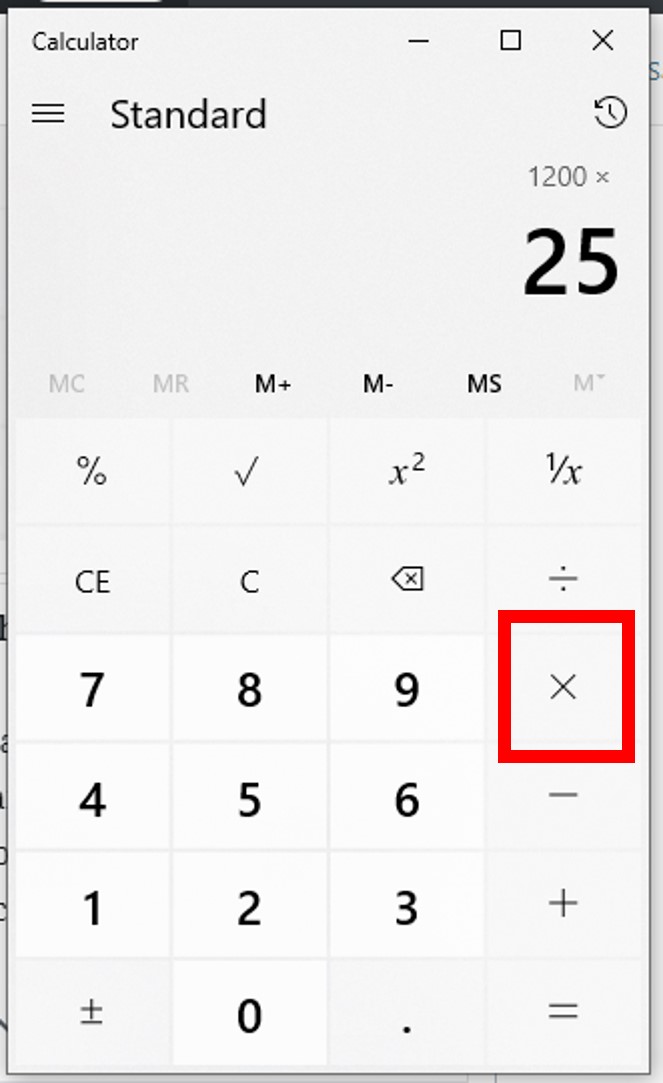
In the service industry, tipping is standard. To calculate an 18% tip on a $65.00 bill, simply enter 65 x 0.18. For those who want to see the total bill including the tip in one move, use the multiplier method: 65 x 1.18 = 76.70. Mastering this ensures you are always fair to service staff while remaining precisely within your personal entertainment budget.
Advanced Financial Calculations: Interest Rates and Debt
Moving beyond simple retail transactions, percentages dictate the “cost of money.” When you borrow money, the percentage is what you pay; when you save, the percentage is what you earn.
Calculating Simple Interest on Personal Loans
While most modern bank loans use compound interest, simple interest is still used for many short-term personal notes and bridge loans. The formula is Principal x Rate x Time.
If you borrow $5,000 from a family member at a 4% annual interest rate for 2 years, your calculator sequence would be: 5000 x 0.04 x 2 = 400. You will owe $400 in interest. Understanding this allows you to compare private lending options against traditional bank products.
Estimating Credit Card Interest and Monthly Minimums
Credit cards are perhaps the most dangerous percentage-based financial product. Interest is usually expressed as an Annual Percentage Rate (APR), but it is calculated daily.
To see how much interest you are being charged in a single month on a $2,000 balance at 24% APR:
- Convert the annual rate to a monthly rate:
24 / 12 = 2%. - Calculate the monthly interest:
2000 x 0.02 = 40.
Seeing that $40 of your hard-earned money is vanishing every month just to “rent” that $2,000 debt is often the motivation needed to prioritize debt repayment.
The Impact of Annual Percentage Rates (APR)
When shopping for a mortgage or an auto loan, the “sticker” interest rate and the APR are often different. The APR includes the interest rate plus other fees, expressed as a percentage. When using your calculator to compare two loan offers, always use the APR. A 5.0% loan with high closing fees might actually have a higher APR than a 5.2% loan with no fees. Always run the numbers: (Total Finance Charges / Loan Amount) / Years can give you a rough idea of the actual annual cost.
Measuring Investment Performance and Portfolio Growth
For those focused on building wealth, percentages are the primary metric for success. They allow you to compare the performance of different asset classes—such as stocks, bonds, and real estate—on an equal playing field.
Calculating Percentage Increase (Capital Gains)
The core of investing is “buy low, sell high.” To calculate your return on investment (ROI) as a percentage, you use the percentage change formula: ((New Value - Old Value) / Old Value) x 100.
If you bought a stock at $50 and it is now worth $65:
65 - 50 = 15(The profit)15 / 50 = 0.30.3 x 100 = 30%
A 30% gain is a clear indicator of performance, regardless of whether you invested $50 or $50,000.
Understanding Dividend Yields and ROI
Income-focused investors look at “yield.” If a stock pays an annual dividend of $2.00 and the stock price is $40.00, what is the yield? On your calculator: 2 / 40 = 0.05, or 5%.
Comparing this 5% yield against a savings account offering 4% or a government bond offering 4.5% allows you to make an informed decision about where your capital will be most productive.
Factoring in Inflation and Real Rates of Return
Smart money management requires looking at the “Real Rate of Return,” which is your investment gain minus the inflation rate. If your portfolio grew by 8% last year, but inflation was 3%, your “real” purchasing power only grew by 5%.
On your calculator: 8 - 3 = 5. While simple, this calculation is vital for long-term retirement planning. If you don’t account for the percentage of value lost to inflation, you may find yourself with a large number in your bank account that buys very little in thirty years.
Conclusion: The Calculator as a Tool for Financial Empowerment
In an era of high-frequency trading and complex algorithmic finance, the humble calculator remains a shield against financial obfuscation. Whether you are calculating the tip on a dinner bill, the interest on a credit card, or the growth of a 401(k), the ability to work with percentages is what separates those who are controlled by money from those who control it.
Mastering these sequences—knowing when to use a multiplier, how to find a percentage of a total, and how to calculate a percentage increase—provides a level of clarity that prevents “math anxiety” from leading to poor financial decisions. Every time you pull out a calculator to verify a percentage, you are performing an act of due diligence. In the world of money, accuracy is the foundation of prosperity.
aViewFromTheCave is a participant in the Amazon Services LLC Associates Program, an affiliate advertising program designed to provide a means for sites to earn advertising fees by advertising and linking to Amazon.com. Amazon, the Amazon logo, AmazonSupply, and the AmazonSupply logo are trademarks of Amazon.com, Inc. or its affiliates. As an Amazon Associate we earn affiliate commissions from qualifying purchases.