
In the ever-evolving landscape of software development, particularly within the Java ecosystem, the term “Spring Bean” is almost as ubiquitous as “Java” itself. For anyone venturing into modern Java application development, understanding what a Spring Bean is and how it functions is not just helpful, it’s foundational. It’s the cornerstone upon which the entire Spring Framework is built, enabling developers to create robust, maintainable, and scalable applications with unprecedented ease.
The Spring Framework, a powerful and comprehensive programming and configuration model for Java, aims to simplify the development of enterprise Java applications. At its heart lies a fundamental concept: the Inversion of Control (IoC) principle, and Spring Beans are the direct manifestation of this principle. They are, in essence, the objects managed by the Spring IoC container.
The Genesis of Spring Beans: Embracing Inversion of Control
Before diving deeper into the mechanics of Spring Beans, it’s crucial to grasp the problem they solve. Traditionally, Java applications often suffered from tight coupling. Objects directly instantiated and managed their dependencies, leading to code that was difficult to test, modify, and reuse. Imagine a Car class that directly creates an instance of an Engine class. If you wanted to swap out the engine type, you’d have to modify the Car class itself. This is where Inversion of Control comes in.
Shifting the Burden: From Object to Container
Inversion of Control, also known as Dependency Injection (DI), is a design pattern that inverts the flow of control. Instead of an object being responsible for creating or obtaining its dependencies, the responsibility is delegated to an external entity – in this case, the Spring IoC container. The container is responsible for creating, configuring, and managing the lifecycle of these objects, which we call Spring Beans.
Think of it like this: instead of a chef going to the market to buy all their ingredients (creating their own dependencies), they simply tell a sous chef what they need, and the sous chef procures and prepares everything. The chef’s focus remains on cooking the dish, not on ingredient sourcing. Similarly, a Spring Bean doesn’t need to worry about how its dependencies are created; it simply receives them, ready for use.
The IoC Container: The Maestro of Bean Management
The Spring IoC container, often referred to as the ApplicationContext, is the engine that drives this process. It’s responsible for:
- Instantiating: Creating instances of your application’s objects (beans).
- Configuring: Setting up the properties and dependencies of these beans.
- Wiring: Injecting dependencies into beans.
- Managing their Lifecycle: Controlling the creation, initialization, and destruction of beans.
This delegation of object creation and management to the container is the core innovation that Spring Beans embody. It liberates developers from boilerplate code related to object instantiation and dependency resolution, allowing them to concentrate on the business logic.
Defining a Spring Bean: Beyond Simple Objects
So, what exactly constitutes a Spring Bean? At its most fundamental level, a Spring Bean is simply any Java object that is instantiated, assembled, and otherwise managed by the Spring IoC container. This definition is intentionally broad, encompassing a wide range of objects within your application.
The “Plain Old Java Object” (POJO) Renaissance
Spring Beans are typically Plain Old Java Objects (POJOs). This means they are regular Java classes with no special inheritance requirements or annotations that tie them to a specific framework. This adherence to POJOs is a key tenet of Spring, promoting loose coupling and testability. You can write your business logic in POJOs, and Spring will handle the infrastructure concerns.
Configuration: How Spring Knows What to Manage
The question then arises: how does the Spring IoC container know which Java objects to manage as beans? This is where configuration comes into play. Spring provides several ways to define beans:
1. XML-Based Configuration (The Classic Approach)
Historically, XML was the primary method for configuring Spring applications. In an XML configuration file (often named applicationContext.xml), you would declare your beans using the <bean> tag. This allowed you to specify the class of the bean, its dependencies, and any specific properties.
Example (Conceptual XML):
<bean class="com.example.service.UserServiceImpl">
    <property name="userRepository" ref="userRepository"/>
</bean>

<bean class="com.example.repository.UserRepositoryImpl"/>
In this snippet, userService is declared as an instance of UserServiceImpl, and its userRepository dependency is set to another bean named userRepository. While still supported, XML configuration is often seen as verbose and less maintainable compared to modern alternatives.
2. Annotation-Based Configuration (The Modern Standard)
Annotation-based configuration has become the dominant and preferred method for defining Spring Beans. By annotating your Java classes, you signal to Spring which classes should be treated as components and how they should be managed.
@Component: This is a generic stereotype annotation. Any class annotated with@Componentis considered a candidate for automatic detection and management by Spring.- Specialized Stereotypes: Spring provides more specific stereotype annotations that build upon
@Componentand convey more semantic meaning:@Service: Used to annotate classes that encapsulate business logic. These are typically the service layer of your application.@Repository: Used to annotate classes that interact directly with databases or other data sources, representing the data access layer.@Controller(Spring MVC) /@RestController(Spring WebFlux): Used to annotate classes that handle incoming web requests, forming the presentation layer.
Example (Annotation-Based):
@Service
public class UserServiceImpl implements UserService {

    private final UserRepository userRepository;

    // Constructor Injection (preferred)
    @Autowired
    public UserServiceImpl(UserRepository userRepository) {
        this.userRepository = userRepository;
    }

    // ... business logic
}

@Repository
public class UserRepositoryImpl implements UserRepository {
    // ... data access logic
}
When you enable component scanning in your Spring application (e.g., using @ComponentScan on your main configuration class), Spring will automatically discover these annotated classes and register them as beans in its context.
3. Java-Based Configuration (The Programmatic Approach)
For more complex scenarios or when you need programmatic control over bean definition, Java-based configuration offers a powerful alternative. You can create a configuration class annotated with @Configuration and define beans using methods annotated with @Bean.
Example (Java-Based Configuration):
@Configuration
public class AppConfig {

    @Bean
    public UserRepository userRepository() {
        return new UserRepositoryImpl();
    }

    @Bean
    public UserService userService(UserRepository userRepository) {
        UserServiceImpl userService = new UserServiceImpl(userRepository);
        return userService;
    }
}
In this approach, the @Bean methods return instances of objects that Spring will manage as beans. This method provides fine-grained control and can be particularly useful for configuring third-party libraries or when you need to customize bean creation logic.
The Lifecycle of a Spring Bean: From Creation to Destruction
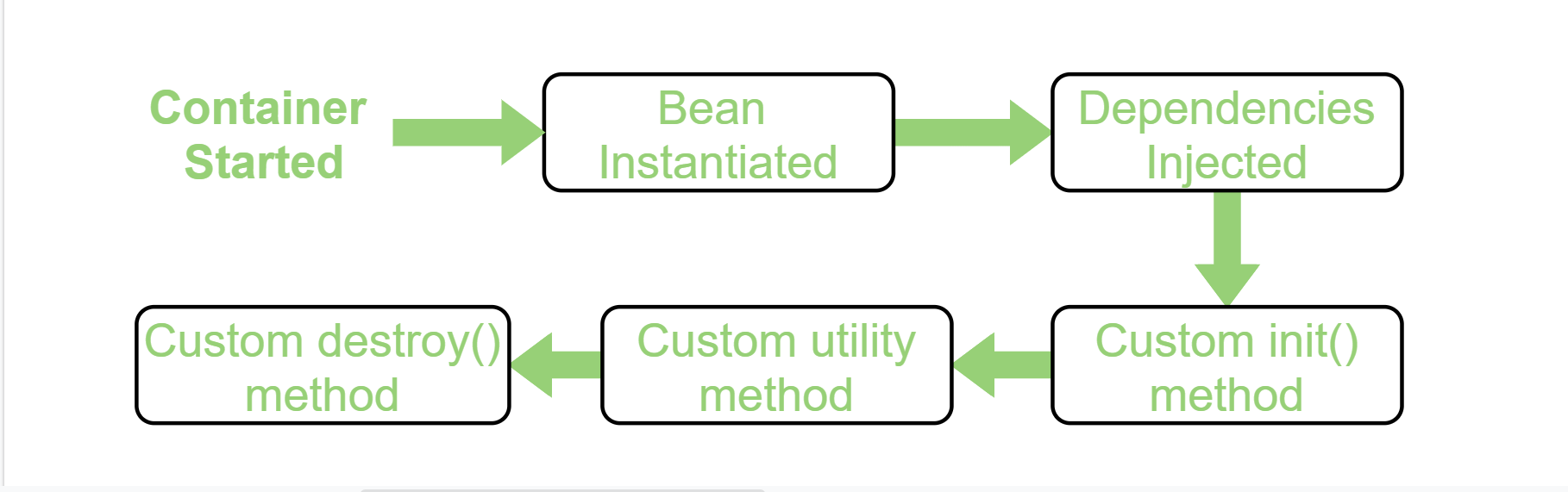
Spring Beans aren’t just created and then left to exist indefinitely. The IoC container actively manages their lifecycle, providing hooks at various stages for customization and cleanup. Understanding this lifecycle is crucial for managing resources effectively and ensuring predictable application behavior.
Key Stages in the Bean Lifecycle:
- Instantiation: The container creates an instance of the bean. This can happen via constructor injection or factory methods.
- Population of Properties: The container injects any required dependencies and sets configured properties. This is where Dependency Injection truly shines.
- Bean Initialization: After all properties are set, the bean can perform custom initialization logic. This can be achieved through:
InitializingBeaninterface: Implement theafterPropertiesSet()method.@PostConstructannotation: A standard Java annotation for post-construction initialization logic.- Custom
init-method(in XML or Java config): A method you define for initialization.
- Usage: The bean is now ready to be used by other parts of the application.
- Destruction: When the application context is shut down, the container gracefully destroys the beans. This allows for resource cleanup. Custom destruction logic can be implemented via:
DisposableBeaninterface: Implement thedestroy()method.@PreDestroyannotation: A standard Java annotation for pre-destruction cleanup logic.- Custom
destroy-method(in XML or Java config): A method you define for destruction.
The container’s ability to manage this entire lifecycle automates much of the boilerplate code developers would otherwise have to write, significantly improving development efficiency.
The Power and Significance of Spring Beans
The introduction of Spring Beans and the IoC container revolutionized Java development. Their significance can be summarized by several key benefits:
- Loose Coupling: By injecting dependencies rather than having objects create them, applications become less dependent on the concrete implementations of their collaborators. This makes it easier to swap out components, upgrade libraries, and adapt to changing requirements.
- Testability: Decoupled code is inherently easier to test. You can easily mock or stub dependencies when testing a bean, isolating the logic under test. This is a fundamental advantage for building reliable software.
- Maintainability: With clear separation of concerns and reduced boilerplate code, Spring applications are generally easier to understand, debug, and maintain.
- Scalability: The structured nature of Spring applications, facilitated by beans, makes them more amenable to scaling, whether horizontally (adding more instances) or vertically (increasing resources).
- Reusability: Well-defined beans, especially those with clear responsibilities, are more likely to be reusable across different parts of an application or even in different projects.
- Reduced Boilerplate: Spring automates many common tasks, such as object creation, dependency management, and transaction handling, freeing developers from writing repetitive code.

Conclusion: The Foundation of Modern Java Development
In conclusion, a Spring Bean is the fundamental building block of any application developed using the Spring Framework. It’s simply an object that the Spring IoC container is responsible for instantiating, configuring, assembling, and managing throughout its lifecycle. By embracing the principles of Inversion of Control and Dependency Injection, Spring Beans empower developers to build applications that are loosely coupled, highly testable, and remarkably maintainable. Whether you’re defining them through XML, annotations, or Java configuration, understanding and leveraging Spring Beans is essential for anyone looking to harness the full power of the Spring ecosystem and build robust, modern Java applications.
aViewFromTheCave is a participant in the Amazon Services LLC Associates Program, an affiliate advertising program designed to provide a means for sites to earn advertising fees by advertising and linking to Amazon.com. Amazon, the Amazon logo, AmazonSupply, and the AmazonSupply logo are trademarks of Amazon.com, Inc. or its affiliates. As an Amazon Associate we earn affiliate commissions from qualifying purchases.